A townful of people begin losing their faces, bit by bit, in this eerie and haunting story by Rowen Jennings. The kids at the center of the story only begin to feel the true impact of the loses when one of them, the eponymous Gideon, falls victim. As the strange ailment moves closer, the focus of the story narrows, and the fate of the narrator becomes inevitable.

The woman who lives behind the gas station lost her face years ago. It started with her nose: the bulb shrinking into the nostrils, the nostrils shrinking into nothing. Then her eyes blinked out one after the other. Before her mouth disappeared she would yell at us across the lot, babble things that didn’t make sense and gulp up the air like water. The kids with bikes used to ride circles around her after school. The rest of us would watch from behind the gas pumps. But they stopped after her mouth disappeared too, said it wasn’t as fun when she couldn’t talk back at them. We watched her get wrinkled and skinny, whither until she was a stick lodged in the mud by the ice-bag freezer.
We were just little kids then; we didn’t understand it. Not until a kid from the seventh grade named Gideon lost his left eye last month. The consensus among the eighth graders was that he got into it with his mom’s boyfriend, because his mom has all her face, but her boyfriend is missing an ear. He has to go to the counselor’s office and they call his mom, but next time I see him he’s missing an ear on the same side. He starts drawing a winky-face in the empty space with a Sharpie before school.
When he gets in trouble he has to wash it with soapy water and he pretends it burns, like phantom pain. His other eye goes days later, faster than any of us have ever seen a set of eyes disappear. He has to sit in a different classroom from everyone else so he can have directions read to him and it won’t “disrupt the class atmosphere.” Then no one sees him, not even the other seventh graders, because they keep him locked away in the suspension room and won’t let anyone else inside. We only see him when he’s walked out at the end of the day. It’s partly to help him find the bus, and partly so that he doesn’t run off and lose any more parts.
Eventually, Gideon stops coming to school altogether. Then a stranger in dress clothes comes around to every class and talks about losing friendships and grief like we can’t still walk the three blocks from the school and watch this seventh grader disappear. Somebody in the class knows Gideon from a summer camp. Another, from hanging out on his block after school. The dressy visitor advises them to let out their feelings, says it’s okay to feel hurt when the people you love are gone. And then the two kids are crying. The air is stifling and itchy with it. Then half the class is upset, like they could have done something if only they’d been a year younger and also his friend and also–also knew how to stop a face from shrinking into extinction. But none of us know that.
A few of us go to find Gideon that weekend. The kids with bikes let the rest of us stand on the pegs of their back wheels and we scan the streets until we find his house, a small thing in the middle of a big street, hidden in the shadow of an elm tree. We wait across the street behind green trash cans, excited because we’re spying and terrified because we’re spying. But we sit the bikes up against the trees and squat on the curb.
We wait until the sun sets behind Gideon’s house. A few of us have to go home when the streetlights come on. The rest stay and watch the shadow of the house stretch into the street, big and imposing. My butt’s wet and numb from sitting on the curb and my hands are bruised from the games of bloody knuckles we play to pass the time.
When we finally catch sight of Gideon it’s late into the night. We hear him first, the shuffle of a rickety screen door and crinkling plastic. We’ve stared into the night too long, and it takes a minute for our eyes to adjust and find his shape. Gideon is gaunt enough to make his short body look long. He’s carrying a trash bag with both hands, heaving it around like a sack of rocks. He trips over his feet onto the porch and wobbles but keeps his grip on the bag. In the shadow of the tree he looks like a ghost, all shape and no body. He drops one hand from the bag and feels for the railing. His hands, thrust out from the shadow, are pale white. Gideon steps forward, gripping the banister tight with one hand and the garbage bag with the other, and inches down the stairs one at a time. He tiptoes into the light and the shadows of the elm’s leaves cast starkly against his smooth, expressionless head.
I can almost make out where his nose was, a dent in the wide expanse of skin around his skull. Where his mouth used to be is ridged with frown lines he’s too young to have. I stand from the curb but hesitate to move forward. He toes down the walkway like molasses until he’s next to the garbage can and pauses like I do. He stands there for a long time. It looks like he’s listening. Or waiting. We hold our breath. When nothing comes, he heaves the trash into the air. Glass bottles rattle when the bag sinks into the can. Then, he inches his way back onto the porch. When his screen door creaks to let us know he’s gone inside, we are alone again.
The street is quiet and cold. I shiver and rub my reddened hands. From somewhere behind me I hear a stilted gasp, then another. And then someone is crying, like the other kids in class. I stand between them and Gideon’s house and hope the feeling will disappear. But the heaviness of it weighs on me, presses my shoulders down just enough for the feeling of dread to slip past me and envelop them still. It lingers on us like smoke the entire ride home.
The next time I go to the gas station I’m alone. There are frozen dinners next to the energy drink fridge and I grab a box of Salisbury steaks and two sugar-free cans. The box is sticky on the bottom and when I drop it in front of the register, I have to peel it off my hands. The cashier looks through me while she works. Her body is on autopilot, scanning and bagging and scanning and bagging. She doesn’t double-bag it and before she can hand it to me the plastic rips and the contents roll behind the counter. Then she single bags it again, hands the bag to me, and takes my ten-dollar bill, and I thank her and she doesn’t respond because she doesn’t have any ears.
The door jingles when I step outside. The old woman sits feet away. She faces straight ahead, contemplative like Gideon and everyone else. She’s smooth like him but older, and the years have carved canyons into her head. I hold on to the handles of the plastic bag and stuff the rest under my arm to keep it from falling apart. We stay still with each other for a moment, until I’m too aware that I can’t see the rise and fall of her chest. Then I run home. At dinner the table is quiet.
I watch my father struggle for the fork, swipe his hand across the entire table before he can finally catch it and stab it into the pile of mush on his plate. He brings the fork up to his cheek, slides the tines across until he finds the curve of his mouth, shoves the rice in and swallows without chewing. He smacks his lips, a big red smear across his pale, empty face. The place where his nose and eyes used to be crinkles, pulling his remaining features into his thinking face. But he’s thinking quietly and doesn’t say anything.
I run grains of rice around my plate with a spoon. They circle the disc of microwave meat until they’re stopped in the cold gravy. All the while, I scan the blank canvas of my father’s head. His ears stick out more than they did before. His mouth is inflamed, chapped, and cracked. He drags another forkful of food across his cheek and I cut my steak-like thing into equal quarters and then quarter those quarters so there are 16 little bits of food instead of one big one.
There are a bunch of almost-starts, where I open my mouth to tell him about the past few days. He still has his ears, he can still hear me. But I stop. I set my spoon down next to my plate and I wait. He eats until the plate is clear and I’ve held all the breath I can hold. Maybe he doesn’t know I’m here, I think. Maybe it makes you forget, too. Like it takes your brain and your face all at the same time.
I’ve heard somewhere that people can smell with their mouths too. You inhale the particles and then your taste buds figure out what’s happening and send a signal to the smell parts of your brain. But it gets a little twisted, and that’s why sometimes apples taste like onions or potatoes. Does it confuse him, I wonder while I watch my father’s hands twist around each other, to taste things he can’t smell? Does the part of his brain that’s disappeared make it easier?
The heel of his hand catches on his fork. It skitters across the table past me and onto the floor by my feet. My father sucks in a breath, a gasp or some last-ditch effort to smell the gravy congealed on his plate. I stand purposefully, making sure to hit all the creaking boards as I take the fork from the ground and feed it back into his hands. He stretches his mouth wide enough for me to see his back molars, assuring me he still has time left. His jaw pops in thanks for my service.
Then my stomach is churning and dinner is over. I wash the dishes slowly, imagine an opposite world where it’s me without a face instead of him. Or Gideon’s mom’s boyfriend. Or the old woman at the gas station. Gideon’s empty head is scarred over the memory of his face before, and I can’t remember if he looked funny or pretty or something else. I remember my father’s face because it looked like mine. If I close my eyes and think hard enough, I can superimpose one over the other and get a full person again.
Behind me, my father’s hip bumps the table hard. Things rattle off the table and crash onto the floor. I turn, but he raises his arm in the air and waves me off, before walking into the living room. I imagine his eyes crinkling, an awkward laugh. I mime the ghost of it over sudsy water and our burned baking pan.
The living room is pitch dark, not that it would matter to him. Like clockwork, my father flops onto the couch and pulls a knitted throw up to his chin. He kicks one foot out of his boot, pulls it onto the couch, and leaves the other booted on the floor. It’s not long before his mouth is open and he’s snoring. It’s strangled deep in his throat, the sound uncanny without a nose.
After the dishes, I dry my hands on my T-shirt and appraise the mess on the ground. A broken glass (and subsequently a small puddle of soda), a paper towel roll, and a couple of small, empty bottles with tacky residue on the sides. I’m careful with the glass as I throw it in the trash, slowly so it isn’t loud against the empty cans and the box from dinner. I’m even more careful with the bottles. They cling to the skin like glue, and I have to shake my hands above the can to get them off. I let myself hold them for just a second, imagine each one is for a different feature. This one is for my father’s right eye. That one, for his left. This one is for his nose, and the leftovers are lying in wait, excited to hold his ears and then his mouth and then all of him.
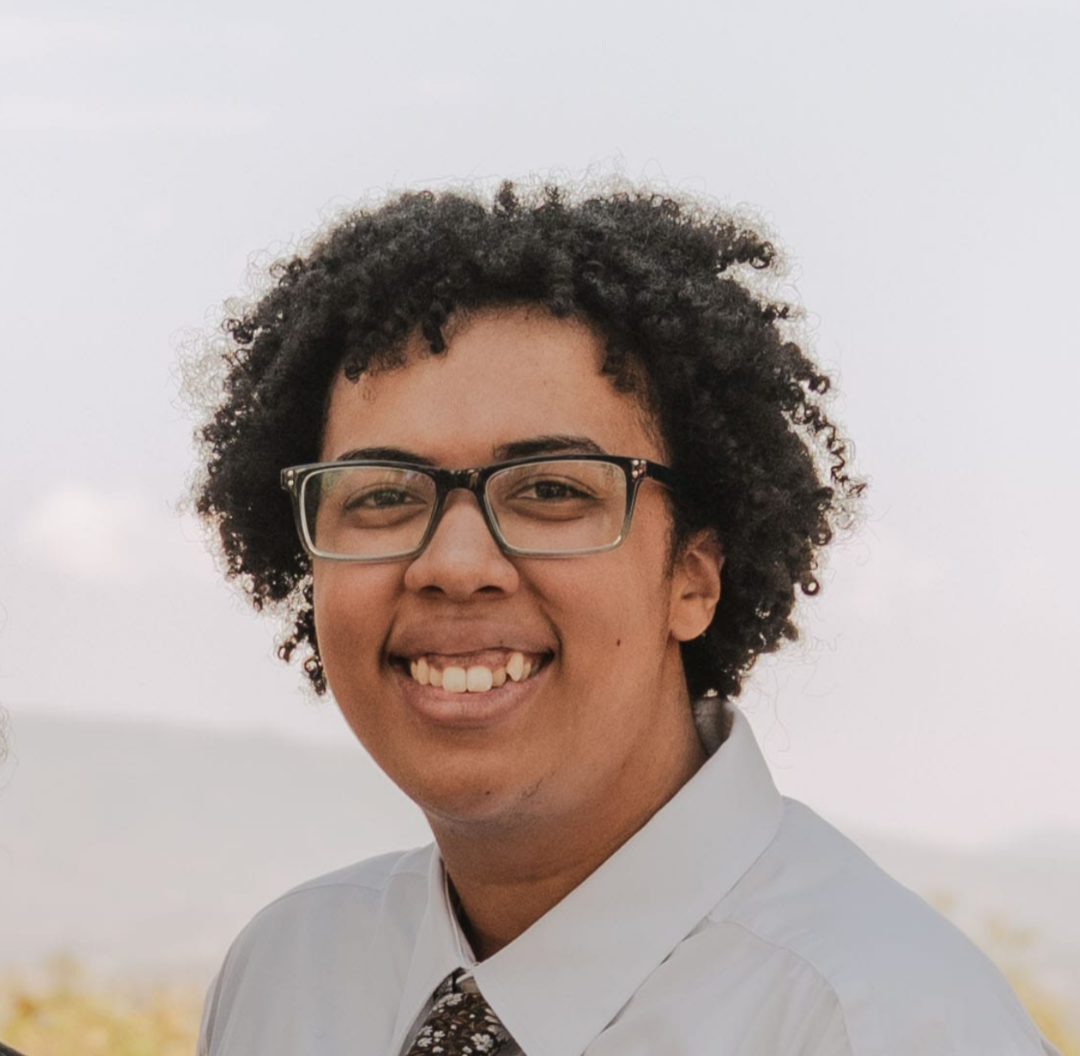 Rowen Jennings is a black, trans writer from upstate New York, specializing in speculative fiction. A graduate of Allegheny College, they spend their free time board-gaming with friends and pampering their cat, Keanu.