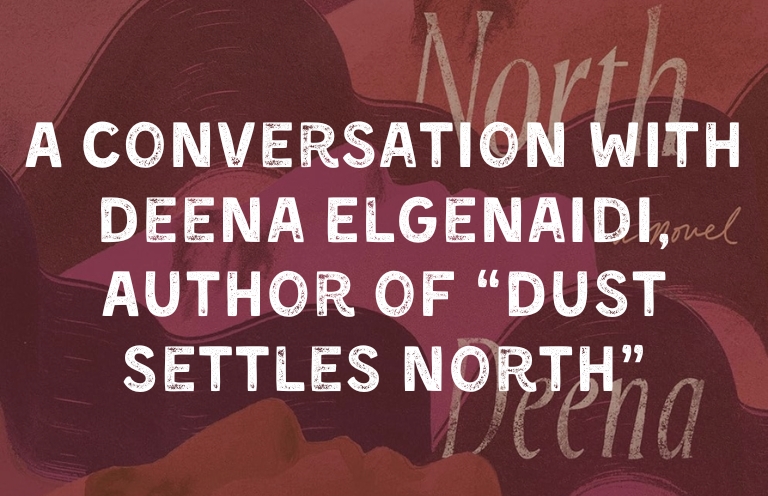
Though Deena and Juliana went to the same MFA program for fiction, they graduated years apart and didn’t meet until learning by chance that they were both releasing a web series during the 2020 lockdown. So, they decided to host a virtual event together to discuss being in filmmaking as women, where women make up under 5% of those working in the field. The publication of Deena’s debut novel, Dust Settles North, is another testament to what happens when two women team up to face a daunting media landscape—Jananie K. Velu acquired the novel through her imprint, Boundless Press in partnership with Bindery. Jananie’s goal with her imprint is to uplift stories by marginalized authors that reveal the complexity of human nature, and Deena’s story of a family’s return to post-revolution Egypt in the wake of personal loss was a perfect fit for the Boundless Press’s launch. Since publication, Deena’s novel has been celebrated by People, Harper’s Bazaar Arabia, and Writer’s Digest, with Jeanna Kadlec, author of Heretic, describing the book as “an unsparing exhumation of the untruths that keep a family together, of the small sins and glaring hypocrisies that can quickly drive them apart.”
Juliana Roth: Did you always know you wanted to set the novel in 2012?
Deena ElGenaidi: Well I had been following the events of the Arab Spring and revolution in Egypt around 2011 and 2012, and I actually visited Egypt in 2012, so I saw firsthand what had been going on at the time. When I started the novel in 2015, I knew I wanted to have some of the events of the Arab Spring serve a backdrop to the story. However, there were moments while writing when I wished I had set it in 2011 because that’s when the revolution began, and the timeline of events, as well as the goals of the movement, were much clearer. Setting it a year later required a lot more research on my end, but ultimately, I’m glad I went with that time period because I think some of the contradictions of that year, as well as the murkier political goals and agendas really mirror what Hannah and Zain are going through in their personal lives. Their story isn’t always so straightforward, and neither is Egypt’s story.
Knowing you personally, and that many days of our friendship in NYC were actually spent at protests, I understand you to be in constant consideration of the political impact and context of your writing and so it was a delight to see how you crafted protest into the texture of the book while allowing the layers of life to weave with the revolutionary moment. Parents still die and disappoint; we still sleep with the wrong people; and ambition still burbles under the surface while we wade our way through pain, change, and fracture. For those in the book who survive revolution, and survive their grief, I felt the central question for me became about home. Have you learned anything new about the idea of home by writing this book?
Yeah, both through writing this book and also just through my own life experiences, I’ve learned a lot about what home can mean. I think home is wherever you’ve built a community, and that doesn’t necessarily have to be a physical place. I think the people you surround yourself with and the community you have can represent home. If you show up for the people you care about, and they show up for you, then in my mind, that’s what home means.
Do you think Hannah and Zain found their home?
Hannah does find some version of home by the end. She goes to Egypt searching for something—whether it’s belonging, history, direction, or just some way to make sense of her life and her mother’s life. By the end, even though she hasn’t quite figured everything out, she does realize that she has a community now and that she’s built a home for herself.
Zain, on the other hand, is still getting there. For most of the book he’s sort of self-destructing, and then he has to pick up the pieces and rebuild his life. But he’s on his way to finding home. And even though he and Hannah are in different countries, they could also be each other’s home.
An American-raised Egyptian, Hannah’s outsider status was complicated the deeper she went into understanding the role of women within the revolution—it felt for me that through them Hannah finds a sense of belonging, despite her Americanness. I’m thinking in particular about two scenes: The first, when Hannah sits with Vanessa at the cafe and she describes her wish to “be with the actual people of Egypt instead, hearing their thoughts, but she knew in reality, this was the room she belonged in. These were her people more so than the ones born and raised in Cairo.” And the second being her wanting to prove to Rami that “women were just as important to the revolution.” I liked how you showed here that sometimes political awakening can be pushed forward both by something as dramatic as returning to a homeland to bury a parent, but also something as seemingly simple as wanting to prove a date wrong. Do you remember for yourself what you felt your first act of political resistance was and what inspired it?
I didn’t really start following politics until college, and I remember going to Obama rallies in 2008, and then again in 2012. But I still wasn’t really aware of what was going on at the time, otherwise I would have been a lot more critical of Obama. My first act of resistance maybe was in 2016, going to the women’s march, or various protests against Trump. For the most part, though, my involvement in those events felt somewhat passive. Then in 2020, I started getting a lot more involved with protests and political resistance during the Black Lives Matter movement. What inspired that was just all of the horrible things police were doing at the time and are still doing today. And then seeing firsthand the unprovoked physical violence that the police inflict on protestors only motivated me more. I’ve gotten even more politically active in the years since, and I think as a society, we all need to ramp up our political resistance, given all of the horrible things our country is doing, from kidnapping immigrants to sending weapons for Israel to continue committing genocide. All of that motivates and inspires me to act and resist.
The Masters Review has a particular focus on emerging writers, many of whom have yet to publish their first story or essay let alone a book. Can you share more about the publishing journey for our readers and what kept you resilient during this past decade of your writing life?
My publishing journey was very long and often disheartening. I started this book in 2015, then began querying agents in early 2020, I believe. After getting some rejections, I revised my book again, then sent out more queries, until finally, I got an offer of representation. Unfortunately, a few months later, my agent quit agenting, and I panicked thinking I’d have to start the process over. Luckily, though, her colleague liked my book and wanted to represent me, and now I couldn’t be happier with my agent.
After I went with that new agent, she gave me edits, and I revised some more before we went out on submission. And submission was extremely stressful because it’s a period of just waiting, and the process was so outside of my control. In the first round of submissions, we got some consistent feedback, so we pulled the book from submission, and I revised again. Then I went on submission a second time for about a year before I got an offer. There were times during that year when I felt completely hopeless, and I started writing another book in the meantime. A part of me worried that Dust Settles North wasn’t ever going to be published and that I should work on something else. I’m so grateful, though, that my agent kept trying, and now the book is out in the world. What kept me resilient is probably just my stubbornness. Once I decide I’m going to do something, it’s really hard to get me to give up.
Deena ElGenaidi is a writer and editor based in Brooklyn, New York. Her debut novel, Dust Settles North, was recently published by Bindery. She wrote, directed, and produced the award-winning comedy web series Codependent. She is a former TV News Writer for Primetimer and a former editor for Hyperallergic. Her writing has been featured in Vulture, Insider, Nylon, Salon, MTV News, Oprah Daily, Longreads, Electric Literature, Lit Hub, and more. She is represented by Monica Rodriguez at Context Literary Agency. She writes about the arts, identity, and pop culture.
Juliana Roth is an award-winning writer, filmmaker, and performer living in New York City, and works for The Masters Review as a guest editor. A former Susan Kamil Emerging Writer Fellow at The Center for Fiction and Miami Book Fair Fellowship Finalist in Fiction, she was named a semifinalist for the Philip Levine Prize for Poetry at California State University – Fresno and chosen as an honorable mention by Hanif Abdurraqib for the Button Poetry Book Contest. She holds a certificate in Advancing Compassion: Exploring Animal Rights in Multispecies Societies from Radboud University in The Netherlands. Her literary writing investigates what we owe to our world and the other-than-human lives around us.