
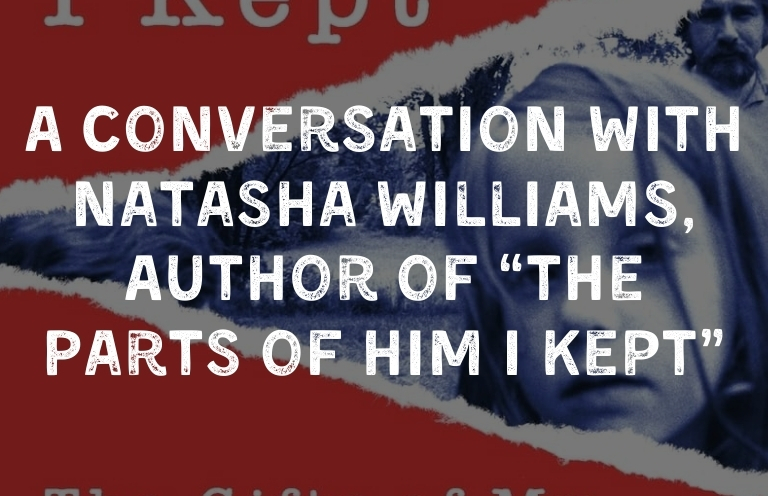
Natasha Williams’s debut memoir, The Parts of Him I Kept: The Gifts of My Father’s Madness (Apprentice House Press, 2025), focuses on her coming of age in gritty 1970s New York amidst her father’s schizophrenic unravelling. In this interview, Erin Wood talks with Williams about the writing life, including the unexpected benefits of having a writing group and how attending Bread Loaf and working with her editor shaped her memoir. Wood and Williams also speak about negotiating familial relationships when family members are central to her memoir.
Erin Wood: How did you find your publisher?
Natasha Williams: Before submitting the work, I’d been fortunate to have several trusted readers over the years. Later I created a beta reading group to see how the book landed with readers. Those six readers fell into two camps: One wanted a lot more about me as a parent having a schizophrenic father as my model. They thought the parenting aspect would have universal appeal. The other camp felt like the power of the story was from the perspective of the narrator as a child growing up with her schizophrenic dad. I ended up responding to both camps, but the structure of the book didn’t change.
When I had a draft that felt ready, I hired a professional editor, Marlene Adelstein, to review the manuscript. Marlene was recommended to me by a writer I respect. This seems like standard practice for those who can afford it in such a competitive book market.
When I felt confident that I had a draft that was ready, I worked with an editor, John Sibley Williams, who helped me shape excerpts of the book and submit them to journals.
Finally, I queried the fifteen or so agents, who represented the writers I admired, but none of them opted to represent me; either the book didn’t fit with their line-up or they had recently tried to sell a similar book and weren’t ready to take on another mental health memoir. So, I decided to submit independently to publishers. John helped me with my submission package and helped me identify a list of academic and smaller presses. Within a month of submitting I got one offer for publication from my chosen publisher, Apprentice House Press out of Loyola University. I then sent a letter to the other presses I had queried giving them a chance to review the manuscript before I would accept my first offer, which is common practice. When no other offers came in, I accepted the offer from Apprentice House. When I got a second offer from Vine Leaves Press several months later, which I couldn’t entertain, it felt good to know another publisher thought the story would resonate with readers.
Once you signed your contract and began the publishing house’s editorial process, what was that like?
Most of the editorial process happened before I got an offer to publish. Honestly, the main reason I wanted a bigger publisher was because I was hoping an experienced editor might have some magic developmental editorial ideas. The edits I got from Apprentice House were helpful but very minor. I think even the bigger publishing houses offer less editorial feedback now than in the past. This memoir was ten years in the making and the editorial work with Marlene and the beta readers beforehand were essential to honing the power of the narrative.
You’ve talked in our writing group about the challenges around receiving the editorial feedback to bring more about your mother into the story. What did that look like emotionally? Practically on the page? In your real-life relationship with your mother?
Marlene pummeled me with questions like, “Where is the mother in all this?” She said, “You have to at least explain her absence.” I sat in Marlene’s office crying, sure she didn’t understand the story I was trying to tell. I’ve heard this is a common experience. Editors often suss out the thing you aren’t talking about that needs to be fleshed out. So, I spent another couple of years trying to make my mother more three dimensional and to do that I had to understand some things about her I had never understood.
On the page; I would get to a section where Marlene asked where the mother was and I would write her absence into the scene, moments in the story when Marlene or another reader might expect a mother to be involved had to be explained. The ways my mother let me make decisions from such a young age, the ways she left it to my grandmother to decide where and when I lived with Dad. I had to build scenes so the reader could understand the mother and how the child made sense of all that autonomy from a young age. Sometimes I reflected back in time to try to capture how the child me felt, which was hard to do. Other times I imagined or tried to make sense of what her motivations and drives were. In some sections of the book, it resulted in full chapters. These were the harder parts, getting back in touch with the feelings I had about my mother’s lack of caregiving. In the end I was glad for that editorial direction because it helped me to comprehend things about my mother I hadn’t considered. Like the time my mother said I got her reasoning for her work in hospice all wrong; it wasn’t so much about caregiving as it was about trying to get over her fear of dying. This made sense and helped me understand her.
Were you nervous about sharing it with your family members? With your mother? How did it go?
When I first learned I had a publisher for the book my mother said, “I could sue you, you know?” I believed she was certain that she wasn’t going to be good enough, even as a character in my book. In the course of writing and researching, I had shared pages with both of my parents, my sister, and other members of my family for feedback and insights. Without exception they seemed to feel seen by the writing and, if anything, their experience and perspective became an annotation to the book.
My biggest concern was making sure my children didn’t feel exposed by the writing. There’s a very pivotal moment when my father tells me one of my daughters is schizophrenic like him. Which I’m happy to say is part of his delusional love for her and not true. But I had to make sure she was okay with even the mention of that going out in the world. It was a careful process of sharing less inflammatory parts with her until I knew I had a publisher and she was feeling emotionally stable enough to hear her grandfather’s delusions without taking them to heart. In the end she understood it as a measure of her grandfather’s love and in no way a prognosis of her mental health. But that legacy is something I grapple with in the book.
Your career has been as a scientist. How did this inform the writing and/or editorial processes of your memoir?
The book is peppered with references to medical, philosophical and even theological thinking as I tried to make sense of our lives. Questions about schizophrenia and how our culture relates to mental illness, not just as a biological condition, but as a social issue. Ideas about the distinctions between prophecy and delusions and what they represent and signify. Although I sometimes took a deep dive into the scientific understandings, I made sure to keep the research pared down to answering the question at hand so it didn’t bog down the story. I hope I’ve done that.
What would you share with other writers about why they may want to consider creating or becoming part of a writing group?
Reading well-crafted pieces from fellow writers in our group has certainly made me a better writer and hopefully a literary citizen too. Each member of the group has different strengths and a unique perspective to offer. I’ve learned how powerful a pointed question can be in helping me think about a piece. I’ve learned that encouragement is a potent form of feedback. Also, having someone simply concur that a piece just isn’t ready to send out helps me go back in and rework it. It’s so helpful to have five people’s eyes on a draft because you can see where there’s agreement about what’s resonating and what’s unclear or still needs work. And even the outlier comments offer a unique perspective.
But more than anything I’ve learned about literary citizenship from the generosity of our members. We read and leave reviews for each other, we share books with friends, we recommend them to local libraries and bookstores. For essays, we keep our eyes open for contests and placements that might be a good fit. Several of our members have done things like this interview to help us reach new readers. In fact, one of our members who had brain surgery during my book launch had my memoir by her bedside and recommended it to the nurses who were her caregivers since it is very much about the burden and benefits of caregiving for my mentally ill father. That’s some kind of support.
A lot of my memoir was written and edited by the time our group formed. But getting feedback on the excerpts from readers who hadn’t read the book in its entirety and finding support in creating the stand-alone pieces I was crafting was invaluable. It was so helpful to know when I needed to put more backstory into a piece or when it was too much.
It was super helpful that two of our members published their books the year before mine, so I had their example to follow and learn from. I listened to their interviews and podcasts and read and gave feedback on the ancillary essays they were writing post-publication. New writers may not learn until after their publication date that publishers and publicists will want you to write essays related to the topics considered in their books in order to gain visibility and reach readers interested in contemplating those topics.
Any cautions you might share with other writers about the influence of a writing group?
As a writing colleague, we all want to offer edits and critiques in order to be helpful. It’s a talent to know how to ask questions and offer select feedback so you don’t overwhelm the editing process. I love line edits and am comfortable knowing what feedback is helpful and what might be a good idea but not necessarily for this piece at this time. But it’s important to discern when feedback starts to feel circular. For example, group members might ask me for more backstory and then in the second round they want less backstory. Sometimes that highlights the fine line between not enough and too much, but also it can just indicate that the piece isn’t working yet.
You attended Bread Loaf. What was that experience like and how did it influence your writing process?
I spent two summers at the Bread Loaf School of English and, in the Summer of 2023, I attended the Bread Loaf Writers Conference.
I felt more at home at the writers’ conference, being in workshop with writers working in a similar genre. I loved going to talks and lectures about the project of writing and the writers who came before us. I had a complete manuscript I was pitching, and meeting editors and agents from many of the best publishing and agent houses was eye opening.
At The Bread Loaf School of English, I was older than most of the student body and hadn’t been in a residential school setting in many years. Living among the under-thirty set on campus was almost like having a second chance at what for me had been a difficult time in college in my twenties. I learned an amazing amount about who I am as a learner, the power of writing at the sentence level, and the power of being a writer in conversation with so many great authors.
Natasha Williams has worked as an adjunct biology professor at SUNY Ulster in the Hudson Valley of New York and as a consultant for the International Public-School Network, coaching science teachers. She has an MA from the University of Pennsylvania and has spent two summers at Bread Loaf School of English and attended the Bread Loaf Writers Conference in 2023. Excerpts of The Parts of Him I Kept have been published in the Bread Loaf Journal, Change Seven, LIT, Memoir Magazine, Onion River Review, Writers Read, Post Road, and South Dakota Review.
Erin Wood’s recent work can be found in The Sun, HuffPost Personal, The Citron Review, The Rumpus, Brevity Blog, and elsewhere. Her essay We Scar, We Heal, We Rise was named Notable in The Best American Essays. She is author of Women Make Arkansas: Conversations with 50 Creatives and is editor of and a contributor to Scars: An Anthology, which assembles the work of nearly forty contributors on scars of the body. She is working on an essay collection. Since 2010, she has owned and run Et Alia Press in Little Rock, Arkansas. Find her at erinwood.com and etaliapress.com.