
 Just over ten years ago, the United Nations General Assembly on HIV set the year 2030 as a global target to end AIDS as a public health threat. What seemed a cautiously optimistic goal in 2015 seems even less likely today than it was then—AIDS may be a manageable disease, but diagnosis and early treatment are still essential. Now, with only four years to go, the collapse in funding and the rising number of countries criminalizing populations most at risk of HIV threaten to undermine the recent discovery of a new injectable that can prevent HIV infection. Instead, we are left with a repeat of the benighted, ineffectual finger-wagging of the 1980s.
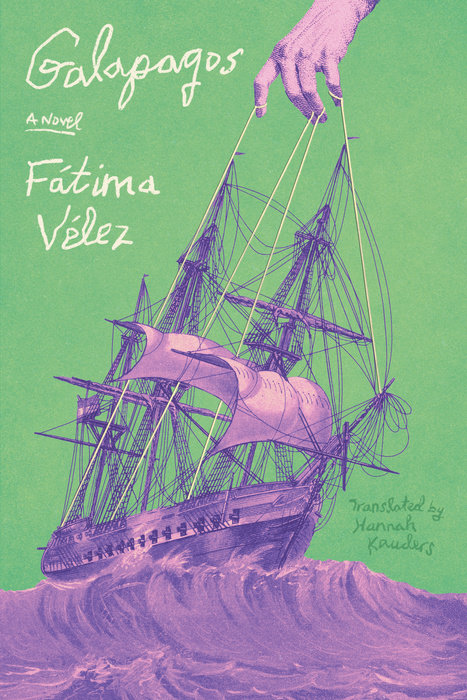
AIDS is not a disease we have conquered. It affects around forty million people across the world. HIV-awareness slogans from the 80s are still pertinent—that silence equals death. Silence also spreads among the sick artist-characters of Galápagos, Fátima Vélez’s startling debut novel. Set in 1994, just at the downward tip of the first AIDS epidemic, a young artist, Lorenzo, is creatively blocked, wallowing, and stuck in a dead-end relationship in Bogotá with the devil-may-care Juan B. He worries at a hangnail and panics when it fills with pus, but Lorenzo’s doctor tells him not to worry. When his condition worsens and his nails start falling off, he changes course to Paris and his erstwhile lover Donatien, who takes him to the French countryside, where Donatien’s grandparents say they can smell death on the young men.
The novel weeps with bodily secretions (pus, blood, snot), and Vélez rips through her characters’ bodies like a tiger through tissue paper, vivisecting mortal realities that we may prefer to look at askance, even in literature. Lorenzo takes pains to wrap his unsightly hands, but the bandages draw even more attention. He isn’t sure how he wants his friends to react. Some choose to ignore them, others acknowledge the bandages only obliquely—“Your hands/ true, my hands, he mentions them, yet he doesn’t ask.” Another friend’s question, “Tested for what?” suggests he surely knows the answer, just before the scene breaks.
Yet bodily decomposition provides Lorenzo with the tools, mentally and physically, to create art, and his interest in Francis Bacon’s similarly macabre works betrays a semiotics of repulsion that serves as a kind of battle banner for Galápagos. Many of the novel’s descriptions could easily have sprung from Bacon’s own canvases. The most abject of these is “the pus man,” an unforgettable shadow-villain in the novel’s first half: “When he goes to kiss you he suddenly doesn’t have lips anymore, he morphs into a white creature, it’s like he’s made of matter, the kind that spurts out when you pop a pimple, and then he engulfs you and it’s almost pleasurable, but then he spits you out and your skin starts falling off.”
Vélez’s run-on prose is feverish and needy. She plunders the deeply codified language of early Catholicism—martyrs, stigmata, sores, visions, ecstasy (“What is pus if not the delicious proof of a body giving its all, yellowish, milky white”) —bringing to mind female mystics who sucked pus from the wounds of lepers to get closer to the Godhead. There are beautiful descriptions of losing one’s tongue in another language, “I can’t go on, my French has tipped the dining chairs onto the shiny cement floors, my French is drunk, it wriggles loose, turns Creole and escapes.” Silences and absences are brought to the page elsewhere in formatting decisions that fracture thoughts across line breaks to recreate the sensation of putting paint on canvas and give the reader, too, a little space to breathe. Elsewhere, by contrast, the prose is decidedly baroque, brought to an apt second life in Hannah Kauders’s shrewd translation.
The first part of the novel closes with Lorenzo and his friends afflicted, and then news from Colombia comes that Juan B and his companion, the eczema-ridden Paz María, have died. In that same moment, in such proximity to their own deaths, these artist-friends are invited to join Juan B on one last voyage.
Our adventurers sail towards the Galápagos Islands. To keep at bay their dark thoughts, their decomposing bodies, and the dangers on the tempestuous seas, the ship’s eight-person crew (plus dog) fill each other’s heads with stories. A group of misfits sharing tales under the encroaching shadow of a plague brings to mind Boccaccio’s Decameron—a text referenced in Galápagos, when a metafictional Fátima, a “bum dressed in red,” recounts to Lorenzo “the tale of a group of friends who were not yet dead and no longer living but dead-alive-dead, and how they sailed through the Galápagos telling each other stories, Like in The Decameron, I said.” Aboard, we meet new adventurers, among them the chronic communist Galaor and the monstrous sirens, Lucy and Scent of Coco Varela.
This is no jolly trip: Crew members argue and throw each other into the sea. They seem to demand answers for questions that lie well beyond the strange netherworld in which they’re sailing. And yet in this “furious” Pacific, still afflicted, the voyagers have even less control over the geographical direction in which they’re headed. Such anger evokes the painful works of 90s artists that commemorate their partners lost to AIDS, like John S. Boskovich’s Electric Fan (Feel It Motherfuckers) and Félix González-Torres’s “Untitled” (Portrait of Ross in L.A.).
“Painting,” admits Lorenzo’s fellow artist, Luis, “is an act of total surrender,” though surrender can take multiple tragic forms. Galápagos invites us to imagine such capitulation at a grand scale. The ship’s destination cannot be a coincidence—the Galápagos Islands are crucial for conservation and ecological research and have nevertheless succumbed to the forces of “eco”-tourism, pushing its vulnerable biodiversity to the margins with every new resort. It is notably Juan B, a child of privilege and with a selfish disregard for others, who decides to take his friends there.
Is Galápagos an angry novel? Perhaps it has every reason to be: Vélez’s unabashedly lucid writing shows us the dangers of keeping silent. “What is more future than a symptom,” wonders Lorenzo, as a friend takes his hand with the claim she can predict his destiny on it. The human body has stories to tell, revealing symptoms that reach beyond the individual to the society that has shaped it. It’s up to us to pay attention to them.
Publisher: Astra House
Publication date: December 2, 2025
Reviewed by Zara Karschay
Zara Karschay’s fiction is published in Ploughshares, The Baffler,