
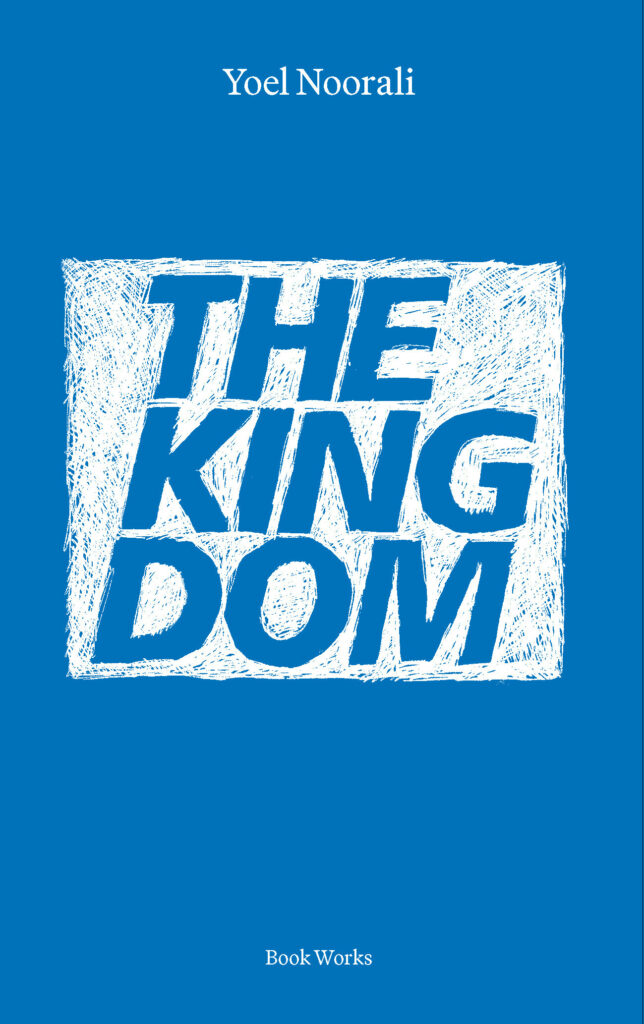
 Taking its title from Lars von Trier’s underseen horror miniseries, The Kingdom is the debut short story collection from Yoel Noorali. A former hospital data entry administrator, the three stories that open the collection follow a semi-fictionalized version of the author as he guides us through his experience working in the liver ward of an unnamed NHS hospital in London.
Skulking around its maze-like back rooms, this version of Yoel encounters a parade of dispirited administrators and medical staff, who between bouts of Instagram and TikTok announce the death of patients in emails without so much as a frowny-face emoji. When one supervisor tells Yoel that he will soon enough get used to it, it is unclear if she means the jargon of the various medical acronyms he has to input, or the ease with which they can discuss life and death while at the same time playing Wordle.
We here in the UK are reluctant to criticize our National Health Service. Although beaten and bruised from years of austerity, we likewise know a privatized alternative would be so much worse. We have learned, instead, to adopt a sort of cognitive dissonance. We pretend the underfunded, over-worked system works well enough as it is, right up until we encounter the NHS’s resulting burnout firsthand. There is a visceral joy then, as Yoel—who writes with a self-aware, Roth-like wit—is made to visit this reality on our behalf.
In “Merry Hell,” the second of the liver ward stories, Yoel is thrust into the center of a human resources nightmare as a fellow data entry administrator named Bez returns from a self-prescribed period of mental health leave. Still entangled in a complaint he has with the team’s manager, Bez spends his time booking holidays or talking with friends, while the other “clickers” (as our narrator refers to them) try to pretend they’re working. After that same team manager likewise takes his own sabbatical as a result of Bez’s complaint, one such clicker (whom Yoel refers to as “The Mother”) takes it on herself to track Bez’s various comings and goings. Fueled by self-righteous anger that seems to stem from the fact that someone is getting away with something she isn’t, the story captures perfectly the pettiness of self-inflicted bureaucracy. “This is how we power our NHS,” concludes Yoel, “Our councils, our government, the EU, the UN: all these institutions run on a steady supply of hate.”
This trilogy of hospital stories ends with Yoel experiencing his own mental health fallout, as the department of clickers is forced to endure the austerity-adjacent weapons of time and monitoring timesheets and budget-tightening, but that isn’t the last we see of him. Noorali’s stand-in appears frequently throughout the collection. He’s in “As Slow As Possible” which follows Yoel as he visits the Danish city of Halberstadt, to be present as John Cage’s 639-year-long symphony adds a D-neutral to that day’s chord, and he’s in “My Dinner with Aziz,” a far-too-short short story that paints a vivid picture of a distant father who claims to have been business partners with Saddam Hussein and yet still makes sure the Pizza Express waiter knows he has a voucher.
But we also hear Yoel in the more outwardly fictional stories, too. In “A Fan of Dogs,” a hilarious story of a husband who is desperate to convince his wife and young daughter that their prized corgi isn’t worth the veterinary costs required to treat her heart defect, the narrator, Sam, speaks with the same hectic mania to his wife, Mallory, as Yoel does to his wife, Charlotte, in “The Kingdom.” And in “Car Park B,” the narrator’s Kafkaesque description of trying to find a parking space in a car park that apparently never has parking spaces sounds similar to Yoel’s description of trying to get out of the labyrinthian hospital with enough time to enjoy what remains of his allotted thirty-minute break.
But if even the characters don’t always sound distinct from story to story, there is still a growing feeling throughout The Kingdom that we are seeing through a veneer of country-wide self-denial, and the failure of those in power to take responsibility for their actions. A theme that resurfaces again and again throughout the collection is how institutions handle the social, economic, and moral quandaries of life and death. In “Money,” an artist, unwilling to decide how to fire his team of studio assistants, resorts to flipping a coin to determine who stays and who goes, and in “Numbers” (a stand out of the collection), a bank manager addresses the suicide of two of his staff via an interdepartmental email, in a desperate bid to prove that further suicide prevention would only put pressure on his already suicidally inclined office. As with the NHS, the moral answer is obvious, but to do anything about it would require confronting a whole brigade of people who can’t look past their own immediate, if lackluster, comfort. Each in charge of their own personal fiefdom.
A rich, textured, and razor-sharp collection that brings to mind Taffy Brodesser-Akner’s Fleishman is in Trouble in style. Noorali’s alter-ego might sometimes feel like he’s already given up, but I hope he’s only getting started.
Publisher: Book Works
Publication Date: November 20, 2025
Reviewed by Mark Daniel Taylor
Mark Daniel Taylor is a writer from London. He is a former member of the Collier Street Fiction Group and is an alumnus of the New Orleans Writers’ Residency. You can find his other published works at www.markdanieltaylor.co.uk.