
In “The Doctor Said,” Judith Hannah Weiss writes about recovering from a traumatic brain injury. With hauntingly on-point prose, Weiss captures the slippery sensation of losing yourself in your own mind. Terrifying, yes, but Weiss also skillfully imparts both humor and tenderness into this essay.
“The Doctor Said” was first published in Intima: A Journal of Narrative Medicine.
The doctor said I forget what. I didn’t understand what she said. But I could tell from her face that it was bad. The room was shivering. I mean I was. Tears burned down my frozen cheeks onto my frozen chest in my frozen gown.
Another doctor arrives, perhaps on another day. He keeps pulling the sleeves of his shirt. His words fall on the floor with a clunk. He asks if I understand what he is saying. No, I say No. He asks if I understand the implications. No, I say No, again. He says, “I’m afraid so,” in reference to something, but I don’t know what. I don’t know what’s scaring him.
The ceiling is moving backwards. I’m strapped on a board looking up at the world. Or floating downriver. Or they put too much of something in the IV. There are no angels most of the time. Once in a while, there is one. He looks tired and green. I mean his scrubs are green. He’s a bit scruffy. And stubbly. It’s not the whole Sistine.
Another doctor arrives perhaps on another day. I’m in a room now, not the ED. He says, “The truth is…” but I don’t learn what it is. I can’t hear that many words. Three is the max I can take, as in, “The truth is.” Plus, if a doctor says something that starts with “The truth is,” maybe you don’t want to hear it.
A resident asks my name. I say, My name is J. I used to have a name with more letters, but that was before the accident. The resident looks up from her screen, so I add, Once in a while my broken brain coughs up pieces of my past. For example, something messed with my head. Sometimes I remember that. She looks up from her screen again.
Add the unthinkable to the unsayable, then fold in equal parts unknowable and undoable, and you’ve somewhat described brain injury. Traumatic brain injury achieved a moment of fame a few months back when it killed someone famous. I forgot his name, of course. He hit his head, thought nothing of it, went to sleep, and didn’t wake up.
I also have aphasia, which achieved a moment of fame when Bruce Willis acquired it. I say dog when I mean cat. Or house when I mean horse. This is called finding words. I can’t. My brain launches like a missile somewhere it’s not meant to go. I try to speak. Words spurt from my mouth and go splat on the wall.
Something deleted the messages. Every message in my head. Every message ever. Someone else arrives to take essential history. Mine disappears. In different ways at different times. This may have happened to Bruce Willis, too. I try to read. My brain starts to disengage. I try to walk. My brain churns like a propeller. A motion I can’t sustain.
I want to throw a chair. The doctor’s in a chair, so I’d have to pitch him and the chair out the window or through the wall. Sometimes the doctor is a guy. Sometimes it’s not. Sometimes there’s a team of residents. If there are five residents, there are five tablets and five sets of eyes and ten opposable thumbs.
Another resident asks if I know why I’m here. I reply, A drunk lady took my life because she ran out of beer. My child says her mom disappeared. She means the mom she had before, and in that sense, she is right. Gives new meaning to the terms first and second person. They’re literal now, not just an occasion for pronouns to switch. One moment, you were someone. Then you were someone else.
Sometimes my brain gets stuck wherever it is at that time in whatever pieces it is at that moment and my tongue gets stuck to the roof of my mouth. Or because I am brain injured, maybe I just can’t speak to doctors with words they can hear. Brain damage chucks out the window any credibility you might ever have had.
A resident asks if I have any concerns. I speak like I’m landing on this planet for the first time. I say, I don’t know what time it is, or what day or month it is. Every hall seems the same, every hill, every corner, every chair, every table, every building, every sign, and nearly every voice and face. He stays glued to his screen.
A top doctor asks if I have any concerns. I say, My vision is filled with black spots that get bigger and smaller, blur, break, disappear. I can’t read. He lowers his tablet, so I add, It’s hard to read when letters rearrange themselves within words. “Bananas” becomes “sananab,” while “We hold these truths to be self-evident” becomes “tnedive fles eb ot shturt eseht dloh eW.”
Another top doctor arrives. She says something about not wanting to pressure me. That almost seems funny. She adds something like I can decide what I want to know. Or how much I want to know. Or when I want to know it. This seems almost funny too. There are holes in any landscape. Gaps where words should be.
Another resident asks if I know why I’m here. I say, 10.0 earthquake, 3.0 skull. I can’t read to save myself, or if I manage to read a few words, I don’t know what I’ve read. The same thing happens if I try to write. I used to be a writer. Stuff I wrote paid the bills. I underline that with my voice.
The resident frowns. I imagine she’s looking for the box on the screen for “can’t read.” Then for the box for “can’t write.” She frowns. I doubt there’s a box for “earthquake in skull.” I’m pretty sure boxes generate bills.
The frontal lobes are among the most complex and recently evolved parts of the brain. They have vastly enlarged over the past two million years, which is like two seconds in evolution, about as long as it took to deconstruct mine.
The sleeve-puller returns and asks if I have any concerns. I say, I used to have a map in my head, which means it was a damned tiny map, lodged between my ears. My GPS used to pinpoint my location. Now it says “You are not here.” That’s all it says all the time.
The resident who blows up her bangs returns and asks if there’s been any improvement, so I say, Soccer stars score goals with their head and their feet. So do I. I take a step. A goal for my feet. I say a word. A goal for my head. I’m promoted to Outpatient Rehab.
They test my head hundreds of times and find things have disappeared. Like the file that remembers locations and the “lay of the land” and the part that integrates physical movements so you don’t fly down the steps or fall out of your chair. Your heart begins to pound as you navigate a tricky, crowded intersection. You need to round a corner without landing on the floor.
Some brain testing occurs while testers zap us with electrical current. The point is to see if we will focus on the zaps, which means focusing on pain, or on something else. If you are focused on daffodils, for example, you will feel the amount of pain minus the focus on daffodils. Or something like that.
Images I’m shown seem pointillist, kaleidoscopic, or worse, pointless, nameless and deleting like the white line when you’re driving fast. I can barely make sense of anything. For that, there is Big Health. The scans of my head are in one place, my kidney scans are somewhere else, my heart scans are stashed downtown, within a few blocks of my hip and knee. This is “integrative health.”
I begin to improve and can use my own tablet. That takes two years and means I can get on the internet. I find the Navy has confirmed multiple sightings of a fleet of UFOs, while the Pentagon has removed a hen which wandered past security.
Also, the moon erased the sun. This is called apocalypse, I mean eclipse. It came on the heels of vicious hurricanes, which destroyed the Bahamas. Meanwhile, wildfires ravaged huge swaths of six continents, cats learned to swim in the Philippines, and due to a massive heatwave in Europe, chickens fried themselves on sidewalks in Spain.
I have Cognitive Fluctuations. Sometimes they are extreme. I’m pretty smart, then very not-smart, then pretty smart, then about as smart as a rock, or an amoeba, depending on current cranial conditions. We have to figure out how to be me based on who or what remains at any given time.
My left eye and my right eye don’t see eye-to-eye. I mean, they don’t see the same thing at the same time. My right ear and my left ear don’t hear the same thing because the brain between got rearranged. Also, images that appear in my rearview mind may be larger or smaller than they appear.
Someone shows me pictures and asks me to point to a teapot, an apple, a plate, a spoon. This is called Confrontational Naming and includes questions like “What is a squirrel? What is a shovel? What is a large animal with a trunk?” First, I couldn’t do this. Then I still couldn’t do it. But then I progressed. I say, I might call him Edward or Oscar, but opt for “elephant,” instead.
My brain goes quiet, which I find suspicious, but also soothing. For some people, transformation takes years of practice. Before the accident I went to yoga retreats and said things like, “I just need to unplug.” Perhaps the secret to a peaceful mind is sweet pics of animals and a TBI.
Sometimes I feel like I’m far away. Very far away. In half-light. Or quarter. Or eighth. Or like I’ve been this way forever. Or since the fifth century. Or the back end of the fourth. It’s not a brief derailment like a flat tire or a wrong turn. It’s like the rail is gone and so are you. One moment you navigated time and space and steps and curbs and turnstiles and doors opening inward and outward, and swiping and speaking.
I check the internet again and find towns up and down the continent of Australia are surrounded by fire and stripped of power, water, phone, roads. That’s sort of like brain damage. Your infrastructure atomized. Back in Australia, fire leaps 200 feet into the air. The Prime Minister frames the flames as business as usual, the Deputy Prime Minister blames them on exploding horse poop, which he, of course, calls horse manure.
Through intensive therapies of all types, I’ve learned to keep my left elbow to the left of my right elbow, my left knee to the left of my right knee and my waist north of my hips. Still, language, once usable, findable – and in sound structural condition – sputters, spatters, stops. And thing after thing hides in plain sight. I open the fridge to take out the milk and look right at it, but don’t recognize it. Not sure if I don’t see it or don’t know what I’m seeing. The same thing occurs when I look for a sock or a spoon.
I see someone called a cognitive therapist if she wants to help me think, and called a speech therapist if she wants to help me speak. She asks why I’m here. I say, “Access routes blew up. There’s no bridge, but you need to cross the river, no airport, but you need to land, no road, but you need to get to Amtrak, no Amtrak, but you need to catch a train. I try hard not to say things like, “When this sky is bending down and tying his shoe,” when I mean, “When this guy is bending down and tying his shoe.” But sometimes I say something right.
I’m assigned one visit with a Patient Advocate. She asks if I have any concerns. I say, “Each time I go to Neurology, I’m handed a form to fill out before seeing the doctor. This is on the letterhead of the Esteemed Institution—which says (and I quote): ‘When is your next F/U?’” I pause. She asks again if I have any concerns. I say, “Yes. The sign to the right of the elevator to Neuro-Ophthalmology says ‘EYE CLINC.’ It’s missing an ‘I.’” That seems like something they might want to change. Just adding an “I” to the eye clinic.
She asks if I have anything else to share. I say, “Yes, the receptionist has a sign on her desk which says ‘the rapist is out.’” It means the therapist, but I think fixing this might help patients feel more at ease. The Patient Advocate says it was a pleasure to meet me and stands up to leave.
My brain has plaques, not Grammys or Oscars, white plaques that can advance like armies and take more and more of me. Leaving less and less. I decide to attempt the impossible. Which means I will write a book. The unbearable lightness of language—lost as soon as it’s found. Catching what I can, while I can, before things are erased.
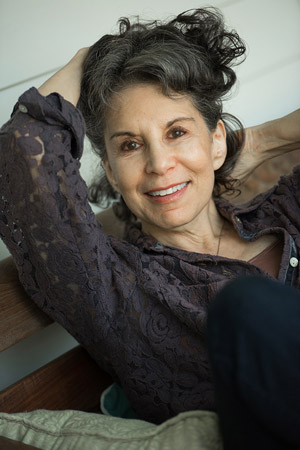 Pre-truck, Judith Hannah Weiss freelanced for clients like New York, Vogue, and Vanity Fair. Post-truck (after a long pause), her work has appeared in venues as diverse as NBC News online, Oprah Daily and in The Washington Post, HuffPost, and Oldster. She has been nominated twice for both The Best American Essays and the Pushcart Prize. You can find her “Dispatch from Bewilderness” on Substack at https://judithhannahweiss.