Writers pour so much energy into their craft that sometimes we forget that creative pursuits other than writing can fill us up in other important ways. Here, we’ll look at what writers do when they aren’t writing, and how those pursuits affect the return to the page. This month, we hear from two writers—Nina B. Lichtenstein and Melanie Cole—who discuss the benefits of doing away with the “butt in the chair” mentality as well as the physical pleasure of flower arranging.
What fills you up creatively when you’re not writing? If you’d like to contribute an essay to the Writers on Not Writing series, email jen@mastersreview.com. We can’t wait to hear from you!
I’ve got the schpilkes, which is just a Yiddish way to say I have ants in my pants, or, “I have fleas in my blood,” as we say in Norway, where I grew up and got into lots of trouble as a kid due to said fleas. Combine this physical itching with a flagrant and howling monkey-mind, and you might see my everyday challenge as a writer whose goal is, “butt in chair.”
I was fifty-seven before a neuropsychiatrist tested me and told me I was a classic case of undiagnosed ADHD. I actually don’t quite understand how I ended up with a PhD in French literature and an MFA in creative writing, considering it was never natural for me to sit still and read or write as a youngster and young adult. The kid with the flashlight under the covers, reading, was never me, nor was I the one keeping a meticulous journal of my youth’s escapades, heartaches, or secrets. Instead, I ran around in the neighborhood, held down a dozen jobs, was super active physically, always on the move. This meant that over the years and decades since I was a young girl, I developed ways of “masking” difficult or challenging behaviors or compulsions. One of them was evolving into a people pleaser, which in itself is exhausting in the long run. So, I take naps. Long, shameless naps.
It’s hard for me to sit still, if I am not engrossed in something, and so I have come to appreciate that all my activities—all that curiosity and compulsion to move that take me away from my desk—also have value in my chosen life as a writer. I used to be hard on myself for not being more disciplined about “butt in chair,” but I realize it’s all writing: my regular yoga, biking, hiking, kayaking, skiing, or swimming, for example, don’t just immerse me in elements and surroundings that feed my thoughts and ideas for stories, these physical exploits also give those ants in my pants a workout so they’ll chill—take a nap, perhaps!—when I do eventually sit down to write; the grocery shopping, standing in line at the post office, stopping at our local indie bookstore, the garden center, Lowe’s, etc., all shower me with sensory impressions and people-watching useful in writing. They are not just boring errands, but open season for my curiosity to diversify! Cooking, which I love and am generally in charge of in my family, engages my senses, all five so important when we create scenes and stories. And then there’s driving, the great American mode of transportation; when I was younger I used to be agitated and quick to yell at passing cars, but now I sit back, turn to my audiobook queue, or play my favorite music on high volume. While cruising and listening, my writer’s mind is in dialogue with the sounds, the words, the stories, and of course, it’s all stored in my very own treasure trove of… experience, which is where I go for inspiration and information when I write.
The interesting thing is that the act of writing is embedded in the viscera of my body: I sense a physical propulsion, a magnetic pull so strong it feels like a combination of hunger, desire, and deep yearning toward the page where a new story can take shape, or where I have a work in progress. The reason for this embodied attraction to writing may be that through writing I have discovered the blessing of “the zone”— that state of hyper focus which slows my pulse and breath, so much so that I lose track of time and maybe even of myself. And all those disrupting schpilkes. When I write, I am home. When I write, I feel joyously gluttonous. When I write, I feel a little drunk and my senses are acutely heightened, even when the work is painfully slow, difficult, or even nearly impossible. When I write, I write toward a satisfaction and satiety that isn’t just intellectual, but physical. Because when I write I am the iteration of me that balances the hyperactivity; writing is the yin to the yang of my schpilkes, which predictably take me away from my desk.
Just today, while writing this (oh, the irony! The non-writing writer writes!) I am cleaning my barn apartment Airbnb, adjacent to my house. With this chore needing me to jump up from my chair to switch over the wash to the dryer, or to stretch and run the vacuum, a story seems to unfold on a parallel track: a yin and yang harmony that allows my non-writing self to find a balance with my writing, entwined like a braided essay, one made with words, the other with movement.
Nina B. Lichtenstein
The satisfying snip hooked me right away. When I started floral arranging, I had just left an eight-year career in disaster relief and emergency management, leaving little room for creativity. Yet, it was during this time that I caught the writing bug. I started writing because it was one of the few outlets I had to process the tragedy I witnessed daily. 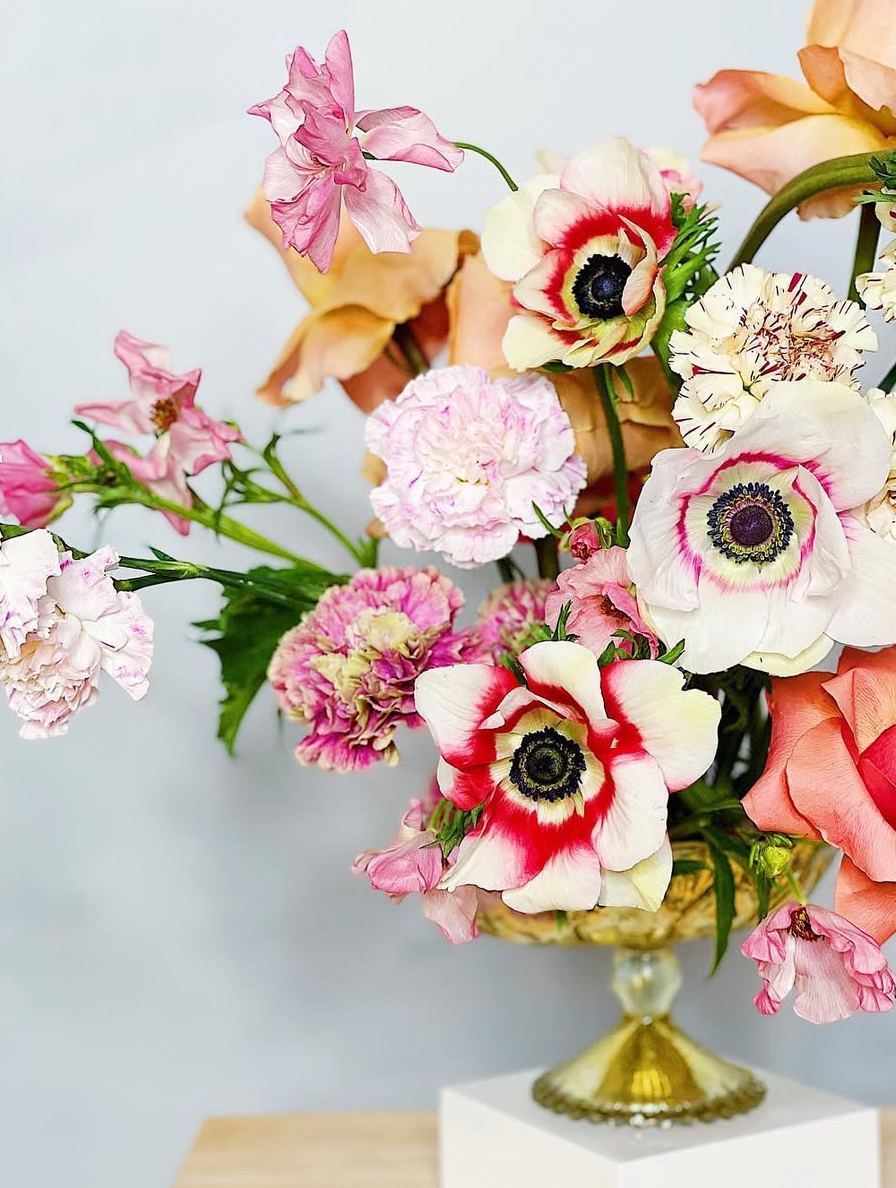
At the same time, the grocery store near my house had an excellent cut stem bar, so I started buying a few flowers on occasion to dress up my small dining table. I liked the challenge of arranging them. First, I needed to assemble all the correct tools. Next, I tried to find a pleasing color story. Third, I tried to choose flowers in shapes and sizes that complement each other. Finally, I selected the correct vessel to place the flowers in and found a way to secure them safely.
I was unaware of all of this when I made my first snip! I still have pictures of my first bouquets that I have saved, so I can see how far I have come with my practice. I soon realized that floral design was just that—a practice. I learned how to de-thorn roses and reflex them. I learned how to wire a ranunculus. I learned how to make a spiral bouquet. I could make corsages and boutonnieres, and I ventured far out into specialty pieces. I glued headpieces on disco-ball astronaut helmets. I made Monet-inspired headpieces for a Monet exhibition. I created wedding work and built large, oversized bouquets specifically designed for photography. I even built a full Día de Muertos installation for a local Latina-owned candle company.
Like floristry, writing is a practice. Floristry informs the way I write because with writing I must have the right tools, the right story, the right characters, and the right vessel. Instead of that snip! it’s a click! of my keyboard.
When I lived in New Orleans, I started work on a play that never came to fruition. It was based on stories that clients had told me about their experiences during Hurricane Katrina. This fall, one of those stories (while changed quite a bit) was published.
My favorite author, James Baldwin, has taught me the importance of bearing witness.
Flowers are beautiful because they bear witness. They are with us through every stage of life. Births, birthdays, weddings, new babies, anniversaries, sickness, and death. Stories, too, bear witness to life.
Melanie Cole
Nina B. Lichtenstein (PhD, MFA) is a native of Oslo, Norway. Her writing has appeared in The Washington Post, HuffPost, Lilith, Full Grown People, Tablet Magazine, Brevity Blog, Dorothy Parker’s Ashes, and AARP’s “The Ethel,” among other places, and in several anthologies. Nina is the author of the memoir-in-essays, Body: My Life in Parts (Vine Leaves Press, 2025). She is the founder and director of Maine Writers Studio, and the cofounder and coeditor of In a Flash Lit Mag. She lives in Maine where her husband, kayak, bike, yoga, and skis keep her (somewhat) sane. Find out more about Nina’s work here: https://www.ninalichtenstein.com/
Melanie Cole is a writer and poet from Tacoma, Washington. Her work has been featured in Grit City Magazine, Dandelion Revolution Press, PHIL LIT Journal, and Creative Colloquy. Melanie also runs her own literary magazine, The Faoileánach Journal. She has most recently published her book, BALDWIN, in October 2025, and is working on her first full-length novel. You can find her at: www.melaniewrites.com