
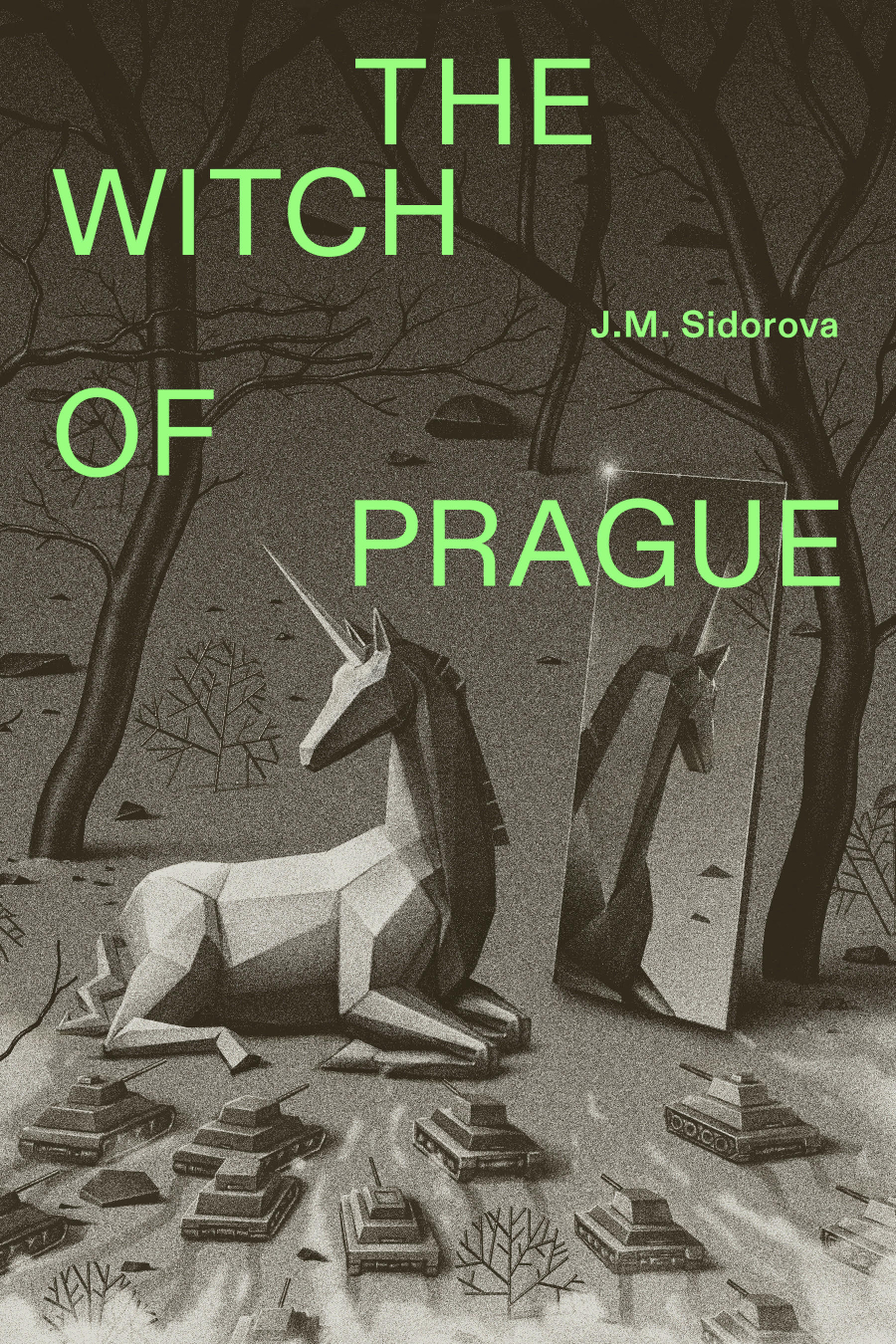
 For reasons that feel more historical than literary, the term “magical realism” is still most often associated with Latin America, even though traditions of magic and realism have also shaped other regions, including Central Europe, even under high socialism. In J.M. Sidorova’s The Witch of Prague, set around the Prague Spring, we follow the magic-saturated coming-of-age story of Alica Hovanova, whose life begins to shift when she answers an advertisement placed by an elderly woman: typing lessons in exchange for housecleaning. Dyslexic, Alica nonetheless manages to succeed in her lessons and becomes the protégé of old Pani Agáta, who introduces her to a job in the foreign ministry and to a magical tapestry at home that can rearrange its own panels. As Alica breaks ties with her abusive stepfather and confronts misogyny at work, the tapestry goes from decoration to confidant to ally. In its most magical intervention, when Alica is assaulted by a General, the tapestry falls from the wall to suffocate him to death. In the aftermath of the General’s death, Czechoslovakia is upturned by the Soviet invasion, echoing the upheaval that has already reshaped Alica’s life. While there is no magical tapestry to save the country, Alica believes that both she and her country will remain undefeated.
Alica is a compelling character not because she is flawless, but because she is willful. Her fighting spirit—apparent in battles waged mostly against abusive men—puts the novel squarely in a feminist narrative of resistance. What’s fresh here is both the setting and the way Sidorova uses magic. The book’s epigraph, quoting Honorius of Autun on unicorns, establishes its connection to Central European mythology from the outset. The magical tapestry itself depicts a king deploying a “bait-girl” to lure a unicorn. As the tapestry’s hunting story unfolds, the characters within that story find opaque yet discernible references to Alica’s life. This fusion of mythology and lifeworld, interlaced with descriptions of dreams in which characters in the unicorn story and those in Alica’s life interact, creates a dreamlike, enchanted feeling that is not out of place in a city whose most famous writer’s masterpiece was The Metamorphosis. This fitting choice of context and magical object—a unicorn tapestry—accentuates that the “magical” part of “magical realism” is essential to the novel: In the battle to assert oneself under patriarchy and authoritarianism, what one lacks in real agency can be compensated for by agents of magic. After all, isn’t that why magic was created in the first place—to grant our wishes when our real abilities fall short? In carrying out the political struggle on Alica’s behalf, magic steps in where revolution cannot reach.
The successful deployment of magic, however, requires that the “realism” portion of “magical realism” be executed equally well for balance. In this regard, something the novel does well is offer many compact storylines at once. The relationship between Pani and Alica forms the story’s backbone, and the turns the relationship takes are among the book’s stronger moments. Around the relationship cluster other threads: the intrigue of the inner workings of socialist ministries; the intelligence and counterintelligence work of the Cold War; the ups and downs of romance. The effect of all these real-enough threads is continual tension—the pull that the reader feels to follow the next turn in the characters’ lifeworld.
Still, there are moments when the realism falters. Realism, whether qualified by “magical” or not, depends on detail to render a sense of groundedness, and the novel does supply enough detail to sustain a tactile feel of the material world that was 1960s Prague: the addressing of one another as “comrade,” the choice of Libuše by Smetana as a date. Yet at the level of character and plausibility, the novel occasionally loses its footing. There is no sense that Alica was much influenced by a socialist upbringing; the fact that she lands jobs in ministries without any kind of political screening reads as unrealistic, even for the most liberal moment of Czechoslovak socialism. The unevenness of the prose—dreamlike, poetic flow sometimes interrupted by over-exposition and trite dialogue—can become jarring, and when this happens, the atmosphere of the novel dissipates.
Even so, The Witch of Prague rests on ideas that are both timely and bold: that magic has a place in the feminist struggle, and that Central Europe has its own tradition of the marvelous woven into everyday life. The novel doesn’t always balance historical realism and enchantment perfectly, but it’s carried by strong storylines and willful characters. In this case, you keep reading because the tapestry keeps shifting, and you want to see what comes next.
Publisher: Homeward Books
Publication Date: March 23, 2026
Reviewed by Hantian Zhang
Hantian Zhang is a National Book Critics Circle 2023-2024 Emerging Critics Fellow. His writing has appeared in Prairie Schooner, AGNI, The Offing, and elsewhere.