
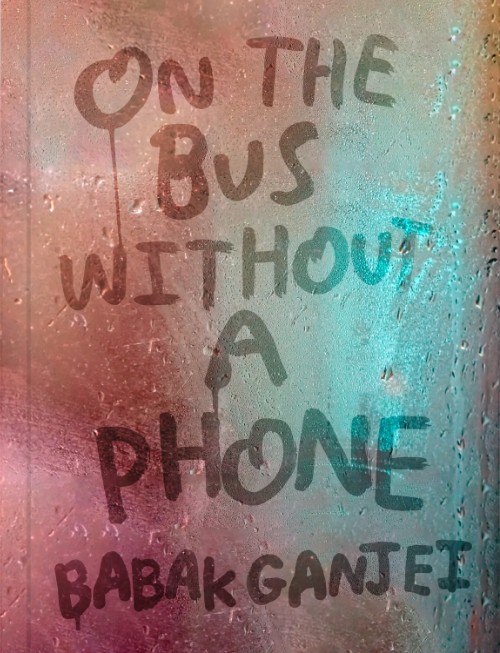
 Bob Green is all on his lonesome. His uncompromising date Rachel, whom he matched with on a dating app and has yet to meet in person, orders him to find her at Larry’s Wine Bar, a place he has never been and which inconveniently happens to be at the very end of his London bus route. Even more inconveniently, we learn our protagonist, in his hurry, has forgotten to bring his phone along for the long ride.
This is the premise of Babak Ganjei’s comic debut novella, On the Bus Without a Phone. “Surrendered to time,” Ganjei conjures in his protagonist the classic archetype of the lovable fool who has a knack for underscoring the disorienting weirdness of inhabiting public spaces without a digital device. “If I had my phone I could pretend I wasn’t here too,” Bob grumbles to himself on the bus’s top deck, his fellow commuters absolutely refusing him entry into their own personal spaces.
A quest novella of sorts, Bob’s bus companions become his less-than grudging sidekicks. “We are not a team,” he protests—not the man next to him who stinks at Wordle, not the inscrutably bland back of the woman’s head in front of him, not the man behind him who is so much troubled by his wife’s interest in mackerel that he phones mid-journey to break up with her, not even the “grown man” enjoying a Calippo (a popular brand of ice lolly in the UK) with innocent abandon, an action Bob finds especially disturbing and disruptive of the peace. Try as he may to connect with his fellow passengers, Bob finds himself frustrated by their convenient extrication from the present moment with their headphones, digital devices, and age-inappropriate ice lollies: “There’s no point being in the real world if you are the only one there.”
If the name Bob Green brings to mind a ruddy-cheeked Brit, think again. Born in Britain and of Iranian heritage, he feels British and yet his Middle Eastern appearance makes him nervous on public transport, anticipating how his fellow passengers might react to an anxious, bearded man on a bus. He has come up with an answer, by the way, if anyone were to question him about his identity. For Bob, proof of his Britishness centers squarely, perhaps solely, on his having read the 1989 novel The Remains of the Day at school (he is in his forties). Despite acknowledging that there is technically nothing to stop a bomber from reading the book if they wish, Bob consistently applies both his having read the novel and the character Stevens, the novel’s butler, as a rigid yardstick for Britishness. Some irony for Bob, given several of the novel’s contemporary critics thought Stevens’s disciplined character was more reflective of Japanese than British sensibilities (the novel’s British author, Kazuo Ishiguro, was born in Japan).
Though Bob’s ethnicity might leave him conflicted, we actually find our protagonist’s central identity crisis in his father’s gratified labeling of his son as a “writer.” Bob torments himself by speculating about the man’s intentions. “I often wonder,” he says, “why my father would be so keen for me to be a writer. I would wonder if he wanted me to have a terrible time… All the good writers suffered, and the best writers would try and suffer a bit more than the good writers to make themselves better writers.” Acknowledging the book as a functional artifact to deflect attention but no more than that—“I do wish I had a book to hand to make me look distracted, sophisticated and unapproachable on this bus”— he determines that a writer plays a useless part in society today, where people prefer to “consume” books via other media like audio: “Imagine being a great writer with your head in the oven while people listened to a paid actor speaking your secrets while running errands.”
Throughout the novella, readers are constantly being teased that there is nothing biographical about On a Bus, and yet Ganjei also litters the path with self-aware contradictions. Within separate chapters dropped throughout the novel’s overarching structure, Ganjei has his protagonist, with whom he shares his initials, reveal multiple letters to a publisher. Sometimes, he will speak to the publisher within the central story, acknowledging narrative digressions as merely there to inflate the word count. At other moments, Bob shares metafictional anxieties about getting a book to print (overly long chapters, prematurely aging the book with what he terms “contemporary things,” publisher frustrations that the full novella didn’t match the quality of the initial submission, and the sheer frustration of readers insisting a work of fiction must be biographical) that are bound to amuse other writers.
But perhaps the most vivid presence of authorial frustrations comes in the very object Ganjei has denied his protagonist: the smartphone. For fiction writers, smartphones can present a real inconvenience that must be circumvented somehow, to avoid characters just looking things up. A world without phones is where characters can imagine, strive, struggle, in short—make up their own stories. “If we start to accept this as a rule, that within our storytelling we live in a fictional world where phones don’t exist are we not one step closer to blurring the lines between reality and fiction,” he ponders, continuing with a mortified grimace: “To be meta used to be groundbreaking, obnoxious and clever. Now it’s all consuming, exhausting and panic inducing.”
On the Bus takes a fun concept and raw-dogs it right to the end of the line. In Bob’s quest to occupy himself without a phone and distract himself from the panic of meeting Rachel, we break free from the conventional narrative with letters, Wordle answers, and screenplays. Moments that lean toward the satirical have Bob cast his Graeberesque opinion on business consulting and the absurdities of present-day influencing. There are smatterings of John Lanchester’s Mr Phillips, whose similarly abashed hero also travels through London in the space of a day. In On the Bus, our narrator bumbles from one embarrassing memory to the next, forgoing a Veet patch test and so flaying the skin off his shoulders, adapting his romantic fantasies into filmic bonkbusters, and finding increasingly fanciful (if ineffective) means to avoid having to talk to his neighbors. Even if some individual scenes bounce a little too giddily towards their punchlines, the novel is belly-ache funny. It is unafraid of being silly. It is a lot of fun. I read this within reaching distance of my phone and never once preferred to consult it instead.
Publisher: Rough Trade Books
Publication Date: April 2, 2026
Reviewed by Zara Karschay
Zara Karschay’s fiction has appeared in Ploughshares, The Baffler, The Gettysburg Review, and elsewhere. She received the Harper-Wood Award for English Poetry and Literature from the University of Cambridge in 2017–18, was shortlisted for The Alpine Fellowship’s Prize for Poetry in 2024, and was awarded second prize in Zoetrope: All Story’s Short Fiction Competition in 2025.