
This month in our recurring From the Archives series, assistant editor Brandon Williams teleports us ten years into the past to analyze Ezra Carlsen’s “The Cultural Ambassador of North Beach.” First, read the story, and the follow along as Williams dissects what makes this story tick.
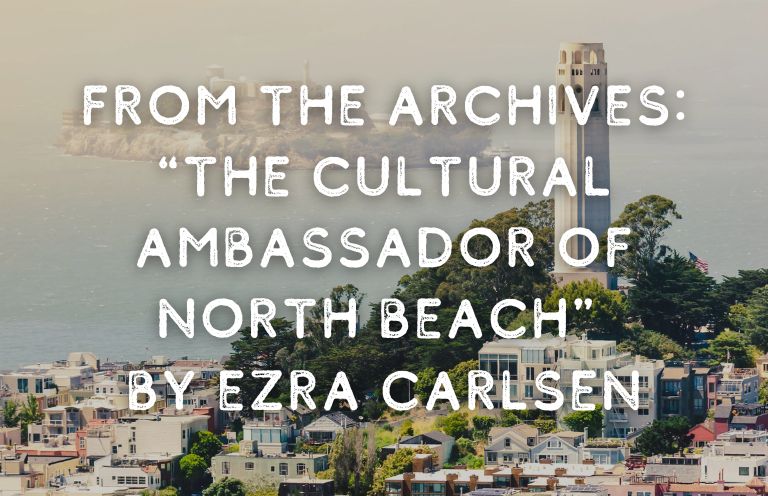
In “The Cultural Ambassador of North Beach,” by Ezra Carlsen, a TMR New Voices story, we meet Perry, a poetry professor on the East Coast who was raised in San Francisco. Much of his current life has been shaped by those years in North Beach, where he knew seemingly everyone (hence the title) and burnished his cultural bona fides through rubbing shoulders with such SF luminaries as Ferlinghetti. He recounts his interactions with Izet, a survivor of the Bosnian War and specifically the Siege of Sarajevo, which consisted of erstwhile discussions and books and Perry’s youthful attempts to understand and explain life and its meaning to the man beside him who had already experienced such horrors firsthand. A few months after September 11, Special Agents come to the bar Perry’s father owns, where Izet works, and in the time it takes them to search the premises for the man, Izet disappears from the bar, from time, and from history. Twelve years later, Izet’s sister contacts Perry, and she reveals that Izet has been missing that entire time. In searching for him, she has filed Freedom of Information Act requests which include Perry tangentially: One single book has a highlighted sentence and the line “For Perry” handwritten beside it. Katje and Perry meet, she gives him some information on Izet’s life in the siege of Sarajevo, and then Perry is left to contemplate the line Izet had left for him.
The piece is written in first-person reflective, and the inciting incident of the piece comes when Perry is contacted by Izet’s sister; this is what spurs the deep reflection that fuels the piece. On a plot level, this story is far more interested with the internal than the external, with there being almost nothing for either of our two characters to physically do: There is no way to find Izet, all possible leads seem to bring them nowhere, and even the single connection between Katje (Izet’s sister) and Perry is one that can only tell Perry about the past. That said, learning Izet’s history recontextualizes Perry’s own life almost entirely: wrapping Izet’s horrors in with Perry’s understanding of reality, mixing the Bosnian War with 9/11 and the War on Terror, all combine with his burgeoning understanding of truth and the poet’s responsibility for chronicling atrocity.
The Opening Paragraph
I’m a big believer in the power of the opening paragraph: It teaches you how to read the story, teaches you what’s important to the author and the character and what should be important to the reader, and it builds in the thematic constants the piece can use. Story is a conversation between writer and reader, built as all conversations are out of both prior knowledge and also out of formlessness that now how has weight and heft, and the first of those building blocks to be laid comes out of those earliest choices. With that in mind, let’s look at this intro.
The opening paragraph is a quick historical snapshot of a clipper ship, the Calliope, that sits beneath the bar Perry’s dad owns. Beyond the bowsprit that sits on the bar’s wall, it’s never seen, and physically it has no bearing on the action of the story, and it’s barely even used as a totem or metaphor in the piece (though it does receive prominent placement both at the beginning at the end), yet it gets the entirety of the opening paragraph, and it’s used in the second paragraph as our transition into the characters and their history with the bar, only disappearing once our main character’s relationship to the bar is fully established.
So then, our pathway into the story is a fairly minor detail. But this detail is one that immediately establishes bona fides, presenting our main character’s knowledge of his area and his deep connection to this place. This intro emphasizes the importance of story and of history, as we see that our narrator has taken the time both to learn from historians as much as he can about the ship at the center of his father’s bar, and also that he wants to share and provide this knowledge to us; he jokingly refers to himself as the titular “Cultural Ambassador of North Beach,” and our first interaction with him on the page portrays him in exactly that museum docent sort of role. On the level of symbolism and theme, there’s a pretty clear connection to Izet’s story in the idea of the ship sitting there un-excavated while life builds up around it. The ship is there at all times, even when it’s not center of mind, but only the tiniest fragments of its story has been or can be revealed. That fits incredibly well with the way that Itzel will be handled throughout the piece, right from the start.
The Present Moment
There are two major technical decisions in the piece: The first is our point of view, using this first-person reflective, to set the current moment of the story far ahead of the Izet moments that dominate the majority of the story’s page-space. We don’t jump into the present moment of the story until the story’s fourth section, and at that point we only stay there for a paragraph before jumping back into memory; we return to the present and stay there in the sixth and final section, something like a quarter of the story. The reason for this technique is simple, but twofold: First, there’s simply not much action to suffuse the present moment, so we save the conversation with Katje for a featured position in the piece; secondly, learning Izet’s history is made far more powerful once we’ve seen him in the few moments of action that Perry was able to witness.
The second technical choice is one of plot: the decision to build in a central mystery around what happened to Izet, both in the moment where he disappeared and then also what happened to him thereafter, and to make that mystery central to Perry—he was there to see Izet disappear, he has no explanation for what he’s seen, and he considers it multiple times as he ages and defines himself and his purpose as a poet—while also giving Perry no way to try to find any answers. As he matures, this moment around Izet appears to be the defining moment of Perry’s life, and yet he has absolutely no way to make meaning out of what happens. He can’t explain how Izet escaped nor where he went, and even once there’s an opportunity for him to revisit, with Izet’s sister, the mystery is simply deepened: Izet disappeared from the bar and then disappeared from life. No explanations will be, or can be, forthcoming.
All of this combines to a character that is fully and entirely stuck. There is a natural and inherent risk in building a story that allows your character no true decision or epiphany moment, but this piece pulls that off so well by utilizing that inability as a significant part of its thematic intent. The Perry of our current moment, the older Perry who is reflecting back upon these moments, realizes that Izet has seen more life than Perry ever will; even that great American tragedy, that moment by which America so often defines its own trauma, Perry spent hungover and excited that he could skip Physics. This moment with Izet and the Special Agents was Perry’s one brush with something heavier than he could deal with or explain, and Perry was a side character, a bit piece in whatever ongoing struggle was or wasn’t happening around him that he could barely even notice. In meeting Katje, in coming back to San Francisco to do so (which he only does ever few years), and in finally hearing as much of the story of Izet as anyone probably ever will, he’s essentially collecting stories, adding another anecdote to his North Beach repertoire, coming back to his own initial self-build as the cultural ambassador here. That’s all Perry can do, collect the stories, observe and then relate them as he can; that’s all anyone can do for Izet now.
Place as Everything
What fascinates me most heavily about this story is its connection to and awareness of place. This story is extremely careful in its use of setting. Perry possesses a deep knowledge of North Beach—naming the bars, speaking casually of people he knew from that time, discussing the ship underneath his father’s bar and its history, and even giving the backstory of his family’s place in that city history—and Izet’s sister gives a similar knowledge of Sarajevo under siege, although her knowledge is built around the survival process during that time. In its willingness to slow down within such details of place, Perry finds himself in a constant comparison that is built out of that awareness and the way that we as humans are created by our setting: He compares himself as a poet now to himself trying to learn to be one as a boy in his past; his firebrand youthful defense of his own personal struggles is built around the inferiority of his experiences when put against those of a young man forged in a literal siege; Perry’s experience of America post-9/11 is almost diametrically opposed to Izet’s experience of the Bosnian War. It is place and history that push both of them to look at the world as they do, and that lead them to the actions they take: Izet to escape or disappear, Perry to teaching and this excavation of the value and necessity of poetry in relation to apocalypse as so challenged by Izet in his final missive these dozen years later. This story is not the same without Perry leading us through North Beach, without his certainty that art is in itself struggle, his understanding created by the vibrant art scene around him, and Izet’s experiences of place—both his own in Sarajevo and his new place San Francisco beside Perry—give him an exacting alternate perspective on exactly these same issues that has almost no choice but to clash with the Perry’s poetry built of himself and his space.
In Conclusion
I’m an absolute sucker for a story of place, and this piece uses setting to complicate theme and character and plot just as much as to establish where we are in space and time. The added complexities around memory and responsibility, the cringe awarenesses of Perry as he used to be, and the depth of complication added to every interaction as he looks back upon this moment with the added awareness of there being no easy catharsis coming even within the one moment where there was the potential of it happening, well, mix all that together and you get a story I remain incredibly proud to host on our site. Go read it!
by Brandon Williams