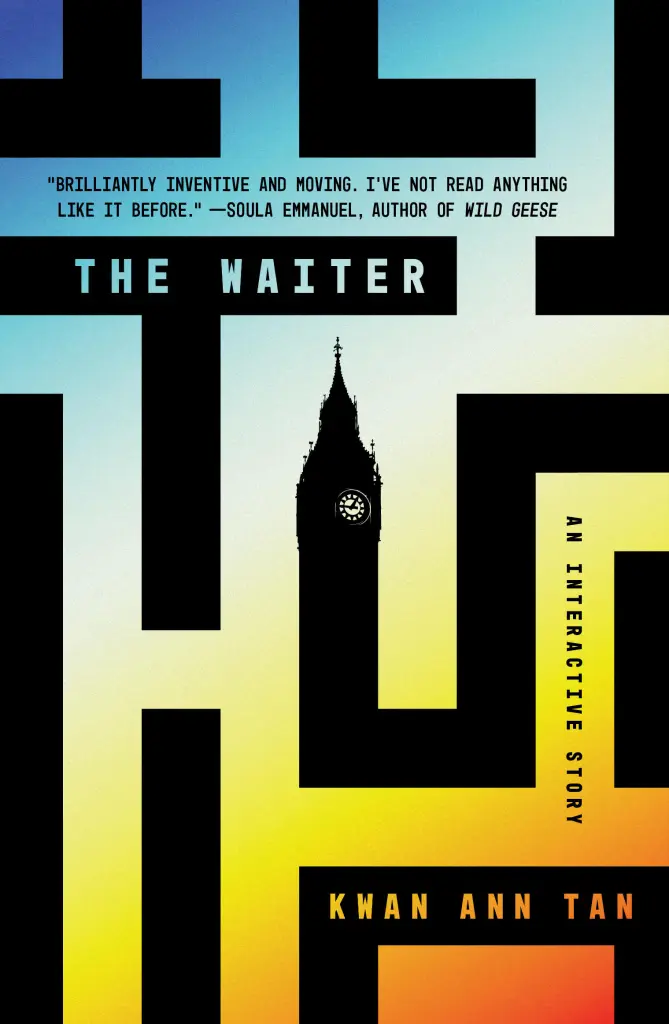
 Kwan Ann Tan’s debut novel, The Waiter, is cathartic, strange, and depressing, yet it leaves the reader with a sense of hope that is hard to describe. As an interactive story, The Waiter offers the choice of eleven different endings, all the product of countless decisions that allow the reader to embark on a journey with multiple splintering pathways through an apocalyptic London.
Our titular Waiter is an underpaid, overexploited employee of “The Company,” an ominous conglomerate that runs a “Waiting” business, where people can use an app to hire “Waiters” to perform various menial tasks. From waiting in line at a trendy shop, to lugging bags around the Underground for tourists, to stirring soup for a mysterious old woman, our protagonist navigates an aloof world of corporate exploitation and isolation. At the same time, she observes a London that has been taken over by “maws”: mysterious and catastrophic sinkholes that have begun appearing all over the world, destroying cities and sucking in people—and sometimes spitting them back out, changed.
Our Waiter is one of those people, having been found by the company beside a maw, with no memories or apparent ties to society. Throughout the book, the Waiter’s inability to remember her life becomes a catalyst, driving her towards any fleeting flash of familiarity as she tries to figure out who she once was.
The book characterizes itself not just as literary fiction, but as a LitRPG, which stands for “literary role-playing game.” The interactive aspect, one of the novel’s main selling points, is incorporated relatively seamlessly, and there is no doubt that the structure aids not only the reading experience but also what the story itself is trying to say. However, for readers unfamiliar with the medium, or those who may not have any nostalgia for the “choose your own adventure” genre, there are moments when the jumps between decisions and scenes can feel disjointed. Endings sometimes resolve too quickly, or the autonomy granted by the interactive format may suddenly be pulled out from under your feet. You make a decision that seems to be leading in one direction, only to find yourself on a path that feels unrelated. While this can initially be frustrating, it does not ruin the genuine fun of the reading experience.
With a novel like this, the more you read it and the more endings you discover, the better. As you encounter different endings in different contexts, you become able to recontextualize old ones through new discoveries. It is this aspect of the book that shines through the occasional jarring transition or unsatisfying ending.
As a “choose your own adventure” style story, the entire book is written in a second person POV. The prose is simple but often surprisingly powerful, minimalistic but genuine in its impact. In a way, this minimalism allows for the world to feel more abstract, which coincides nicely with the book’s main external threat, the otherworldly time-bending maws. The main character herself is a blank slate, with no memories, few defining features, and almost no visual description. However, there is no doubt that she is indeed her own person. One characteristic that comes up multiple times, and which lends itself very well to the book’s interactive structure, is her reluctance to make decisions for herself. Despite how exploitative and poorly paid her job is, she remains loyal to the company for most of the book, for the pure fact that she finds safety in being told what to do.
Ultimately, the most compelling aspect of The Waiter is the way its interactive format feels neither like a gimmick nor an inconsequential choice of medium, but something directly connected to the story’s themes. Self-discovery, autonomy, and the ability to change the course of your life—to choose your own path—are the main drives for our character. As we weave through the novel’s decisions and narrative pathways, trying to figure out who “the Waiter” is and what is happening in this world, the Waiter, too, navigates her own internal struggles with identity, autonomy, and whether it is possible to change her life for the better.
At its core, the book is about finding yourself. It asks simple questions, with not-so-simple answers. Who are you, who could you be? Is it even possible to change your life, to become someone new, or to start again? There are no clear directions, and no clear answers—it is for you as the reader to decide.
Publisher: Union Square & Co.
Publication date: November 3, 2026
Reviewed by Emi Craig
Emi Craig is a writer and literary translator from Vermont, currently based in NYC. He is an alumni of the Oberlin College Creative Writing program. He has had his fiction published in The Limelight Review, does editorial writing for Musée Magazine, and self publishes on Substack at @emicraig. You can find more of his work at emcraigwrites.com.