Through his use of an inventive point of view in “Fossil,” Dave V. Riser creates an intimate portrayal of a child who knows what they want and what they don’t want, even if they don’t yet fully understand why. “Fossil” is a painful, yet hopeful, coming-of-age story you won’t soon forget.
You are ten years old and your mother doesn’t love you because you won’t wear the pink T-shirt she bought you from the Key West flea market. It’s got SPF protection, she insists. It’s going to protect you. It’s for your own good.
You refuse. You keep refusing. The argument escalates until she is red faced and screaming at you on the Gulf-side beach at Bahia Honda State Park. There are families of sunscreened tourists staring at you: The adults look on in disgust, and the kids, a mix of fear and relief. They’re all glad they’re not you. The ruins of the old bridge tower over the beach, bigger than you can really comprehend. You wish you were up there instead of here, crying silently, arms crossed tight over your chest and your neck tucked like a turtle so she can’t force the shirt on you.
“—You ungrateful little bitch—” she says. She says other things, too, but that’s what you remember. That’s what makes you decide that you can’t keep living here.
If you had survived, maybe as an adult, you would have reconsidered the color pink—after your second puberty, after testosterone let you speak in public, after top surgery made it simple to wear shirts again, and bottom surgery made it fun to stand in front of the mirror. You would not have hated the color so much, really, because it was never about the color, it was about the symbol, the girlhood foisted upon you, the erasure of your own, imperfect self-knowledge.
At ten, your favorite color is green. Green like the seaweed growing in the deep part of the Gulf where you’re not supposed to swim unless an adult is with you. You do anyway, though, if you have your snorkel. You can swim forever if you have your snorkel. Plus, you know it’s not the sharks you have to worry about. Not the alligators, or the snakes, or the huge green lizards. Not even the other kids, not really, although they laugh sometimes when you don’t mean to be funny, and you never know who to sit with at lunch.
You are ten years old and you already know that you never want to become an adult. You want to stay the thing that you are. You don’t want to become the thing that every adult you know wants you to be. Even your aunt, who is the only adult you trust to tell you the real truth.
The car ride home from the beach is silent, but the weight of what your mother called you sits heavy between your narrow shoulders. Ungrateful bitch. A bad word.
Sand digs into your bare feet, scraping the plastic mat in the footwell. You put your elbows on your knees to steady yourself as the car hits a pothole. Normally, you’d laugh, try to get your mother to hit the next—but not today. Not ever again, you vow. You won’t speak to her anymore. See how she likes that.
You know that you’ve tried this militant silence before, forgetting your vow around dinner time, or the next morning, but this time is different. She’s never made you into a bad word before.
You’ve seen her and your father fight. You’ve seen her and your aunt fight, too. You know that this kind of silence, these kinds of words, only grow. It doesn’t really make sense. Or, rather, you can’t figure out what has changed to make this so important.
You can remember when your mother loved that you loved green. She bought you hair ties and notebooks in different verdant shades. She liked that you liked science. She bought you books about Marie Curie and Ada Lovelace. Your favorite was the picture book about Mary Anning. You used to trace your fingers over the ichthyosaur she found when she was twelve. You started looking at rocks differently, and found shells and sparkling corals in the limestone in your backyard. You want to be like Mary Anning, only, yourself.
Would you have become a paleontologist? Would you have still loved Mary Anning, kept a photograph of her at your desk, first in undergrad, then in your grey cubicle in graduate school? A reminder that it was possible, that there was so much to be discovered, that you could love the world even when the people inside it didn’t believe in you.
There is an empty space where that photo should be. There’s a field of study missing your name, your nasally, deep laugh, your sketches of the first full nanuqsaurus skeleton. You should be here.
* * *
Your mother gets out of the car and slams the door behind her, all without even glancing at you. She’s still carrying the pink shirt.
You could follow her. You are supposed to follow her. A part of you wants to sit in your room with your collection of stuffed toys—alligators, dinosaurs, one horse you call Pony who sleeps with you in your bed, who was a gift from your aunt—but it’s not safe. Your mother doesn’t usually like to do the spanking, but she’s mad enough she might. She might even be up there now, looking for the leather belt she and your father use to punish you.
You decide, instead, to run away. Maybe forever.
You don’t yet know that this will be the last time you believe you can save yourself.
You get your bike from the garage as quietly as you can, opening it slowly and then leaving it open, even though your father has told you at least a hundred times that that’s how things get stolen.
Your bike is green and white, with little tassels on your handlebars. No one calls after you as you turn onto the pavement, leaving behind your sunshine yellow house on its tall cement stilts. You were too young to remember when your parents moved in, but your mom likes to tell you how you, a little three year old, tried to call it sun-house. That’s when I knew the Keys would be perfect for us, she used to say. Our own little sun.
And the sun does beat down on you as you pedal, sweat beading your skin almost immediately. Two turns of the road, and then you cut across someone’s yard to turn onto Key Deer Boulevard. For the first time all day, you feel something buoyant that might be happiness. Or maybe it’s relief.
You will find out later that it was only five minutes after this, when you failed to enter the house, when she saw the open garage door, that your mother called the police.
* * *
You have been thinking, every once in a while, about what it would be like to die. Your grandmother told you that every person who dies comes back in a new body, as a baby. She’s paying her priest a lot of money so he can help her figure out all the people she used to be.
You sometimes think, watching the other kids play during recess, that you would like to die and come back as something else. A boy—your heart kicks and leaps. Or a girl, a real girl, not whatever you are now. You’d come back right, and no one would be angry with you, no one would scream at their husband that you were some dyke in the making because he was home too much. You’d wear pink shirts and study hard and write beautifully, like the girls in your class do. You wouldn’t wear makeup until you were thirteen, because girls should be modest, but you wouldn’t loathe the thought like you do now. You would be excited. You would be happy.
* * *
Once, in the backyard when you were six, you had stepped on more than ten stickers at once, and you hadn’t screamed or even cried at all. You limped over to the grass and sat with your own foot in your lap and pulled them out one by one. The last two made you bleed, little specks of red where their thorns had gotten deep in the meat of the arch of your foot. You had thought of them like the bear traps you saw in cartoons. You didn’t yet know they were shaped like that to better escape their home, to dig deep into something, someone, else.
* * *
You coast down the pavement on your bike, bare feet extended past your pedals. Key Deer Boulevard is a neighborhood road that goes right through a nature preserve. If you keep driving down, and then fight past the brush and the ferns and the crab spiders, you’ll make it to the ocean, your mom says. The Gulf side. Every once in a while a car passes in the opposite direction, headed towards Highway One. Palm fronds lean into the road, brushing gentle over the plastic of your bike helmet. Swoosh swoosh swoosh, like a cartoon sound effect.
Sweat prickles at your hairline. You take one hand off your handlebars to scratch your neck and your fingers come away wet. You feel a little nauseous. You should have had a glass of water before you left.
You weave your bike across both lanes, because there aren’t any cars coming, and because you need to think. Maybe you can become someone new. That’s what people do when they run away. You’ve read about it; From the Mixed Up Files of Mrs. Basil E. Frankweiler. Those kids lived in a museum. Or in The Thief Lord, where the one character rides a merry-go-round and becomes an adult. You liked that one the best, although it makes your heart ache to remember the distance between that character and his best friend after his transformation.
You don’t have a merry-go-round, or a museum, but Mulan cuts off her hair when she runs away. The idea makes your pulse quicken. Excitement. Or maybe fear. You would be in so much trouble if you cut your hair.
You slow even further and start looking for broken glass. Your dad had wanted to get you a pocketknife when you joined the Girl Scouts, but your mom said no, that you might hurt yourself. But you know glass will work; you saw a boy step on some at the beach once. He bled everywhere and everyone got out of the water just in case.
The boy had cried a lot, even though earlier he had been making fun of you for being nervous about swimming past where you could touch. You were a baby back then, still unsure of your own ability to keep your head above water. But he cried, and you had realized he was a baby too. Even though he’d hurt your feelings, the knowledge had made you want to care for him, an instinct you angrily shoved down. You swore you’d make fun of him if you saw him again, but you never saw him again.
“Hey,” comes a woman’s voice, startling you out of your search. Your hands tighten reflexively, hitting the brakes, your feet coming out to keep you upright.
“I like your dinosaur,” the woman says, standing at one of the mailboxes next to the road. She has short hair, blue and purple like a peacock’s feathers.
You glance down at your shirt. “It’s not a dinosaur,” you tell her. “It’s a pterosaur. They are flying reptiles, not dinosaurs.”
“Oh, I didn’t know that.” She’s wearing a pink shirt with a glass of alcohol on it. Margaritaville, it says, like the song. You’ve seen a lot of shirts like it. “You live around here?”
“Yes,” you say, even though it’s a little bit of a lie.
“What street?”
You hadn’t planned for this. “Back there.”
“You know your way back?”
You can’t help but bristle. You’re ten, not five.
“Yes. I come this way all the time.” It’s a little bit of an exaggeration, but it’s not not true. Your mom drives down this road with you sometimes, with lettuce, so you can feed the Key deer.
“Okay.” The woman puts her hands up, but she’s smiling, the way adults smile when they think you’re being funny. Everyone always smiles at you like you’re being funny when you aren’t. You do not yet know the word condescending, but once you do, it sinks somewhere deep inside you, the answer to a question you didn’t know how to ask.
“Okay. I’m going home now,” you tell her. Without waiting for her to say goodbye, you hop on to your bike. Once you’re halfway down the road, you glance over your shoulder at her. She’s on the phone, still watching you. Her expression looks a little funny.
You turn off the main road, like you’ve found your driveway, even though it’s the opposite of what you already said. It doesn’t matter. You could live down this road, she doesn’t know. Every adult you speak to seems to live in some kind of parallel world, full of hidden rules and ways of saying no without saying no. You think, sometimes, that they aren’t human. They’re not like you, can’t see the things that you can see so clearly.
The road transitions to dirt almost instantly, and you have to drive a little bit into the bushes to avoid the mud puddles. Your front tire twists, but it complies, bringing you deeper into the woods.
The last time she visited, your aunt said, “It gets easier once you’re eighteen.”
You think about that. You think about staying here for eight more years. You don’t remember being two—it’s hard to contemplate that length of time. You can remember last year a little bit.
Last year, you would scream back at your mom. This year, you’ve stopped. You’re tired. It would be easier to just wear the shirt, even though you hate it. You could learn how to do all the things that you hate.
What will you be like next year?
You learned the word suicide from a talk a woman did at your school. She was talking about how important it was not to play with guns and to always tell an adult if someone tried to touch you. She said when people didn’t, they might die, like her daughter had died, from cutting her arms open in the bathtub. The woman had cried a lot while talking and the assembly had been very quiet after she left.
You don’t want to die. You just want to be different. You wonder if her daughter wanted that, too, if she had been trying to peel back her skin to get at her real self underneath.
* * *
The sun rises high in the sky, shining down on you, maybe giving you skin cancer in the future that you can’t imagine. There are trees in the road now, baby slash pines sprouting out of the dirt. They’re as tall as your knees. A few turns later, they come all the way up to your waist. The whine of mosquitos has grown louder.
Everything’s taller when you’re ten years old. Monumental. You don’t know that the palm trees around you are young, only fifteen feet tall, cut down by developers and then regrown when the flooding and the hurricanes and the increasing heat drove demand down. When you turn the corner and see the swamp encroaching on the road, ferns and swamp grass forming a permeable boundary between gravel and landscape, it feels like you’ve discovered a lost world.
You forget about your mother, you forget about the pink shirt, you forget about the woman and her strange, uncomfortable smile. You forget about your own body.
Shallow water somewhere between green and blue stretches before you like an inland sea, dark with algae and shadows thrown by the longleaf pines that lean over you, bowing inward like they have something to tell you. A fish jumps a few yards out, catching the mosquitos that fly in lazy circles. A blue heron regards you from a few yards away, submerged up to its knees. It dips its long beak into the water. An acceptance of your presence. A welcome.
You could spend the whole of your life cataloguing the bugs that flit from grass to stalk of grass. You could pull off your skin and slither into the warm, brackish water, and drag your tail behind you in lazy S shapes. You could scare the tourists.
It’s not true, but you think, I could live here.
I want this for you, because I can’t bear what I know comes next.
I want to forget about the cop who finds you here. I want to forget about what he calls you. I want to forget the things your mother says to you when you are returned to her custody. I don’t want to remember the years that follow—slow, grey years, as your body changes and no one cares, as you get smaller and smaller inside yourself. As you learn to live with it, to endure the pink shirts and the laughter from the other girls, until you don’t recognize yourself. Until the only way out is through the bottle of painkillers you buy from a stranger online.
Fuck that.
You are still standing at the edge of that flooded pond, breathing in the salt and musky scent of decay. The red eared sliders kick as they look for branches to sun themselves on. Below the surface, adolescent alligators and crocodiles share space, uneasy, knowing somehow that this place is the one place in the world where they might grow up side by side.
And below even that, in the glittering limestone, only a few hundred feet below your sneakers, the imprint of a life you’ve spent all of yours waiting to find.
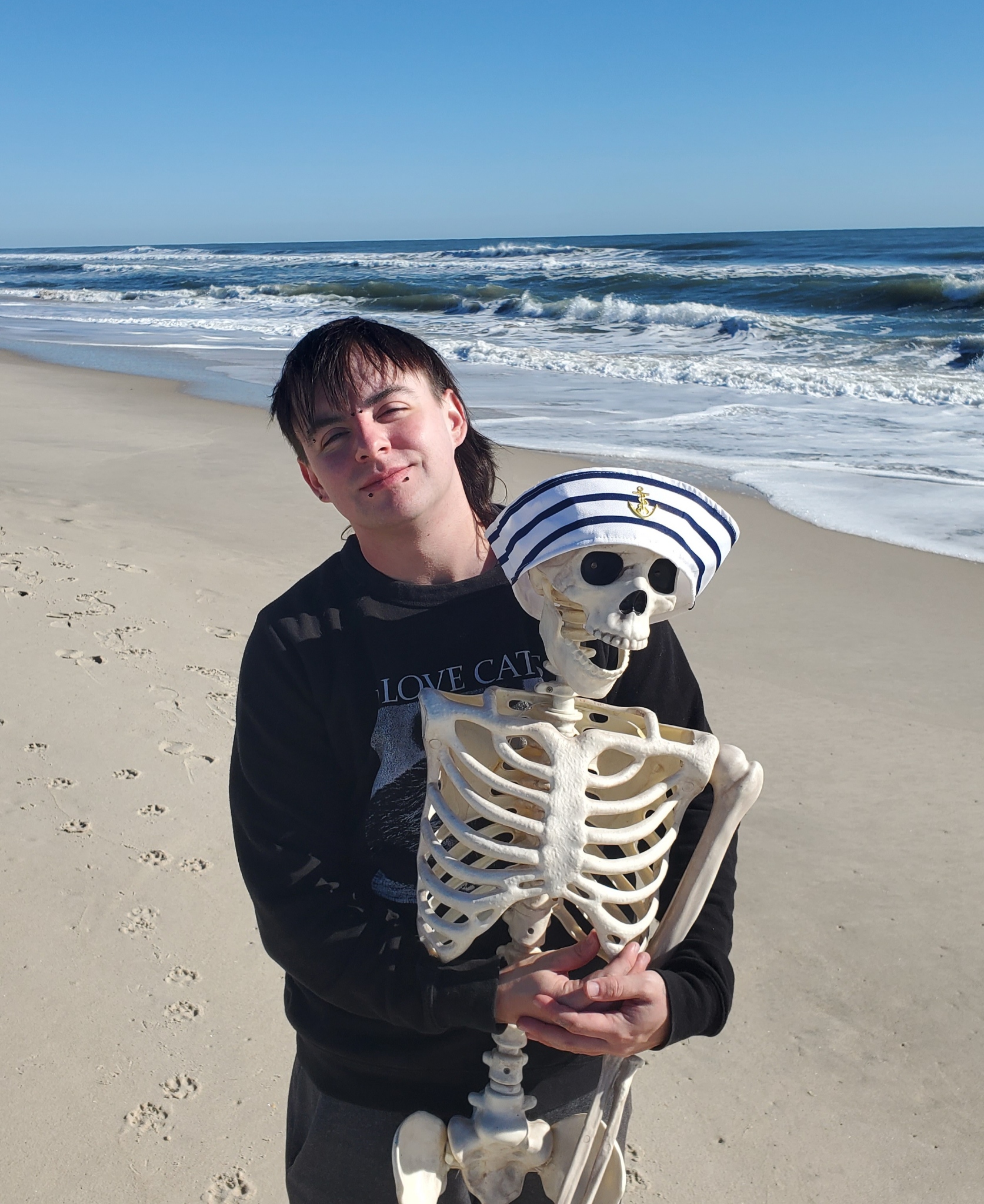 Dave V. Riser (he/him) is a graduate student at the University of Pittsburgh. His short fiction has appeared in the Arkansas International, as well as in Dark Matter Presents: The Off-Season, an Anthology of Coastal New Weird. He can be found on Bluesky @davevriser.