
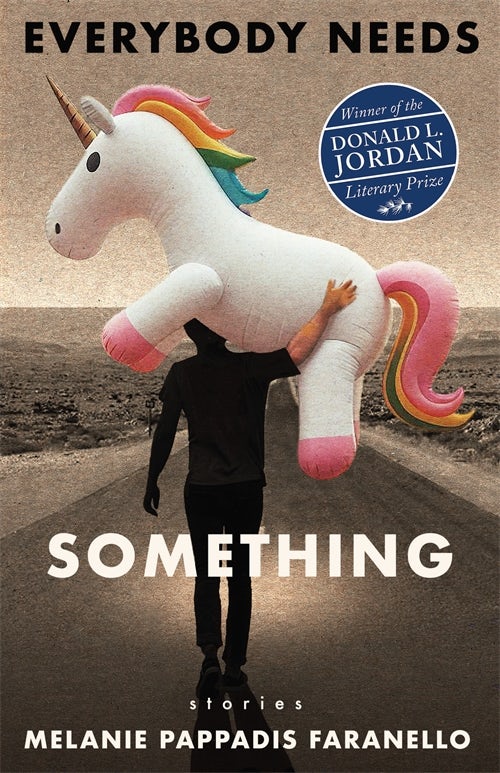
 In Everybody Needs Something, Melanie Pappadis Faranello offers a quiet but deeply observant debut collection that highlights how ordinary moments evolve into lasting emotional truths. Across fourteen stories, Faranello explores how people live with loss, carry regret, and keep reaching for connection even when the past seems to influence every choice. Faranello’s prose is direct and lyrical, marked by a careful attention to detail that makes her characters’ inner lives feel lived-in rather than explained. What stands out is her ability to show how time changes people through small shifts in perception and memory, and not through dramatic, grandiose events. The result is a collection that asks readers to recognize the weight of what goes unspoken, and how compassion can be revealed in ordinary moments.
“Flotsam,” one of the collection’s most affecting stories, follows Jack, a newly widowed construction manager who drives four hours to Missouri after a former high school girlfriend promises relief in a so-called “healing pool,” and it is here that Faranello’s control of detail and image is most striking. Her prose is direct yet richly textured, grounded in physical particulars that subtly mirror Jack’s psychic disorientation and grief. She writes, “He took another swig, and the bottle made a suction sound as it pulled from his lips, a little bubble of froth rose to the top, threatening to spillover.” And later: “She was close enough for him to see a dewy perspiration beading beneath her powdery deodorant marking the edges of her tank top. Her breath, a mix of cigarettes and cool ranch, didn’t bother him.” Faranello excels at rendering internal insights through external minutiae, and the details never feel decorative; they accrue meaning, turning ordinary spaces into charged emotional terrain. The result is a story that captures grief not as spectacle but as an inevitable drift through memory and desire—showcasing Faranello’s expert command of imagery and her rare ability to make a life feel fully inhabited on the page.
In “Just Fine” and “Airways,” the first two stories in a trio of linked narratives, Faranello traces how unresolved emotional inheritance carries forward across time, reshaping rather than fading. In “Just Fine,” Will’s attempt to tell his father about his divorce registers as the accumulated fatigue of waiting for connection that never arrives: “So many years, Will had waited for some alternate father to show up. He felt the foolish weight of his expectation press down on him now.” His mother’s absence becomes fundamental, a missing presence that once translated feeling between them: “…in her absence, they did not know how to manage the space she once occupied.” When “Airways” finds Will years later, remarried and facing impending fatherhood, that same tension manifests into the physical world. A storm-torn gutter and a fallen ladder symbolize the pressure of responsibility and self-doubt. Faranello writes, “The monstrous gutter blew away from the house then back at it, slamming into the siding…It was as if the gutter were calling out his failures to have done anything to fix it yet.” In Will’s risky attempt to repair his home, the lingering voice of his first marriage resurfaces, exposing how deeply criticism can root itself over time. Yet Faranello allows for a fleeting counterbalance: Soaked and tired, Will returns to bed, where the prose softens and steadies—“This was a place he could stay, on this stream of breath sliding through the constriction, while the world simultaneously swelled and contracted around him.” The moment does not resolve the past, but it suggests how intimacy, however fleeting, can quell the effect of disillusionment.
In “Arboretum,” which takes place years after “Airways,” time fully reveals itself. Will and Bethany now have a son, and Will visits his father in a nursing home. Faranello renders aging with a restraint that rejects sentimentality: “He sat in his chair like something overgrown. His fine silver hair nearly brushed the tops of his shoulders, and his face was covered in ashy stubble. He looked like he had become part of the room, like something rising from the carpet or the cushions of the chair.” As Will tenderly cuts his father’s hair, the story captures the moment when responsibility extends both backward and forward, binding generations through acts of care rather than responsibility. Faranello’s gift is her patience with these transitions, highlighting her confident understanding of how time fosters innovation.
The title piece, “Everybody Needs Something,” extends the collection’s patient reckoning with family and time by shifting the focus from inherited roles to improvised ones. Sal, a divorced father with limited custody of his teenage son, moves through a world where traditional structures of family have thinned or vanished altogether, leaving him to imagine replacements. His half-serious idea for a “Rent-a-Relative” service emerges as a genuine response to absence, a way of filling the emotional chasm that follow when parents die, marriages fail, and children begin to drift. Faranello grounds Sal’s longing in an acute awareness of time’s narrowing possibilities: “He was fifty-two next month and he’d known himself for too long,” a knowledge that carries the quiet grief of understanding “the things you knew you’d never do.” Generational tension throbs beneath the smallest moments, especially as Sal struggles to recognize his son’s changing presence, feeling the ache of separation even in closeness: “How was it possible to miss someone who was right in front of him?” What distinguishes the story is its refusal to resolve that ache into easy insight or redemption. What Faranello ultimately emphasizes is the clarity about consequence: Sal’s presence feels obligatory rather than chosen, marked by a man who has stopped imagining better versions of himself and settled into the diminished comfort of acceptance.
Everybody Needs Something is a collection keenly attuned to the subtle negotiations of ordinary lives, where longing meets limitation and genuine care persists without reward. These stories present time as the commanding engine driving each character’s choices and losses. Later, in “Marionette,” a young boy’s endurance of bullying unfolds alongside his mother’s hesitant reach for intimacy, while “My Father, My King” examines paternal distance and memory with the same cautious restraint. The linked trio “Just Fine,” “Airways,” and “Arboretum” traces how emotional inheritance evolves across time, whereas the title story displays how it can devolve. What grounds the characters are Faranello’s prose: simple but beautiful, sharp but unpretentious; this consideration proves how passing time can feel both intimate and inevitable. This effect showcases Faranello’s patient understanding of universality, how loss, love, and longing echo across generations, giving each story a confident authority. A Pushcart Prize nominee, Faranello writes with precision, and by the end of the collection her characters demonstrate that endurance is less about achievement than about the courage of continuing.
Publisher: University of Georgia Press
Publication Date: March 15, 2026
Reviewed by Mark Massaro
Mark Massaro earned a master’s degree in English Language & Literature from Florida Gulf Coast University. He is currently a Professor of English at a state college in Florida. His writing has been published in DASH, Litro, Newsweek, The Georgia Review, The Hill, Los Angeles Review of Books, Rain Taxi Review, The Sunlight Press, and others.