
Submissions open February 2!
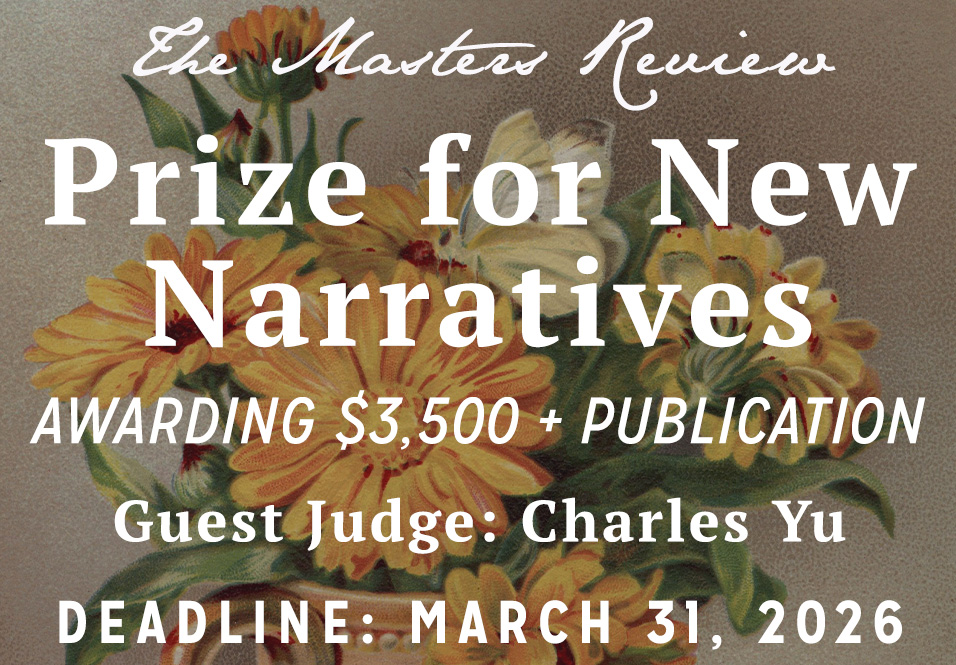
For writers who challenge convention, The Masters Review Prize for New Narratives is calling. With this contest, The Masters Review will celebrate stories that push boundaries and subvert expectations, that experiment with form, voice, and point-of-view, that demonstrate an innovative approach to storytelling. We are not looking for the traditional or the conventional. Instead, we want to read your metafiction, your fragmented narratives, your stories in second person, your nonlinear essays. The Masters Review Prize for New Narratives will make space for unconventional narratives that may not find a home in other journals. Whatever your story, we want to see it in its most daring and authentic form.
Three finalists will be chosen by Charles Yu, author of Interior Chinatown, winner of the National Book Award for Fiction. The grand-prize winner will earn a $3,000 prize along with publication and a two-year subscription to Duotrope. Second- and third-place finalists will receive $300 and $200 respectively, along with publication.
This award is open for submissions from February 2 to March 31, 2026.
“I’m looking for surprise, which can come from any style, subject or genre. I’m looking for the pleasure unique to short fiction—whether it’s a work of meticulously fine-grained realism or conceptually wild experimentalism, or anything in between or beyond. I’m listening for voice, hoping to stumble into a sentence that stops me, compels me to read it again. Compels me to read the next one. I’m eager for stories in new, unexpected forms, or in old, familiar forms made new again. I love when form is intrinsic to substance, when the interplay between the two feels vital and necessary. And finally, I’m looking for the thing I don’t realize I need yet—until someone comes along and brings it into the world.”
–Guest Judge Charles Yu
Need inspiration? Look no further:
“Problems for Self Study” by Charles Yu (Harvard Review)
“Especially Heinous: 242 Views of Law & Order SVU” by Carmen Maria Machado (The American Reader)
“Calculus BC: Final Exam” by Abigail Hodge (The Masters Review)
“The Semplica-Girl Diaries” by George Saunders (The New Yorker)
“A Rogue Planet” by Thomas Pierce (The Masters Review)
“Lust” by Susan Minot (Narrative)
“July 2015: A Compendium” by Daniel Garcia (The Masters Review)
Submission Guidelines:
- The first-place winner receives $3,000, online publication, and a two-year subscription to Duotrope.
- The second- and third-place finalists receive cash prizes ($300/$200) and online publication.
- Submissions of fiction or creative nonfiction must be under 6,000 words.
- While we’re open to hybrid work, The Masters Review is not a journal for poetry. Traditional, lineated poetry will not be considered.
- Images may be included with your submission, provided you are either the composer or have secured the necessary permissions.
- Submitted work must be previously unpublished. This includes personal blogs, social media accounts, and other websites. Previously published work will be automatically disqualified.
- The entry fee is $20.
- Simultaneous and multiple submissions are allowed, though each submission requires a $20 entry fee.
- Writers from historically marginalized or underrepresented groups are invited to submit for free until we reach fifty submissions in this category. No additional fee waivers will be granted.
- If your submission is accepted elsewhere, please withdraw your submission on Submittable, or contact us otherwise to let us know the piece is no longer available.
- We do not require anonymous submissions for this contest, but the guest judge will read the shortlist anonymously.
- This contest is for emerging writers only. Writers with single-author book-length work published or under contract with a major press are ineligible. We are interested in providing a platform to new writers; authors with books published by indie presses are welcome to submit unpublished work, as are self-published authors.
- International submissions are allowed, provided the work is written primarily in English.
- No translations, please.
- All submissions must be double-spaced with one-inch page margins and use 12pt Times New Roman or Garamond font (unless doing so impacts the form of your submission).
- The contest’s deadline is 11:59pm PT on March 31, 2026.
- All entries are also considered for publication in New Voices.
- Every submission will receive a response by the end of July 2026. The winners will be announced in September 2026.
- AI-generated or -assisted submissions will be automatically disqualified.
- Friends, family, and associates of the guest judge are not eligible for this award.
About the Judge
Charles Yu is the author of four books, including Interior Chinatown which won the National Book Award for fiction and was a finalist for Le Prix Médicis étranger. He has also received the National Book Foundation’s 5 Under 35 Award and been nominated for the Humanitas Prize. His fiction and nonfiction have appeared in The New Yorker, The New York Times, The Atlantic, and Wired, among other publications. Together with TaiwaneseAmerican.org, he established the Betty L. Yu and Jin C. Yu Writing Prizes, in honor of his parents.
Editorial Letter Option
If you’re interested in getting feedback on your writing, utilize our editorial letter add-on option. Our response to your submission will be accompanied by a one- to two-page letter from an experienced guest editor, who will offer observations on the strengths of the piece as well as opportunities for revision. Your editor may also offer further submission and reading suggestions, or other comments on craft. A significant portion of the additional fee is paid directly to your feedback editor. See a sample editorial letter.