
“How to Begin A Love Story” will draw you in with its beguiling voice, and keep you reading with its sense of rhythm. Starting from abstraction and generality, it builds momentum and intrigue with playful, complex tone, keeping the reader off-balance and wondering and enjoying. And then the particulars, a story blooming inside the meta-story, the piece working on both levels and in the space in between. I finished it and immediately wanted to read it again. —Guest Judge Charles Yu
Start with a character. The character is like a person, but not. The character wants something it does not already have, which makes it like a person except a person usually wants many more incompatible things all at the same time. The character misses what every person misses, which is perfect understanding, a warmth that knew exactly what was needed, before the person was even a person. Then, bright, cold world. Not-psychic parents. The end of total merging, all the worse for having once known it.
The character learns to cry, just like people do, to get what they want, to get what they once had without needing to cry at all, and soon they learn not even crying works anymore. They want something unintelligible but must use intelligence to get it. Satisfaction depends in large part on cuteness and cunning. The end of cuteness corresponds with the end of being given things for no reason. This is not the beginning of the story yet, though this is most beginnings.
The character wants something they cannot have, and the wanting itself is not enough, the way it can be enough for a person, for years, as they talk about what they want to everyone in their lives and do nothing. The character is not supposed to sit and do nothing, not even a monk, unless the monk during his morning sit-and-do-nothing is fantasizing about how to kill the abbot. The ordinary person’s mind thinks of many things meanderingly, but your character should not have a typical affliction of attention (though you should keep in mind your readers’ many afflictions of attention). Your character’s mind should be as focused as a murderer’s with many years of meditation training.
This is a world that valorizes work, so the character is supposed to take some action to get what they want instead of simply being given it, so as to be virtuous and relatable. Even an attractive heiress needs to work in a story, for respect and love if not for money. To be given everything in a story would be easy to make happen on the part of any creator, which could very well be God’s excuse. An artsy believer might argue that in the choice between a good world and an interesting one, what was chosen was not ethics, but aesthetics. Interest is created by wanting but not having: love interest, we say, only in the seeking stage. Desire, like story, is attraction plus obstacle.
Give your characters attractions plus obstacles, to make them work, to make them relatable, but unlike people, they should not be overwhelmed by many small obstacles that erode over time, but rather a few composite obstacles, conveniently acute, around which the story orbits. Obstacles can come from the outside or from the inside. Obstacles from the outside—often, other characters—are usually there to trigger obstacles on the inside.
In a novel, the characters can keep living for stretches, but in a story, a character should live a condensed burst at a time, the living swift and narrow. A character has access to upwards of eleven chairs, but only one gets any action. And a chair is not always just a chair in a story. Details in a story should take up more space than they occupy in life, that is, they should be symbols. Symbols are the all-in-one microwave/oven/air fryers of precious story real estate: efficient but not always reliable. Even in a story, sometimes a banana is just a banana.
But some things remain meaningful: for example, that the character is a mediocre cook not just because he never got around to it, as people often don’t, but he doesn’t know how to cook because he is rebelling against his father, who is forever trying to get him to cook, to do self-improving things. This is because the father character is worried about the son character, to be at the brain-stable age of twenty-five and still living at home, quelle horreur!, to the father, who values independence, who himself was out and about at seventeen. A French immigrant by way of Algeria, he wants his son to have what he has, to want what he wants, a very simple story of success. Or at least the father, a vendor of luxury fruits, thinks his story is simple because he does not know how to feel feelings, but that is another story. The fruit is also not important here.
Unlike people, characters have no need to wash dishes, water plants, or perform other acts of maintenance. The refrigerator and the closet magically fill themselves; even lunch is an afterthought. Characters are not addicted to the Internet and actually go out of the house so the things they want have a chance of happening to them. Ultimately, what both people and characters want are symbols that allow them to tell better stories about themselves. This is what the father character wants for the son character in this story: not happiness, but a better story, or a symbol for a better story, a.k.a. a real job. The immigrant father is the external obstacle in this story. In a story, people are means to an end.
* * *
Philip, the main character in this story, wants to be a pancake, but his father wants him to be a more sophisticated thing, a crêpe. His whole life he has been a pancake trying to be a crêpe, and he is tired of spreading himself thin. He is sitting at the kitchen table, of solid burnished maple, because it is his parents’ kitchen, it is a symbol of his parents’ small old-timey story of success. He is begrudgingly eating his father’s crêpes, and he is wanting something, he is wanting that feeling back of perfect mergedness, but he is lazy just like his father thinks he is. He is lazy the way any person would be, because he has not yet found the structure of his story.
Being lazy, he is more reactive than proactive. Perhaps his father has just come back from the farmer’s market with spare quarters and says something like, “Ah, how nice, the sound of money jingling in your pockets!” A reporting of facts, sonically. But remember that a character, like a person, never hears just the facts. You have to deeply know what the character hears. Instead of, Ah, how nice, the sound of money jingling in your pockets! he hears his father commenting on the lack of money jingling in his, the son’s, pockets, the money that should be jingling by now, the kind of jingle that friends and foes respect alike. He is hearing his father comparing him to his brother, Jack, who is some kind of marketing whiz, while he, Philip, is stocking Amazon warehouses with no graduate school in sight.
Give your character a backstory: Philip likes the 4am shift, taking the light rail into the city while it’s still dark, he likes the feel of walking in his sturdy industry-standard steel-toe boots, walking up and down the predictable marked aisles filled with boxes to scan, he likes even the feeling of repetitive exhaustion, and he has gotten used to not being allowed to listen to music. He can enjoy it because he knows it is not forever, he has the privilege of working to avoid shame vs. working to avoid starving, and he tries not to think about forever. He had tried it for a year and a half, the office job that felt like purgatory, used his vague liberal arts degree to do something (he still doesn’t understand quite what) about violations of intellectual property. Mostly, he had fact-checked logos and haunted Wikipedia while being underpaid, and it was not even the work itself but something about being in that tall building that made him panic. All those anxious brains overheating together, maybe, the way it was in college. He was tired of brains, and it didn’t feel bad to exchange one low-paying job for another, with a year of millennial floating and tail in between.
But he is hearing that his father thinks he should be ashamed (inwardly, he is ashamed but does not need this pointed out; outwardly, he is angry, rebellious, he has a manifesto against the need to work at all, and he does not know he is lying to himself, but the narrator knows; the narrator always knows). Philip is hearing that this is why he doesn’t have friends, this floating quality of his, and it’s true that he often feels like he is essentially alone, unmerged and behind the times. He hears, “Have you thought about law school?” He hears the story of failure, and this is what he reacts to.
And he reacts as if it were the thousandth time he were hearing this from his father (when it is only the twelfth), he responds with his body as if that were true, walks immediately out of the kitchen and stomps up the stairs to his childhood bedroom, another symbol of failure, and his father who understands nothing of subtext, who has never read “Hills Like White Elephants” in high school, is honestly baffled. The father does not yet know his role is to cause an inciting incident.
Philip has been on a hunt, but he does not know he has been on a hunt. He is on the hunt for a true friend, with very specific criteria: not one who does not care about success at all, but one who is in fact a bit if not a lot elitist, a crêpe kind of person who nonetheless will make an exception for him, who will enjoy his particular pancakeness, because love is the making of exceptions. He is on the hunt for someone who has grown up with the beliefs of his father, but has converted into this other, better person now, a person who could be his true friend.
Of course, because this is a love story, he is also on a hunt for this same friend as love interest. A love interest who accepts your unambitiousness completely is even more validating than a friend who accepts it, since you become part of your love interest’s identity. “Your friends don’t care about you,” his father has said a thousand (twenty-seven) times. “They tell you what you want to hear. Only parents will tell you the truth.” Really, he wants his father to be his true friend. Really, he wants his love interest to be his ideal father. He wants to be loved for essence, not action.
But this is still a story, so essence alone will not work. This is perhaps not the beginning of the story on the page, but it is a true beginning.
Another possible true beginning, for Philip (this is where the mother is important, briefly): He is one of those who actually remembers the golden merging feeling, remembers it more acutely than others, and overwhelmingly feels the loss of effortlessness, like a fish bereft of floating. It is not the breathing of water vs. air that is the most salient characteristic of fish vs. humans, but the fact that fish do not really work; they have no hands. Also, he is an emergency C-section baby: He did not work together with his mother to come out into the world, he did not push or feel pushed but was simply plucked, without pressure or transition, perhaps that is why he cannot choose living. But any story is a speculation.
Not wanting to die is not enough for a character, somehow a character must also want to live, to push into the world, to sled downhill on a winter afternoon, to sip hot onion soup from a packed thermos afterward. Philip has these memories of living with his father, but he does not choose to remember them, but his father remembers, his father who does not understand the unreasonable desire of not wanting to live, his father who wants him to live and have a small child to sled downhill with, a small child to make memories with, even if the child does not remember. So the father gets his child a seat in a coveted one-day Life Accelerator™ workshop, and the father, to get what he wants, goes upstairs and says to his child, you are living in my house, eating my crêpes, etc., facts, all facts, not cute but very cunning (the father was not allowed to be cute for very long so he made up for it with cunning).
The father does not know the most cunning thing of all to say would be the truth, which is that this, too, is a love story, not a power play. Philip and the father both know this, but without knowing they know it. To acknowledge they are in a love story is to end the story, because a love story thrives on the tension of the characters pretending they are not in a love story until the very end. At the end, there is only pure love, which no one wants to read about. But because this is a story, the tension continues. The father gets what he thinks he wants, which is for Philip to go to the workshop, but not what he really wants, which is for Philip to be grateful. Still, the father is, briefly, satisfied.
Philip is a reluctant hero, and reluctant heroes must be pushed, after all, at least in a story.
* * *
The first presentation of the Life Accelerator™ workshop starts with a slide broken into two halves: The left-hand side, labeled the Old Way, is an image of a tiny knight holding a toothpick sword against a giant fire-breathing silhouette of a dragon while the right-hand side, labeled the New Way, is an androgynous knight riding atop a similar giant dragon, now in detailed color. FEED YOUR DRAGONS is the title of the slide, and the leader of the workshop, Eileen, guides them into imagining their own dragons and befriending them.
Eileen, who was a debater in high school, has impeccable posture, talks extremely quickly and opinionatedly and has many things to say about dragons and reluctant heroes and stories and also many exercises for them to do.
Eileen likes to frame things in terms of homeostasis; happiness, to her, is mostly biological, a matter of well-adjusted cells.
Eileen points out the energy unanswered e-mails take up in one’s psychic space: a lot.
Eileen says things like, “Don’t believe your mind. Your mind is a fucking compulsive lying narcissist. Your mind is the Donald Trump of your mind.”
Forget everything you know about your childhood, Eileen says at one point. Imagine you live in a world in which there are no childhoods, there are no such things as parents, you arrive, with your personality, with a way to communicate, and your brains are no more malleable than anyone else’s. A world in which you are responsible for yourself. In this world, who would you blame for your problems?
Similarly: Imagine a world without memories, a world without stories of love. How would you be free to love if you never knew how you were supposed to go about it?
Eileen entertains ideas for apps, such as one called Tender, in which your exes can leave you reminiscences and reviews.
“A soul mate is a luxury good,” Eileen says. “But you won’t waste your life more with one person than any other, as long as they’re not terrible.” She proceeds to expound on polyamory.
Does his father know this is what he signed him up for? Philip thinks.
Eileen has them consider their childhood blueprint of work, a.k.a. the image they most associated with work growing up. He has always liked the dwarves in Snow White, singing as they worked, how effortless it was for them to fill wheelbarrows of glittering gemstones. Perhaps he has unrealistic expectations now, also a romanticization of mining.
Eileen has them consider the difference between a problem and a dilemma: A problem can be solved by external means but a dilemma can only be solved by internal means, a change in perspective. For example, to Eileen’s mother, Eileen’s problem is the problem of success. Eileen’s mother does not care at all about Eileen’s workshops, because success to her is a nuclear family and by this standard Eileen is not successful at all. But Eileen’s mother really has a dilemma: She has to change her definition of success. A dilemma can only be solved by a paradigm shift.
Eileen tells her own story about a dragon: Once upon a time, she hated men. There were good reasons for this, violent ones, but it was a problem because she also wanted very much to sleep with them. She just did not want them to sleep with her. She solved the problem by pegging: Look, a change in perspective.
As the last activity of the day, Eileen encourages a Daoist practice called the dearmouring of the anus. “So you can be less anal,” she says, “going forward.”
Afterwards, she approaches. “You’re Jack’s little brother, right?” Of course Jack would have done Eileen’s marketing, Philip thinks. And of course his father would never have paid for this workshop.
“What was your work blueprint?” she asks.
He answers honestly, about the mining.
“Hmmm, that’s the Old Way,” she says, and Philip desperately wishes he could have been less honest.
“But if that were your relationship blueprint, you’d be good at following instructions,” she says, then—did she wink?
Philip’s insides warm. They are both griddle cakes of desire, but they do not know this yet. Something in him is what she has been hunting for. And he realizes what he has always wanted is not to hunt, but be hunted.
* * *
This is where the beginning of this love story ends. Yet it would be wrong to call any encounter a beginning. The ones who believe in past lives say it takes a thousand lifetimes of almost-meetings to properly rendezvous in this one. And this is the sensical explanation. Those who don’t attribute uncanny connections to the past must believe in something more mysterious, like randomness. But even for the thousand lifetimers: How did that very first not-meeting take place? The old question: how something came out of nothing.
Romance is not the beginning; what we find romantic always has its beginnings elsewhere. Eileen’s and Philip’s attraction to each other is possible only because they meet each other in the middles of their stories. And how is it that Eileen, who happens to like only the frailest of men, meets this one who is supremely frail? There is a deus ex machina in every story, but it is less like God and more like pattern completion. In some moment or lifetime, they were primed, like the rats who during their sexual awakenings were exposed to the scent of cherry blossoms and the color yellow. Ever after, in the long middles, fellow rats in eau de sakura and yellow vests were sexy to them. Beginnings are not everything; they are only essential clues to where we can begin to let go of our boundaries. Love is always the crossing of a boundary, and story is always the creation of them.
Because this is not the first story ever told, it has all the problems of stories, which are the problems of people: believing there are rules a story should follow, just as there are rules a person should follow. A good life does not necessarily follow the rules of stories. If the characters could choose: Do you think they would rather have good lives or interesting lives? The narrator has the same problems as people. The narrator too is not infallible; omniscience is relative. You think at least the writer gets to decide, but the writer, if any good, is also writing from the void. The story itself, at the beginning, does not know if it can be a love story. You can set up all the conditions for love, throw the characters together in improbable circumstances, at just the right times in their lives. But still no one knows.
The beginning of a love story is in fact the beginning of Eileen and Philip being trapped: not trapped in love, but trapped in a story—willingly. Because they believe they are in a love story, they will try to act the way they think they are supposed to act, based on other stories of other loves. They will make up stories about each other, give things up for each other, things the other never wanted or needed them to give up. They will stop treating each other like people, and start treating each other like characters, like means to ends. They will try to reinforce their own stories about themselves, attempt to complete the stories of their childhood. They will want their love to be a symbol and love is not a combination microwave/oven/air fryer. Many other things happen in the middle. You can imagine what you will.
Every love story is supposed to end with love, but it begins with a hole in the heart, a hole in the heart that perfectly matches what another character’s holy heart is hunting for. And yet they must not fall into these holes for each other. Merging is not the solution, because there is no perfect merging after the beginning. The problem is always separation. The problem, after all, is really a dilemma. The character must present with one problem, the problem, for instance, of love, but the problem cannot be solved on the same plane on which it was created. A dilemma cannot be solved by external means, only a change in perspective, a paradigm shift.
Love stories do not necessarily need the characters to love each other. They just need something from each other that they would not otherwise have arrived at on their own. The characters must realize they have only been seeking symbols. They must realize they have been performing the story of love, but now they know this is only a story, and stories are not reality. Stories are shorthand: because life is chaos. Stories are only data structures, a way to tolerate information, to tell us what is worth paying attention to. Perhaps life itself is also just a data structure with beginnings, middles, and ends. One can imagine our lives as entertainment for higher-dimensional beings, except we are both the character and the narrator, and we are making it up.
Like every character in a love story, we must realize at some point we are making it up, though our delusions too are beautiful and they are real. Why not? The difference between the imagined and the unimagined is that the imagined exists now. The act of imagining brings it into being. We loved the story enough to create it, to have it exist.
And yet to begin any love story is to sentence it to death. Things that are not born do not end. At the end of every love story, the characters have to not want to be characters anymore in a story. At the end of every true love story, they become people. To become a person, you have to choose chaos. To become a person, you have to die.
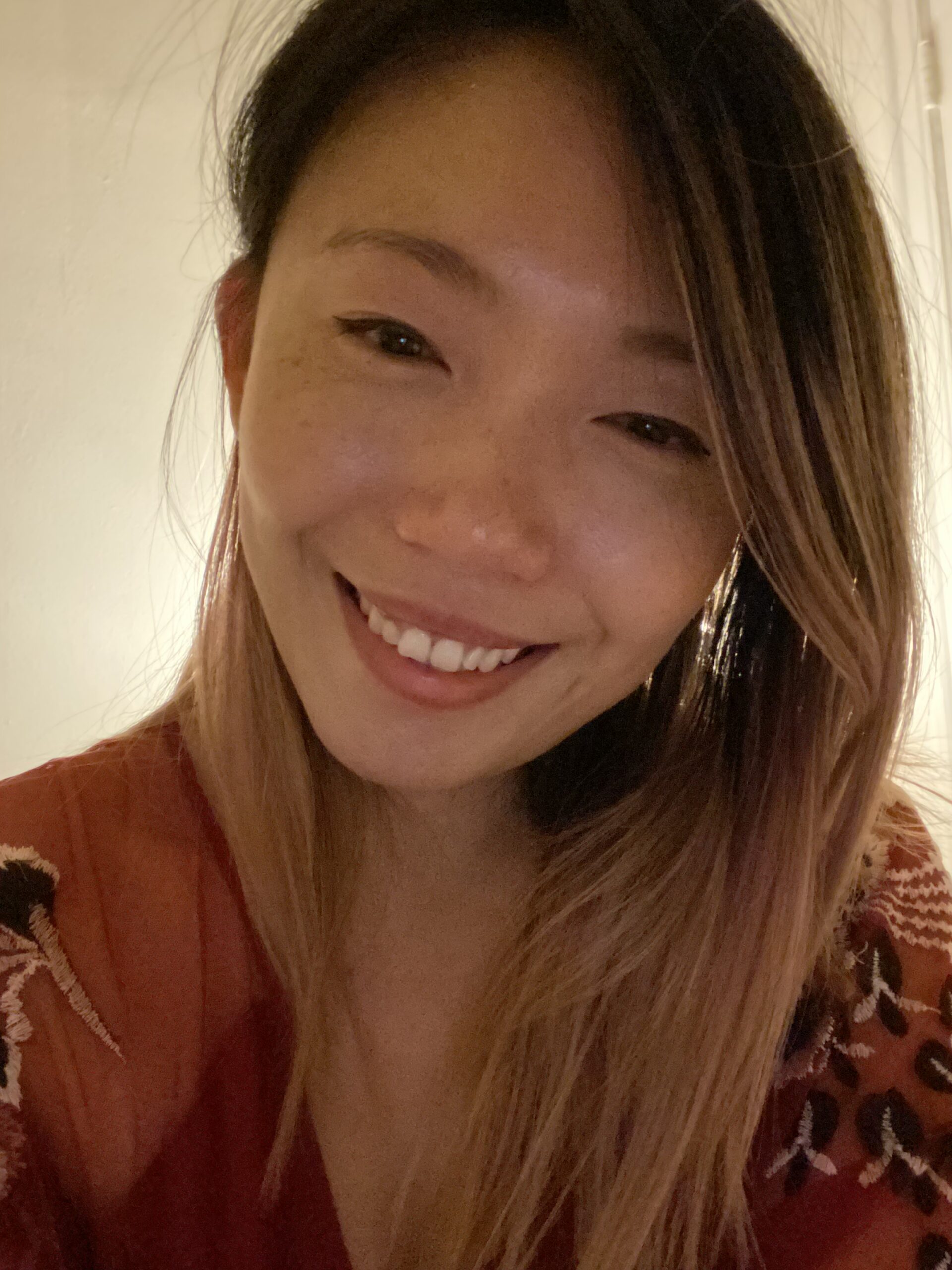 Lei Wang is a graduate of the Iowa Nonfiction Writing Program and the Clarion Science Fiction & Fantasy Writers’ Workshop. She has been published in Ecotone, Meridian, and the New York Times’ Modern Love column, and is a columnist for the science, art, and philosophy blog 3 Quarks Daily. She is at work on her first book of creative nonfiction, Just in Case You Have to Be Here, a secular myth buster on spiritual enlightenment.