
Writers pour so much energy into their craft that sometimes we forget that creative pursuits other than writing can fill us up in other important ways. Here, we’ll look at what writers do when they aren’t writing, and how those pursuits affect the return to the page. This month, we hear from two writers—Sarah Fawn Montgomery and Vicky Ellaway-Barnard—who have learned to let go of the need to be perfect and reignite their creativity, one through gardening, the other through play.
What fills you up creatively when you’re not writing? If you’d like to contribute to the Writers on Not Writing series, email jen@mastersreview.com. We can’t wait to hear from you!
In summer, words come easy, stretches of sunlight and time golden before me. I wake early to head to my office where I write poems and essays, the occasional fiction, watching in delight as the work blooms. The more I write, the more the stories grow, offshoots and tendrils, ideas vining their ways through my days.
But more often, I abandon my writing to tend to my garden. My garden is expansive, beds stretching ten to fifteen feet wide the entire length and width of my house so that on all sides and from every window I witness what I have created. Other garden beds line the driveway so that driving home up the dirt road to my solitary house surrounded by conservation land, is like driving into the lush solitude I have cultivated throughout my lifetime. I’ve built others still so you can walk the grass paths between beds as though entering secret gardens, stepping stones leading to benches and bird baths, garden statues of rabbits and squirrels, turtles and cranes, each a stone creature of one I have seen in my garden, along with coyotes and bobcats, foxes and groundhogs, racoons and fisher cats, hawks and cormorants, once even an otter.
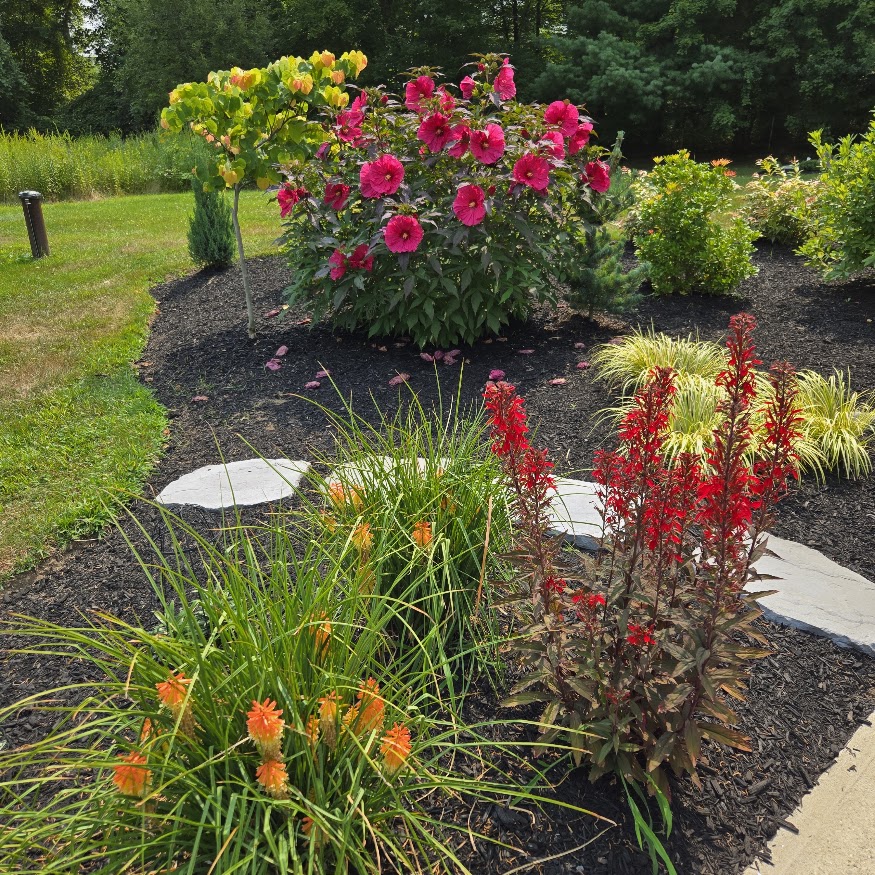 My garden is something I have built over the years along with my writing practice, both reminders that making something beautiful takes time and dedication, trial and error. I have planted dozens of flowering trees that burst to bloom each spring, hundreds of bulbs, crocus, daffodils, allium, and tulips. This means that each winter, after months of darkness and desolation, I have bursts of blooms to light up the landscape. But it is not without failure—squirrels and deer run off with bulbs, wet winters rot others, and some fail to thrive, sending green shoots into the sky that never flower. The same goes for shrubs and trees that fail due to poor watering or fungal rot or inherent ailment. And perennials are short-lived, living just a few years before the natural end to their lifespan. But I like this failure, for it reminds me not to be so hard about my own.
I initially began gardening to develop hobbies other than writing, and reading, and submitting, and the many endless ways writers believe that fixating only on words will help us most succeed. I’d neglected other hobbies to pursue writing and that in doing so my writing began to suffer. So I went outside and put my hands in the dirt, enjoying the halfmoon crescents under my nails and spying wriggling worms squirming beneath the surface. I knew nothing of gardening, found I could name few plants though I could rattle off dozens of literary terms, and books, and magazines, all the knowledge of our trade. But I loved not knowing. I loved being a novice.
And though I learned to garden in order to forget about writing, I found that helping my garden thrive helped my writing thrive. Designing a garden space is no different than designing a piece of writing. In my garden, undulating flower beds move like an essay, small vignettes much like a poem. My garden space utilizes various craft elements like any piece of writing, though the elements are different, comprised of various foundational shrubs and trees, layers of perennials, and colorful annuals to round out the scene. As with writing, I must also work within the boundaries of my abilities, working to understand my gardening zone, my soil composition, my microclimate, and my personal aesthetic much like any writer must discover their voice, their style, what it is they want to say. I love playing with design the way I love playing with words, aiming for contrasting foliage and the balance of red, blue, green, and yellow foliage that provide visual interest to any garden. I love to prune trees, trim shrubs, and deadhead spent blooms much like I love to edit a piece of writing, killing my darlings without regret, for it is a part of the process, and one of the only times in life we can go back and change what no longer serves.
I have always had a restless mind, which is why I was drawn to writing in the first place. Writing is a way for me to understand a mind that darts from subject to subject, that ruminates, obsesses, replays and revises. But as much as writing has been a way to understand this mind, to utilize its imagination and energy, gardening is what has taught me to still the mind long enough to focus, to reflect, to enjoy the process. Gardening has become a kind of meditation, a way to focus on the present moment long enough to get grounded and create the kind of pleasure and ease that writers need in order to work well. There is nothing like a morning spent pulling weeds, listening to birdsong, noticing the way spent blooms have turned to seed that stills my mind, distracts it from worrying about my writing just long enough for the answer to present itself. Sometimes I find the solution in the patterns of nature, the structure of a story presenting itself in the shape of a leaf or the right metaphor for a poem appearing on the wings of a dragonfly. This does not mean that when I discover the solution in the garden that I rush away from tending to this space to put it on the page. Instead, I hope to remember it when the work is done, and I remind myself that that if I fail to do so, I need only return to the garden for inspiration.
Autumn means that my garden is shifting from the abundance of summer into the stillness of winter. But this does not mean there is not much beauty to behold. Bright bursts of crab apple and dogwood fruit like a well-timed fragment in a piece of prose or the subtle punctuation in a poem. Crunchy yellow and brown leaves, and faded hydrangea blooms add texture and contrast to lush green and icy blue evergreens. The red stems of shrubs planted purely for their cheerful twigs remind me of the way they light up a winter landscape. A few lone berries remain on the honeysuckle, reminding me of the fragrance of spring, and the roses and Gaura push out a few last blooms, reminders not to worry about the frost before it has even arrived, reminders to stop and enjoy the moment, however fleeting, rather than rushing to the next season. Some may find this depressing, but when this abundance dies back, it allows me to notice the smaller details that are just as important for gardens as in writing—delicate capped mushrooms, buds already forming for next year’s show.
Perhaps what I love most about this stillness is the way it is acceptance that gardens must quiet in order for new growth to burst forth; I am reminded of the necessity of fallow periods for writers. Like many writers, I struggle during these periods, seedless and idle, desperate for creativity and the joy it affords me. It is impossible these days to escape our culture of productivity, which insists we produce at a rapid pace, as though inspiration and time to work and are easy to come by, so I sometimes fall into the desperate trap of productivity, eager to tick boxes off my To-Do list, to claim that I am a writer simply because I have finished a project.
But gardening has taught me that fallow periods are essential, for every artist needs time to rest, to gather strength, to cultivate ideas and dream. A garden can only bloom in spring if it has time to rest in winter, and so do writers need time to rest. As I put my garden to bed for the season, in many ways I put myself to bed, settling in to hibernate through a long New England winter much like the animals in the woods that surround my forest, each of us tending to ourselves now so that our stories will come later.
Sarah Fawn Montgomery
It fascinates me how my son, at three years old, can be so purposeful and creative in everything he does; how he sees the world not as a series of objects with a clear-cut and singular purpose, but as an adventure in imagination. When we play together, anything goes. We rescue tractors from clifftops; we deliver ice creams to ants; we dance and make music and bake and all of that is made so much more joyous because we’re doing it as bears. For him, play comes before everything else, and everything is improved by play.
As a child myself, thirty-something years ago, the Disney characters I most associated with were the vultures in The Jungle Book. There’s a scene towards the end of the 1967 film where they look at each other and shrug. “What we gonna do?” says one. “I don’t know. What you wanna do?” replies the other. Like them, shrugging was my usual refrain when flung into another playdate, preferring to defer to others rather than speak my mind.
Looking back, I can still feel the fear of that moment of being asked. In all honesty I think I was scared of playing. Scared of having opinions, of suggesting the wrong thing and being ridiculed. Maybe that’s why, when I came to writing as an adult, I was equally tentative. I feared exposing some hidden part of me. Feared being judged for how I choose to play.
I can see this now in how I handled the first novel I wrote when I returned to work after maternity leave. As an ex-Geography teacher, I’d leant into issues of migration, place, and identity—the sorts of topics everyone expected me to write about—and I’d extensively researched the setting, Algiers. But the actual story was hard to describe. It lacked… punch. It lacked me.
A year later, stuck partway into my second novel, fed up with managing real worlds at work and preferring to dive into imagined ones with my son, I turned to short stories as a writing outlet. A short burst of play that could be over before I knew it; before I’d had a chance to get nervous. The first story I wrote, about a woman imagining her husband’s murder, was shortlisted in a competition. My second, about a giant breast that disgorges real food, was too. These stories—and now many more—were so much fun to write. They excited and challenged me, and they certainly weren’t what anyone expected.
Every time I play with my son, he shows me how to think beyond my self-imposed creative barriers, to have opinions, to let the weird out, and to own it. By following his example, I now give myself permission to play, and to not worry about doing it correctly. And when this version of me turns up, anything can happen on the page.
My third novel is bigger and braver than anything I’ve written before.
And I can’t wait for him to read it.
Vicky Ellaway-Barnard
Sarah Fawn Montgomery is the author of Quite Mad: An American Pharma Memoir, which The Atlantic says, “Exemplifies a nuanced approach to life with mental illness” and The Paris Review describes as “The wakeup call that we need.” She is also the author of the essay collection Halfway from Home, winner of a Nautilus Book Award for lyric prose, the craft text Nerve: Unlearning Workshop Ableism to Develop Your Disabled Writing Practice, the flash collection Abbreviate, and three poetry chapbooks. Fathom is forthcoming with the Propel Disability Poetry Book Series. She is the founder and editor-in-chief of Nerve to Write, a magazine for disabled, chronically ill, and neurodivergent writers, and an Associate Professor at Bridgewater State University.
Vicky Ellaway-Barnard lives in Cambridgeshire, UK, with her husband, son and antisocial cat. Her work has appeared or is forthcoming in numerous places, including Cambridge Writers and New2theScene anthologies. When not reading or writing, Vicky can be found surrounded by any combination of cards, LEGO or kitchen utensils, courtesy of her three-year-old. She’s online at www.vickyellawaybarnard.com and on Instagram @vickyellawaybarnard.