
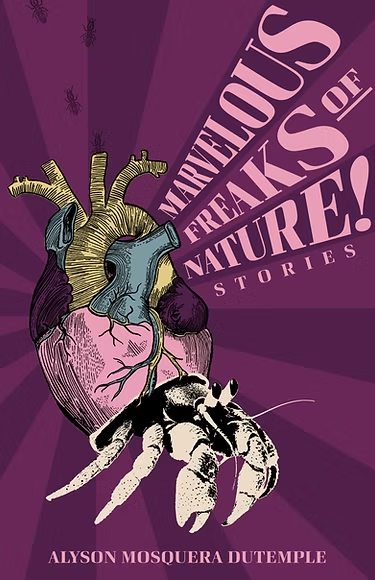
 In Alyson Mosquera Dutemple’s debut collection of short stories, Marvelous Freaks of Nature, characters in transitional moments are scrutinized under a microscopic lens to reveal their freakishness, their capacity for making egregious miscalculations, and also their ability to triumph against the odds. Marvelous Freaks of Nature at times revels in the absurd, but more often than not teases out every little thread of awfulness—the shrapnel of hope in a phone screen lighting up, a confession that doesn’t land, the meaning ascribed to a row of dying trees—and lays these parts bare for us to peruse, as if on an autopsy table, to see what marvelous freaks of nature we are all capable of becoming under enough pressure.
Dutemple’s characters are often wading through the fog of low points, maybe the lowest points, of their lives. They are often acting on impulse or old patterns of behavior rather than reason. Penny gives Mavis a book, aptly titled Marvelous Freaks of Nature! which provides Mavis an odd sense of comfort as she pores over the vulnerabilities and differences that plague the purported “freaks.” Mavis makes one bad decision after another until she hits rock bottom. Only then does she take the first tenuous steps forward, toward renewal, in an arc that sets the tone for the rest of the collection.
What’s marvelous about these characters is their penchant towards undoing. Each section of the book adopts a word from the title, with each “Marvelous” story reckoning with expectations that fail to line up with reality: a man whose internet girlfriend turns out to be scamming him, a child who feels betrayed by the actions of adults exterminating her beloved possums, a woman settling for a man she never imagined for herself, but does anyway because, as her mother told her, “to want is to suffer.”
There is an ebb and flow between connection and crossed wires. Heading off the “Freaks” section is “Everything Must Go,” which follows moody teenagers on a road trip replete with believably faltering, often tender, attempts at connection. The narrator indulges her friend Duck’s despondent march toward a fate that’s been sealed for him by his family’s decision to send him to military school, while unresolved blips of her own past color the journey. The story wrestles with sexuality and consent, and Dutemple’s handling of both characters’ vulnerabilities and motivations softens the bleak outcome when the narrator gives pieces of herself, even her darkest secret, to someone unable to receive it. There’s a point at the end where the mirage begins to shatter, and she sees that she’s alone, and it’s wrenching.
In “Culs-De-Sac,” an older narrator relays an uncanny tale that involves a string of strange misfortunes from her youth. Despite the narrator claiming up front that this is not a fairy tale, the story uses fairy tale cause-and-effect logic to tell a story about suburbia, coming of age, transformation, and danger. The departure from the more straightforward realism of the other stories in this collection doesn’t feel jarring, but is rather a natural avenue for conveying a harrowing, inexplicable story of girlhood. “Saint Nobody,” which follows “Culs-De-Sac,” effectively mucks around in this territory, too, but with religious undertones souring the sweetness of a first crush.
Dutemple is not afraid to end a story on the cusp of possibility, where the characters’ lives could go one way or another, all of their desire and yearning building up to the place where the road forks. Take, for example, the trace of hope in the pregnancy test at the end of “A Hill of Beans,” or the ambiguity in “The Grand Old Duke,” which sees Helene, who went through life trying not to want too much, beginning to walk away from a stagnating relationship.
Both “Three-Season Room” and “Touch-Me-Not” exhibit one of Dutemple’s greatest strengths: building a cyclical narrative that dives into each of the central characters’ perspectives and shows how they orbit around each other. This layered form of storytelling lets the tension in these relationships gradually unfurl in a satisfying way. “Three-Season Room” circles around Charlotte, whose fiancé has died in a car accident that also maimed Charlotte. Through the perspectives of her sister, Shelly, and Shelly’s family, whom Charlotte now lives with, we see how Charlotte’s extended stay, as well as the grief she carries, upsets the household dynamic.
And in “Touch-Me-Not,” Dutemple seamlessly loops in scenes from the past, all the way back to when the married couple—now on vacation with their two children—met. These flashbacks, along with scenes from the children’s lives, are interspersed with the present moment of tension as they become lost during a perilous hike they weren’t prepared for. This is the longest story in the collection, and it uses the space to draw out every fateful misstep in the family’s past and present. Each narrative detour adds context to the disastrous vacation. The wife’s desperate attempts to salvage the trip, which she does with the same effort she put into saving her marriage over the years, allows her to fail to notice as her children make some of the mistakes she and her husband have made over the years.
Dutemple has a knack for imbuing ordinary scenes with grim mortality in lines like, “The two of them are lying flat on their backs, head-to-head like murder-suicide victims or conjoined twins,” (“Three-Season Room”) or “The glow…crossed the center of his body so that he was split at the waist, two sides of a magician’s assistant waiting to be fused back together” (“Everything Must Go”). Each observation or reference mirrors the emotional weight of the story in cutting ways. In “A Hill of Beans,” for example, daycare children are being read Jack and the Beanstalk, and the narrator, struggling with infertility, recalls of the story, “It began with trouble over a cow who had dried up, could no longer give milk.”
With the exception of the stand-out “Three-Season Room,” the stories in the first part of the collection can at times rely too heavily on quirky premises. The collection really finds its stride in the second section and beyond, the more it grapples with subjects that are dire and singularly strange, forcing the reader to sit in the dread and uncomfortableness of these characters’ lives, who are easy to root for in spite of their flaws. For anyone looking to be jogged out of a rut of well-behaved, predictable characters, this is essential reading.
Publisher: Cornerstone Press
Publication Date: October 20, 2026
Reviewed by Abbie Lahmers
Abbie Lahmers earned an MFA in fiction from Georgia College and State University and was formerly a managing editor of Arts & Letters. Her fiction has appeared in Allium, A Journal of Poetry & Prose, Flyway: Journal of Writing and Environment, Barnstorm, and others. She is currently part of the Prudence Island Artist Residency, working on a novel. She lives in Providence, RI, and can be found camping and hiking around New England, and posting wildlife photography on Instagram (@abbie.in.the.wild).