
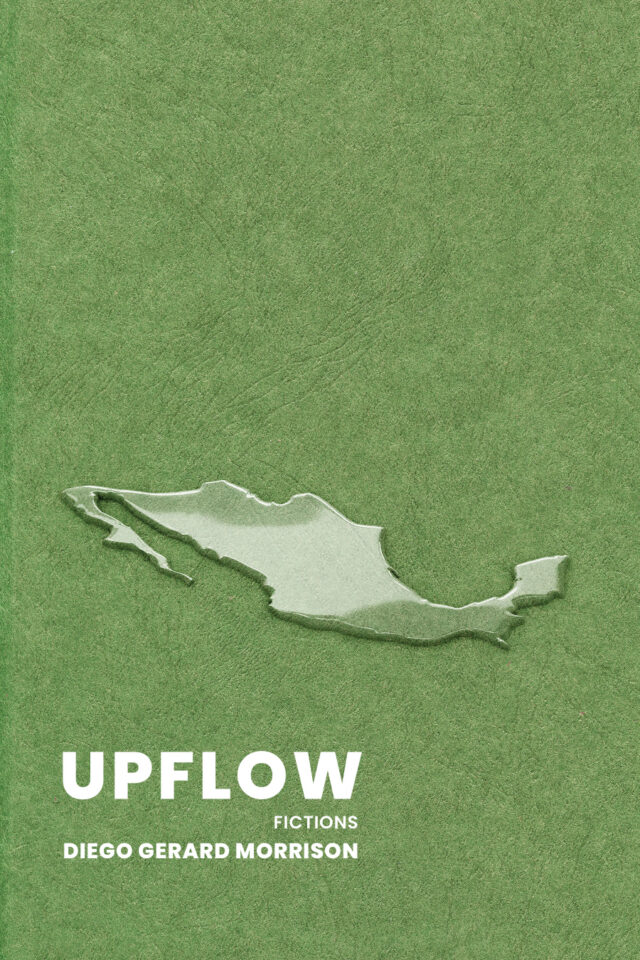
 In Upflow, a short story collection set in the vicinity of Mexico City, Diego Gerard Morrison does something that fiction writers seldom do: He explains what the book is trying to do right at the outset. In “The Water Was Drained,” the story that opens the book, Morrison recounts the disappearance of the lake system on which Mexico City was built and highlights the absurdity of a city that must pump water uphill from its surrounding areas before sending its wastewater back outward. Morrison then tells us to read what follows as a collection of fictions, or perhaps a “polyphonic novel,” tracing the historical movement of water through and around the metropolis.
This note sets the readerly expectation but does not overdetermine it. As one might expect, water flows through the stories as motif, passing through them in almost every conceivable state: rain, reservoirs, irrigation, sewage, drought, flood, drinking water, groundwater, water being pumped, stored, stolen, contaminated, rationed, and redirected. Unexpectedly, however, water also appears as an organizing principle: the movement from one story to the next feels less of a break than a transition, with an image, place, word, or unresolved condition at the end of one often flowing into the beginning of the next. “The Town Crier of Erongarícuaro,” for example, ends with Don Mateo announcing roadblocks across the region due to armed avocado farmers, burned buses, and protests over contaminated rivers. The next story, “Roadblocks,” opens with four travelers driving through avocado country on the Day of the Dead. Such transitions give a sense of continuous current, with material from one story flowing into the next.
Furthermore, longer stories are interspersed with shorter, impressionistic pieces, which vary the collection’s narrative velocity and recall river bends where the current slows down, a moment of closer inspection before tension accelerates again in a new direction. What is more, in cases like “Swallowing Rain,” water makes a more literal appearance: Raindrops are rendered as streams of punctuation marks. As slashes, apostrophes, and other signs accumulate across the page, the prose itself appears increasingly inundated by the storm. Here, the collection’s governing principle is at its most literal: Water does not simply appear within language; it becomes the language vocabulary itself.
Read in this light, the collection’s title extends the same principle. A literal reference to water being forced uphill toward Mexico City, the word “upflow” also anticipates how Morrison chooses his subjects. Drowned land, suppressed histories, waste, disappeared bodies, and the costs of colonialism and state failure are all pushed beneath the surface only to rise up again. “Mausoleum of Water,” for example, follows Colonel Ramírez Ramírez as he searches for his brother, who has disappeared amid cartel violence. At the same time, a reservoir recedes, exposing debris carried up from its depths. As the water is drawn away, what has been submerged returns.
What rises to the surface can be as large as “history” or “violence,” but Morrison approaches these topics through the local, the ordinary, and the everyday. The collection’s recurring figures are farmers, gardeners, food vendors, drivers, rural residents, and other people whose work and routines bring them into contact with water scarcity, development, and violence. In “Expropriation,” the state’s modernization project becomes visible through farmers whose land is to be flooded; “progress” rolls off the bureaucrats’ tongues to justify the exchange of cropland for a reservoir. In “Roadblocks,” cartel violence enters not through kingpins or detectives but through avocado farmers who have armed themselves after criminal groups begin extorting their hard-earned income. “We are working people, humble people,” one tells the travelers. By making such people seen and heard, Morrison moves away from abstract ideas such as a metropolitan water infrastructure, together with all its attendant grand narratives of justification, to bring out the lived realities that are displaced, fraught, or lost through the gaps.
Though the flowing structure is the book’s most inventive feature, it is nonetheless overstretched at moments. The first appearance of the typographic rain rivets the eyes; extended over a page, however, the stream of punctuation begins to feel gimmicky. Why do we need such detailed rendering of five minutes of rain? The flow of the book also feels uneven at times, particularly when its richest narrative situations are underdeveloped. “A Kidnapping,” for example, follows Facundo Fernández, a water-tanker driver through a village during a water shortage. Villagers take control of his truck because, as one explains, they once begged for water deliveries but now know that “if we want any water, we have to resort to a kidnapping.” Comic, threatening, and politically suggestive at once, the story touches on issues of scarcity, informal redistribution, and environmental justice, all of which seem important enough to warrant fuller development. Yet the story dissipates its tension too quickly. It feels cut short before it really begins, a problem one would find again in “Drainage Diver.”
Despite such drawbacks, Upflow succeeds. Water does more than simply recur across these stories but becomes a way of connection and resurfacing, carrying buried histories, neglected lives, and displaced consequences to the surface. What the water regime attempts to drain away, the book brings back into view.
Publisher: Split/Lip Press
Publication Date: Oct 27, 2026
Reviewed by Hantian Zhang
Hantian Zhang is a National Book Critics Circle 2023-2024 Emerging Critics Fellow. His writing has appeared in Prairie Schooner, AGNI, The Offing, and elsewhere.