
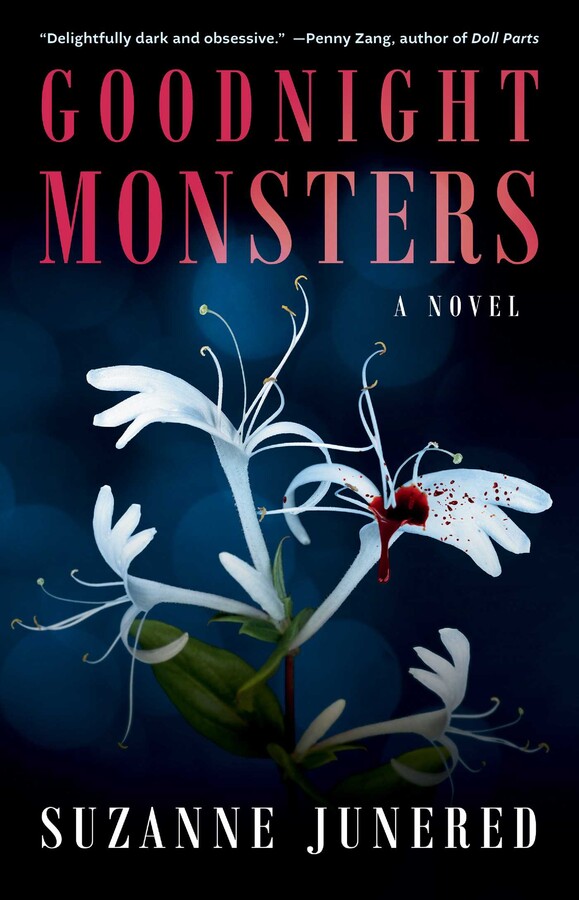
 Suzanne Junered debuts brilliantly with Goodnight Monsters, a psychological horror novel that follows Lia, a housewife in Tennessee suburbia. The mysterious, violent death of her father when she was twelve years old lingers in the dark recesses of her mind, kept at bay. More than two decades later, as the anniversary of his death nears, Lia’s mother and sister are certain she will be overcome by grief, but, as she tells the reader, she’s fine:
This time of year was difficult for me as a teenager, losing my dad the way I did at the end of May. It took me a few years not to freak out around the anniversary of his death, but that has long since passed. I have regained the ease of the season. I wish someone would explain this to my mom because she doesn’t believe me.
In the manner of a very fine person, she has instead contacted a former professor and blackmailed him into giving her a job on the Body Farm, an expanse of land that houses a plethora of dead bodies in various positions, locations, and states of decomposition for the sake of research.
When those around her begin dying, the lines between Lia’s fantasies and reality blur. The reader finds themselves lost in time and place: Is really happening and, if so, when and where? It’s a choice that risks alienating the reader, but Junered manages instead to pulls them closer still to Lia. The reader experiences Lia’s own uncertainty along with her. Neither she nor the reader know what parts of her mind and story can be trusted. And while the violent fantasies bring on euphoria for Lia and her traumatic past is pushed deep down with seeming ease, the reader will (perhaps metaphorically, or as is the case with a certain book reviewer, perhaps literally) read through partially covered eyes, wincing away from the monsters Lia puts on display.
Lia’s voice in Goodnight Monsters is instantly accessible and relatable. Lia speaks like a close friend confiding in the reader. The confessions weave the mundane, the unexpected, and the horrifying in a way that conveys equal importance to each. This narrative voice is juxtaposed with Lia’s deeply unrelatable actions. Starting first with her decision to hide her pregnancy from her husband, best friend, and family, Lia’s choices throughout the novel become increasingly worse. She is a deeply flawed and unreliable narrator, one it would be easy to label as unlikable or unrelatable. The reader recoils from Lia and her cascade of terrible—deplorable! inexcusable!—choices. But if she is so unlikeable, what compels the reader to keep turning the page? Why should the reader continue to root for Lia even as the consequences of her actions seem increasingly inevitable and deserved?
The answer is deceptively simple: This timely novel comes as the world begins to notice how much is being asked of women’s minds, as medicine begins to admit how women’s pain and hardships, especially in pregnancy and childbirth, have been overlooked. It is no accident that Lia’s fascinations and fantasies coincide with some of the biggest physical changes of a woman’s life: puberty, pregnancy, and postpartum. Junered offers these up as if to say, Look what we endure, and asks, What happens when we can’t endure it any longer?
As the novel progresses, the reader is not only faced with the question of what Lia is capable of, but of what they themselves are capable of. As Lia peels away her layers to reveal the monsters within her, it is impossible not to wonder if we are capable of the same, if perhaps our own monsters linger somewhere under the surface as well.
Can our monsters ever be truly put to rest?
Publisher: She Writes Press
Publication Date: September 1, 2026
Reviewed by Chelsea Utecht
Chelsea Utecht is a speculative fiction writer. Her work has appeared in Bluestem Magazine, Shooter Literary Magazine, The Gravity of the Thing, Thirteen Bridges Review, and more. She lives in Sarajevo, Bosnia with her husband, two sons, and former street dog/current princess. More about her writing can be found at chelseautecht.com