
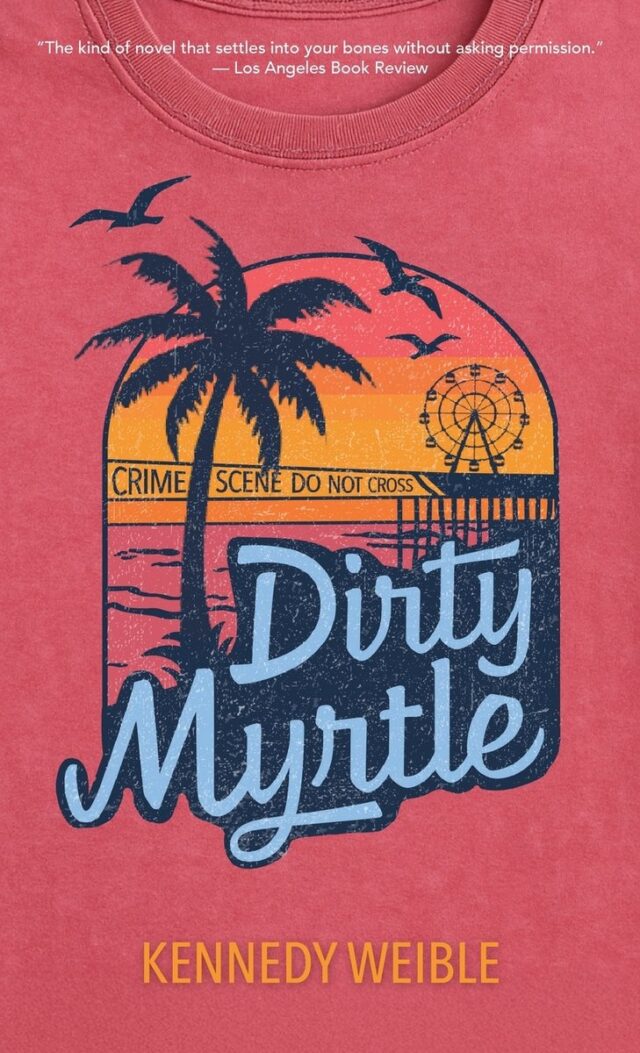
 Kennedy Weible’s Myrtle Beach-centered Dirty Myrtle, which takes its name not from the town’s residents, but from an unpalatable brand of whiskey, is in a constant tug-of-war between playing with cliché and falling victim to it. The book’s locals-centric perspective is fresh and well-implemented, yet as the quirky cast of characters navigate various crimes, conspiracies, heavy drinking, infidelity, resurfaced bad blood, and a comedian’s fateful livestream, the line between playing with tropes and being burdened by them gets blurrier.
The book opens with a hungover Sailor Cassidy waking up next to a woman she just met the night before. The book then moves into an ensemble piece that, across fifteen chapters, centers more than a dozen different characters; including Sailor’s sister, who is ready for a divorce; the cheating husband’s mistress; Sailor’s comedian brother; the police officer who’s sleeping with Sailor’s sister; and the newly returned Jug. Their seemingly unrelated conflicts begin to intertwine when Sailor’s sister is kidnapped after Sailor unintentionally reveals, on their brother’s comedy livestream, that she might be cheating on her unfaithful husband.
Dirty Myrtle is best when it plays with nonlinearity to tie together different characters’ perspectives on shared events. For instance, during the aforementioned comedy pre-show livestream, the reader witnesses the reactions of multiple characters, all of whom have something at stake from the revelation. Other chapters in Dirty Myrtle are also broken into sections in which Weible stays in the point of view of a single character. This structure grounds the reader in what each character does and doesn’t know but is sometimes muddled with too many moving pieces. Yet, each time this technique lands the way it’s intended, it elevates the story.
Weible’s storytelling is strongest when it lets the most central characters showcase their personalities without being weighed down by a convoluted plot. Take, for example, the moments that expose the police officers’ incompetence and the residents’ rash, stupid decision-making. Or the moments when Sailor prides herself on her charm as she sits in an apartment that echoes the disrepair in her life. Weible crafts these characters with a naturalness that makes their voices distinct, memorable, and believable.
When Weible attempts to be too democratic with how many characters receive their moments in the spotlight, he loses sight of what makes the early chapters so engrossing and entertaining. The characters never shed their personalities fully, and the prose never goes too long without injecting dark humor into increasingly dire situations, but it does collapse under the weight of having too many characters who need equal attention. The novel’s most baffling move is when the focus shifts away from the characters we’ve grown attached to in order to showcase the criminals behind the majority of the story’s mayhem. It’s unclear, though, whether this shift in focus is a subversion of genre expectations or a surrender to an overly complex plot.
There are places in which the plots of Dirty Myrtle and Fargo overlap, but it’s unclear if Weible means this as playful or derivative. Weible may also be playing with genre tropes when he writes, “Sailor just knew things,” in order to explain how she intuits connections between characters and events that no human outside of a fictional story should be able to deduce. Is he referencing the suspect who vomits every time she lies in Knives Out or is Sailor assigned this almost-supernatural gift simply for the sake of advancing the plot? Depending on a reader’s familiarity with, and enjoyment of, this particular strand of humorous crime story, the answer may differ. As will the reader’s willingness to look past some of the novel’s conveniences and coincidences.
It’s evident that Weible grew up in Myrtle Beach: He devotes no attention to tourists, he portrays residents so used to the beach they rarely head to the shore, and he renders the small-town dynamics as surprising yet authentic. Like Fargo, this novel respects its characters despite their flaws and quirks. Maybe it respects them more because of these flaws and quirks.
Dirty Myrtle has fun enough characters as well as a captivating enough setting that it—despite its flaws—feels self-aware. The novel takes itself seriously in the right ways while not shying away from any chance to have fun. If nothing else, Sailor is as charming as she thinks she is and Dirty Myrtle is as entertaining as it needs to be.
Publisher: Apprentice House Press
Publication Date: June 9, 2026
Reviewed by Jeremy Mauser
Jeremy Mauser is a Pennsylvania-born MFA candidate in Creative Writing at the University of Alabama. His writing is featured or forthcoming in Sonora Review, Pithead Chapel, New Delta Review, and elsewhere. He is a reader at The Masters Review, an assistant fiction & nonfiction editor at Black Warrior Review, and a stand-up comic who can be found on Instagram @jeremymauserwrites and Bluesky @jeremymauser.bsky.social.