
A mysterious voice takes over the airwaves, the first snow arrives to New England in years, the woodland animals are acting odd, and oh, there is also a multi-state kidnapping and an eccentric proprietor sulking around his abandoned resort. If you told me all these plots could not only be squeezed into an opening chapters, but laid out in a clear, sensible way, I wouldn’t have thought it possible. Yet “The Snag” accomplishes this feat and more, leaving me mildly despondent when the excerpt came to an end. The writing is sharp. The plotting is near perfect. Narrative “fuses” are lit early on, and with a confidence that ensures they’ll go off on precisely the right pages. With a masterful blend of family, parenthood, ecological disaster, inherited wealth, and a tinge of magical realism, The Snag is sure to make a big splash, not if it’s published, but when. — Guest Judge, Nick Fuller Googins
We’ll leave the TV and the radio behind
Don’t you wonder what we’ll find
Steppin’ out tonight?
—Joe Jackson
- Snowparading
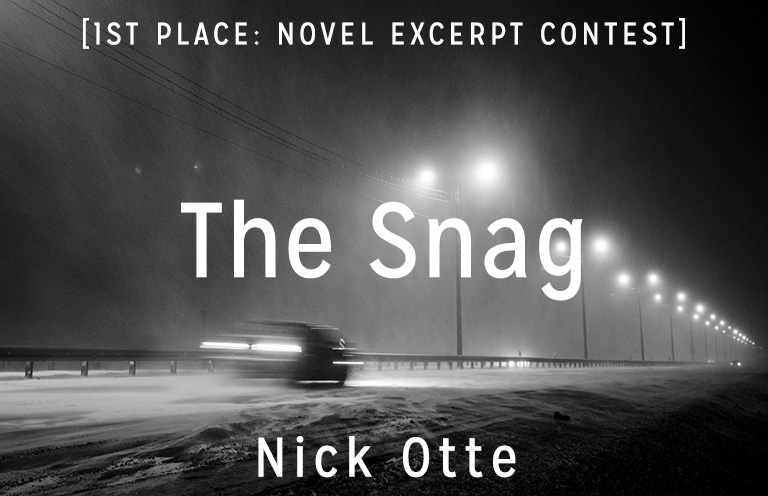
The first real snow Jorie Stoke had seen in seven years had just begun to fall when the voice came over the radio. It spoke in shreds and stutters beneath the hiss of dead-station static, a drowning fist beating against the top of a frozen lake, but soon broke through and smoothed clear enough that Jorie could make out three words repeating without pause or interruption.
“You are invited.”
The voice was warm but exceedingly anonymous; the voice of a drowsy news anchor or a veteran teacher whose mind has wandered from a lesson too often taught. Its recitation of the three-word phrase was staid and rhythmic, and put Jorie in mind of a lullaby. She could feel her eyelids growing heavy, chin dipping toward her chest, hands slipping from ten and two. She’d been awake for nearly thirty hours, just driving, driving, stopping only for gas and whatever she could find that passed for food along the interstate. She hadn’t been able to sleep much in the previous week, either—her mind buzzing with anticipation, making sure all the details were in place, heart racing faster as the chosen night of her departure approached—and now even the suggestion of sleep tasted like rescue.
Glenn was fast asleep in the backseat, nestled beneath a pile of stiff blankets that still stank sweetly of her father’s horses. Jorie had cared for the animals, in her way, though not with the intensity that Toby or Glenn seemed to. She used to watch them, father and daughter, riding and brushing and feeding the horses, feeling herself at a great distance, privately resenting their common affinity, as if they spoke a secret language she could not grasp. She’d tried to ditch the blankets at a rest stop dumpster outside of Oklahoma City, but Glenn had woken up and started to cry, clinging to the fetid fabric with surprising strength. After a brief tug-of-war Jorie surrendered. She used some of her dwindling cash and bought an air freshener that was supposed to smell like fresh pine but smelled more like candied bleach, hung it from the rearview mirror, and tried her best to breathe through her mouth.
The car crested a hill. The snow was coming steadier now, sticking to the pavement. Fat flakes alighted on the windshield, melted against the warm glass, and ran, pixelating the night.
The lights of a ski lodge nestled at the base of a small mountain sent up a firelight glow a few miles ahead. Bald streaks on the mountain’s face where trails had been carved were slowly turning white, probably for the first time in years. Jorie’s sister, Kate, had told her over the phone how things had been changing in the northeast. She’d felt similar changes back home in New Mexico, and of course she’d seen it on the news. Rising temperatures, shallowing lakes and parched riverbeds, seasons becoming indistinguishable, flattening into a marathon summer. But maybe now that was all over with. Maybe the snow was a sign that the world was finally righting itself.
People must be talking about it, Jorie thought. Vermont’s first blizzard in nearly a decade. It might even be national news.
She turned the radio dial, tried another station. The same voice spoke to her through the dashboard speakers.
“You are invited.”
She assumed it was some kind of local advertisement. They’d been getting more and more of those as they pressed north through a string of increasingly quaint towns, all of them similarly decorated with silos and churchyards, rust-eaten husks of cars sinking into front lawns, skeletal barns that looked one swift kick away from kindling. She’d listened to dozens of ads boasting sweetheart deals on backup generators, guns and ammo, water filtration systems. The ads sort of blended together after a while, but Jorie kept the radio on anyway, turned down low. It was good to have voices in the car to keep her company, and Glenn had hardly said a word since they set out.
She felt a sudden, clawing urge to wake her daughter. To hear her voice and look into her big blackberry eyes. Glenn had never seen snow—had grown her six quick years through wavering radiant days of brittlebush and skittering lizards and cloudless nights that echoed with coyote laughter—and Jorie was curious if the alien substance now falling from the sky would scare or delight her. If she did wake up, she would probably have some questions, and not just about the snow. She would want to know why they’d left in the middle of the night. Why Jorie had dragged her from her bed, why she wouldn’t let her speak or change her clothes or pee, why they couldn’t stop to say goodbye to the horses, why they’d taken her father’s car and driven fast, so fast, not stopping, not even when the lights of the house came on behind them and the front door slammed wide open.
Jorie didn’t know how to answer these questions. Not yet. There would be time for all of that later, when they were finally good and gone. Right now, they were still on the way. In-between stations, Jorie thought, and reached for the dial and tried another frequency, but the same voice was there too. Murmuring those same three words. Over and over.
“You are invited.”
Invited to what, Jorie couldn’t guess, but after trying five more stations—all the same—she let her hand return to the wheel.
Glenn was snoring softly now. The sound made Jorie want to climb in back and lie down beside her, even with the stinking blankets. She imagined the two of them, curled up, their breath falling into perfect rhythm, drifting together on the edge of sleep, the world beyond their bodies melting away.
Only a few more hours, she thought. Only a few more hours to her sister’s place in Burlington, only a few more hours until stillness and safety and sleep. Finally.
All she had to do was stay awake.
She knuckled her eyes and fixed her gaze on the twin yellow lines on the road, growing vague beneath a layer of gathering powder.
Glenn made a sound and stirred beneath the blankets. Jorie glanced into the rearview mirror, hoping the girl would wake, hoping she would sleep. When she looked back through the windshield, she saw a moose emerge from the trees and amble straight into the road ahead.
It was far enough away that Jorie had time to slow the car without stomping on the brakes and slamming into the guardrail, but the tires still skidded slightly, drawing lines in the snow. She came to a stop only a few short yards from the animal. It lifted its head and faced her, poised and unmoving in the middle of the road.
It was a massive beast, and old. Graying at the snout and ears. Crowned by antlers that splayed outward like bone carved wings. Jorie had never seen a moose outside of a museum diorama, stuffed and posed before a painted backdrop, and she stared at it with her mouth hanging slightly open, hardly able to believe its size. Its unreasonable closeness. The animal’s marble eyes stared back, lit by the jaundiced glow of the car’s headlights.
Jorie inched the car a few feet closer, but the moose stayed perfectly still, fresh snow accumulating on its back. It took up most of the two-lane road, and there wasn’t room to maneuver the car around it. Jorie was considering leaning on the horn, in the hope that the sound might shatter its trance-like fixation on her, when something else emerged from the trees.
A calf, unsteady on new skinny legs, tracked across the two lanes. It passed within inches of the moose, though the larger animal did not seem to notice. It crossed the road, moving slowly—purposefully, Jorie thought—then disappeared into the dark wall of trees on the other side. Two more calves stepped into the road, following its tracks; one jet black and the other spotted cream and brown. They were in turn followed by a trio of wild turkeys and an opossum—half a dozen joeys clinging to the pale hair of its back.
“Holy shit,” Jorie said, and nearly choked on the words. Her throat was dry, her voice scratchy. She swallowed the warm, syrupy dregs of an energy drink from the cupholder. When she looked back up, the moose hadn’t moved an inch, but a brace of foxes had padded into the road, stepping daintily in the tracks of the larger animals that preceded them. They were all moving in the same direction. It was hard to tell for sure, but it looked like they were headed toward the lights of the ski lodge, which sat like a cooling ember at the base of the nearest mountain.
“What’re they doing?”
Glenn’s voice came soft and groggy from the backseat. She leaned forward, her face so close to Jorie’s ear that she could feel the girl’s breath warm against the side of her face. She hadn’t realized how cold it was inside the car until she felt that warmth.
“I don’t know,” Jorie said. “I’ve never seen animals do that before.”
Glenn’s teeth clicked behind her lips. It was a sound she often made while thinking things over. Jorie realized at that moment that she’d forgotten to pack Glenn’s retainer. Had left it sitting in its case on the bathroom sink. They would need to get her a new one when they reached her sister. If only the animals would get out of the way they could start moving again. They might even get there in time to watch the sunrise.
The clicking stopped.
“Snowparading.”
Glenn ran the two words together, the same way she did when she’d first started to talk. She was late to it, and though Jorie worried over what this might mean, the words did come eventually. When they did, they spilled out fast and fluid, as if she was worried that she might at any moment lose the ability to speak and all the thoughts that crowded her mind would again be trapped inside with no way out.
“Snowparading,” Jorie repeated, and smiled, liking the way it felt in her mouth. “I think you might be right.”
The interior of the car was lit with sudden blue light.
Jorie turned around in her seat and saw a car approaching from the road behind them. Blue lights flashed on its roof, swinging wide through the dark, illuminating the innumerable flakes of falling snow.
Jorie stiffened. Her skin felt tight and alive.
“No,” she breathed between clenched teeth. “No. No. No.”
“Whatsamatter?”
“It’s okay, baby. It’s okay. Just let me think.”
The car crawled to a stop close behind them. Glenn turned around in the backseat and placed a hand on the rear window’s frosted glass.
“Sit down,” Jorie said, a little louder than she meant to. She took a breath and tried again: “Sit down and stay calm, my love, okay? Please.”
Glenn started clicking her teeth again, harder than before, but did as she was told.
Jorie considered her options. She couldn’t reverse without running straight into the car, and in front of her the moose was still standing there, still staring. A rangale of deer flowed behind it, followed closely by a pair of panting dogs. One looked like a stray, ribs visible beneath its patchy fur, but the other was well-groomed and wore a green collar fixed to a leash that looked to have been chewed straight through. More animals followed. Jorie looked for a gap. An opening in the procession big enough for the car to pass through, but there seemed to be no end to them.
“You are invited.”
The voice on the radio spoke the words with the same even cadence, but now Jorie thought she could detect the slightest hint of urgency. Of encouragement.
Go for it. Just go.
Now or never.
Her foot hovered over the gas pedal. They were only animals, after all. Animals that wandered into the road were hit all the time. Just another hazard of living. No great tragedy.
“You are invited.”
She looked in the sideview mirror and saw the driver’s side door of the cop car behind her swing open.
“You are invited.”
The shape of a man trekking unsteadily through the snow towards them filled the mirror.
She gripped the wheel.
“You are invited.”
She took in a breath.
“Pleasedon’t.”
Glenn’s voice came softly from the back seat. Jorie turned and looked into the girl’s wide, wet eyes. She looked so small, huddled beneath the blankets. Jorie opened her mouth to tell her it was all okay, that all would be well, but before she could speak the cop’s face filled the window. His face was old and thin, topographic. He wasn’t wearing a coat or gloves or a hat, and Jorie could see that he was shivering. He tapped his blushing knuckles on the glass and made a circle with his fist, signaling for Jorie to roll the window down.
She let her hands fall from the wheel. On the other side of the windshield, she saw the moose’s eyes flash blue, then darken again before it lowered its head and passed from the road into the trees, following the line of tracks already filling with fresh snow.
- A Peculiar Season
Karl Bellow pulled a half-empty carton of milk from a large industrial fridge, pinched the paper spout, gave it a perfunctory sniff, then poured the contents into a massive metal bowl pre-filled with three different kinds of breakfast cereal—a special mixture he’d perfected over the years.
There were prime steaks and dry aged burgers and racks of lamb and whole heirloom chickens in the deep freeze, not to mention enough canned goods to make a doomsday prepper breathe easy, but all Karl wanted to eat lately was cereal. Sugary, colorful, reliable. It hurt his teeth and upset his stomach, but he didn’t care. It tasted just the same as it did when he was young—before everything changed, before the world betrayed him—and, to Karl, this was a small but welcome comfort.
He swirled the mixture and drank from the lip of the bowl, wiped his dripping moustache with the sleeve of his bathrobe, and carried the bowl from the kitchen through the empty lodge, keeping his eyes down as he stepped over a bearskin rug splayed before the cold, hollow fireplace. The walls were decorated with antique snowshoes and crisscrossed skis. A chandelier made entirely of boiled antlers hung from the rafters of the steepled ceiling. The wall at the north-eastern end of the room was taken up by a single giant window that looked out over the foothills of the mountain, which rose up from the earth and loomed over the lodge. Karl didn’t care for the view these days, and kept the tall, thick curtains drawn. As long as he couldn’t see outside, it was easy to imagine the place alive with the small colorful shapes of people carving downward through the snow, sunlight glinting off their poles and goggles, the ski lifts running swiftly up the mountain’s face, the whole resort filled with lights and laughter and motion. As long as he did not look, he could still pretend that everything was just as it should be.
He carried the bowl into the back office. In the corner were several cardboard boxes, stacked in a leaning tower. He took another sip of the milk, which was quickly staining neon as the cereal’s artificial coloring bled, and set the bowl down on the desk. He dragged one of the boxes away from the others and used a large pair of scissors to open it.
Inside were several hundred brochures printed with the Mt. Bellow Ski Experience name and logo: a bejeweled crown perched askew atop a snow-capped mountain. The brochures had been printed on heavy cardstock; full color gloss, no expense spared. They were supposed to have been distributed and displayed in every rest stop and hotel lobby in the state. But that was before. Now they just sat inside their boxes, utterly useless, until Karl and his scissors got to work.
He pulled half a dozen brochures out of the box, fanned them out on the desk in front of him, and started cutting.
* * *
The little mountain on the side of I-91 wasn’t much to look at before Karl came along and built his resort twelve years earlier. Just another unremarkable peak among peaks. Thickly green in summer, white-capped in winter, briefly ablaze with searing color in fall. A place where locals came to sled and hike and camp on occasion when all the good spots were full up. But Karl saw potential in this particular mountain that no one else could. He had traveled to the world’s most famous peaks, skied the most expertly groomed slopes, stayed in the most state-of-the-art luxury resorts with their fabulously appointed rooms and fine dining, but to his mind, all of these places had lost sight of something important: the snow. The simple, unadorned purity of it. The way it fell from the sky with unhurried grace and covered all things; the way it seemed to speak when it shifted or crunched underfoot; the way it made the world seem bright and full and so much more alive. The snow was what mattered. The rest was merely fashion. Unnecessary distraction. And the snow on that little mountain was the best that Karl had ever seen.
When he first laid eyes on the spot, he had experienced what he suspected mediums and mystics might call a vision. He saw a place where people of all kinds could come to experience the singular joy of gliding down the side of a mountain with the sun on their faces and a good hot meal waiting below. A place free from unnecessary frills where everyday folks could visit without breaking the bank. Though Karl himself came from money, and lots of it, he did not believe that such an experience should be reserved for the super-wealthy alone. The billboards he erected on the side of the interstate echoed that sentiment:
Visit the Mt. Bellow Ski Experience
Where Anyone Can Be King of The Mountain!
He’d purchased the land from the state, lent the mountain his name, and began construction using money he’d inherited after his mother, Pamela Bellow, died when her private jet crashed into a field outside of Sheridan, Wyoming. Pamela had made her fortune back in the eighties after purchasing the patent for a particularly realistic type of synthetic doll hair that quickly became the industry standard. Within a decade there was hardly a toy on earth with hair or fur or fuzz that wasn’t using Bellow synthetics. Later on came the wig and toupee divisions and the experimental grafting and transplant procedures, but for Pamela, the heart of her business still resided in providing joy to children. She only wished that her own children had turned out as well as her products.
Ever since Karl, her youngest, could crawl, it had been clear to her that he was entirely lacking in the same ambition that had made her a captain of her industry. She thought him an aimless, distractable child who seemed interested in nothing at all except getting loaded and tumbling down the sides of mountains with his buddies. He was the undisputed lazybones of the Bellow family, and Pamela had no intention of allowing her hard-earned wealth to fall into his lap. But after Karl’s father succumbed to liver cancer in ’92, and his sister Jeane drowned off the coast of Mali in ’09, and finally Karl’s brother Freddy, who was widely seen as the natural heir to the faux hair empire, swallowed one too many sleeping pills shortly before Pamela’s demise, Karl was the only Bellow left.
He’d been hanging out in Vale, making snow angels with some friends he’d made while bumming around The Alps the previous season, when the call came in. All at once, at the age of thirty-three, Karl Bellow was an orphan and, according to the news, the country’s sixteenth richest person.
After discussing how he might manage the family fortune with several of his mother’s lawyers and most trusted financial advisors, he’d settled, against their avid protest, on investing in the one thing he truly loved in life. The board suggested that if he wanted to move into the vacation space, why not invest in a resort in Hawaii or Costa Rica or Cabo San Lucas, places where people were always sure to go, places with clear water and pleasant weather. Karl refused to consider it. The suits could protest all they liked. The money was his now, and though he didn’t claim to know as much about business as the rest of his family, he did know one thing: peace was the ultimate product. For his mother, peace had come in the form of creepy little dolls. For him peace could be found wherever there was snow.
Within a year the resort was finished. The kitchens were stocked, the fireplaces were lit, the lifts started running, and to everyone’s surprise, the place did well. Not financially, of course. Karl was operating the Mt. Bellow Ski Experience at a significant loss. But word got around fast, and soon people were coming from all over to spend time on his charming, improbably affordable slopes.
Every afternoon when most of the visitors kicked off their boots for a break and a bite, Karl would walk the floor of the lodge—smiling at the families, shaking hands, making sure everyone knew that they were welcome. In those moments he felt, for the very first time, that all of his easy wandering through life had actually led him somewhere. In this place he had finally become someone. Someone important. Someone who had spent far too much time taking, but now had something to give.
Then, one day, it stopped snowing.
* * *
That first winter, everyone assumed it was just an anomaly. A peculiar season. Something they’d talk and laugh about the following year, when winter again arrived as it always had. Then another year passed, and another, and though there were a few odd flurries further north, most of the state, including Bellow’s mountain, remained warm and disturbingly green.
The resorts in Ludlow and Stratton and further north in Stowe turned on their big machines and made their own snow for a while, but it was never enough. They leaned into summer activities—hiking, camping, guided ATV runs, they even set up massive water slides on the bunny slopes—biding their time, but after a while they simply couldn’t pretend anymore. They had to face facts. What they were experiencing wasn’t a fluke but a new normal. The snow wasn’t coming back. Financiers pulled out, reliable season pass holders found other ways to spend their money. Restaurants and hotels shuttered and hundreds of people in the surrounding towns lost their jobs. In no time the resorts came to resemble empty castles perched among the trees. Places that had once been the seat of great power but were now nothing more than ruins.
Only the Mt. Bellow Ski Experience remained stubbornly open for business.
Karl kept up payments on gas and electric and water, the last of which had tripled in price over the last few years as things got worse, but the people had stopped coming. He instructed the board to redirect funds in order to keep the resort running, and as a result the company soon began shuttering whole divisions. He sold the family’s other properties, giving up the place in Lake Como, the pied-a-terre in Brooklyn, the penthouse in Tokyo, and even the cottage in Wyoming where his mother had lived as a girl, combing the brittle hair of hand-me-down dolls by candlelight.
With the rooms vacant, Karl took up residence in the honeymoon suite, and with the staff gone, there was no shortage of ways to occupy his time. He rode the mower, mopped and dusted, made little repairs as needed, but no matter how much there was to do, he still made time at least once a day to walk the floor of the lodge. There were no longer any hands to shake or smiles to collect, but he walked the floor anyway, bearing the silence as best he could, the lonesome king of his very own mountain.
* * *
Karl leaned back and slipped the scissors into the pocket of his robe. His hand ached. He flexed it, opening and closing his fingers until the ache was replaced by the staticky sizzle of pins and needles. He didn’t know how long he’d been at it, but the box on the floor beside him was empty, and the light behind the curtains had changed.
On the desk in front of him were hundreds of glossy, full color paper snowflakes. They resembled the kind he used to make in school as a kid. The kind his teachers would use to decorate their classrooms before winter break, his favorite time of year. He always tried his best to make each one of them unique, the way that real snowflakes were said to be unique—no two alike, not even in a snowstorm—but eventually his mind would wander, and his hands would move on their own, making the same patterns over and over again.
He stood and stretched vociferously, then lifted the big metal bowl to take another sip but stopped when he looked inside. The milk had darkened to a muddy, all-colors-at-once brown, and the cereal had turned bloated and soggy. He set it down, grabbed a step ladder from the storage closet, and went to hang his handiwork over the entrance to the lodge.
It wasn’t likely that anyone would stop by—no one had in months—but just in case anyone did happen to come along, Karl wanted them to see that at least someone remembered that it was winter. Then they might feel that same feeling he had felt when he was young, and the first snows began to fall. That feeling that something was ending, but that at the very same time something new was about to begin.
He carried the snowflakes to the broad front doors, pushed outside, and stood barefoot on the massive custom-made welcome mat.
He blinked.
He rubbed his eyes.
Shook his head à la etch-a-sketch, trying to clear his mind, make sense of what he was seeing.
He wondered if perhaps he’d slipped into a dream. If his body was still in the back office, sleeping face down on top of the cut-up brochures. That would explain why the world outside the lodge’s front door now looked much the same as it did in his dreams. Not green but white. So white it was almost blinding.
But if this was a dream, that wouldn’t account for the cold. The quick, enlivening sting on his cheeks and bare ankles. In his dreams he often reached towards the snow, but he could never touch it. He could see and hear and even smell it, but he could never feel a thing.
The scissors were still in the pocket of his robe. He pressed his palm into the sharp edge of them until he could feel the skin break. The pain was bright and immediate, and when he closed his fist, he could feel the warmth of his own blood flowing between his fingers. That warmth sent a message through him. Clear and true.
Not a dream.
He dropped the paper flakes from his other hand, reached out, and felt the cold, weightless touch of snow against his skin. He stepped forward, hearing the subtle but unmistakable crunch beneath his bare feet. He stuck out his tongue. Snow fell across it, melted on contact. Cool moisture ran down his throat, deep into the core of him.
He began to laugh. Tears gathered in the corners of his eyes. He had kept the lights on, kept the place in decent shape, but he had never really believed that things would change, or that the world would return to the one he recognized. All that time he had been performing hope, not feeling it. Not really. Not for years.
But now here it was. All around him. Falling in the air. Swirling at his doorstep.
Headlights flashed as a car pulled off of the snaking white interstate and turned up the access road that led straight to the lodge’s empty parking lot.
Karl shielded his eyes and watched the car’s slow approach, his heart quickening. It wasn’t until it was nearly beside him that he saw that the car had a peeling decal of a badge and the word Sheriff written across the side.
The giddy grin he’d been wearing fell from face. He cinched his robe close against the wind and racked his brain for what recent offenses might earn him a visit from the local authorities.
In the early days after the snows stopped, Karl had gotten himself into trouble on several occasions. He was drinking too much and had more than once caused a scene at one of the nearby bars in Easton, the closest town. But he hadn’t been down to town in ages, and the drinking had mostly stopped. The hangovers had gotten in the way of his work around the resort, and now his only real vice was his sweet tooth.
When the driver’s side door of the car opened, an elderly man that Karl recognized as Trip Tomlin, Easton’s septuagenarian sheriff, emerged and started toward him, hugging his thin arms against his even thinner chest.
The man looked as though he should have retired years ago, but Karl knew firsthand that he still had some power hidden in his seemingly wilted frame. Karl had taken a swing at him once when he was drunk. Why he’d thought this was advisable in the moment, he couldn’t remember. All he knew was that his fist had missed its mark. He vaguely recalled seeing the much older man’s sizeable knuckles headed in his direction, and after a dim interval, he’d woken up on the floor of a holding cell with a hellish headache and the taste of blood in his mouth. Trip had let him go after he’d slept it off a while. Hadn’t said a word about the altercation, or admonished him, or warned him off stepping foot in his town again. He’d only given Karl a long look up and down as he slouched from the cell. A look that Karl felt conveyed only one thing: pity. He felt in that moment and still felt now that he would rather take a hundred blows to the jaw than see that look pointed in his direction again.
The old cop climbed the steps toward him. The wind had scattered the paper snowflakes, and the cop stood on one of them, shivering. He wasn’t wearing any boots.
“Evening, Karl.”
“Trip.”
Karl was about to remove his hand from his pocket and shake the sheriff’s hand when he remembered that it was covered in blood. It wasn’t anything incriminating, but still, a bloody hand felt like something that ought to remain hidden from a man in uniform.
“Some weather,” the old cop said stiffly, as if the comment were required.
Karl shook his head.
“I just can’t believe it. I didn’t think—I thought maybe…” he trailed off, afraid that if he said more, he might begin to cry. And he didn’t want to cry. Not in front of a guest.
“As far as unbelievable things I’ve seen today, this snow is coming in about third place,” the cop said.
Karl was about to ask what he meant, but he held up a quivering hand.
“Listen, I can’t get through to the station. Some asshole is jamming up the radio, keeps telling me I’m invited to a party or something. My phone isn’t working either. You have a landline here, don’t you?”
“Sure. I still pay the bill. Not that anyone calls.”
Karl peered around the old cop at the cruiser. Snow was accumulating on the windows, but he could make out the vague shapes of two people: one in the backseat, the other in the front. The one in the front seat looked quite small.
“Found those two in a car that was reported stolen last night,” the cop said. “Stolen in connection with a kidnapping.”
“You’re kidding,” Karl said, though he could see by the look on the old man’s face that he wasn’t.
“Lady in the back there says she’s the kid’s mother, but I can’t confirm that until I reach Clara at the station.” The sheriff cupped his hands and breathed steam into them, then rubbed them together. “Strange part is the car was stolen in New Mexico.”
“New Mexico,” Karl mused. “That’s quite a drive.”
“It is.”
The two men stood in the doorway a moment, snow gathering on their shoulders and the tops of their heads, staring at the shadow shapes inside the car.
“So,” the sheriff said. “How about that landline.”
“Of course.” Karl hooked a thumb over his shoulder. “It’s in the back office.”
The sheriff didn’t move. His teeth chattered behind pursed lips.
“Heat’s busted on the cruiser,” he said. “Been that way for years. Didn’t seem worth fixing all that time, but well, now…” he trailed off.
“Okay,” Karl said, not quite following.
“What I mean is, I can’t leave those two in there. Sorry to impose on you like this, Karl, but, we’ll all have to come inside.”
Karl felt his face go warm.
He stepped aside to reveal the open front door of the lodge. Snow was slowly drifting inside and melting on the hardwood floor.
He stood up straight, cinched his robe tighter, breathed deep.
He knew exactly what words to say next:
“Please, make yourselves at home.”
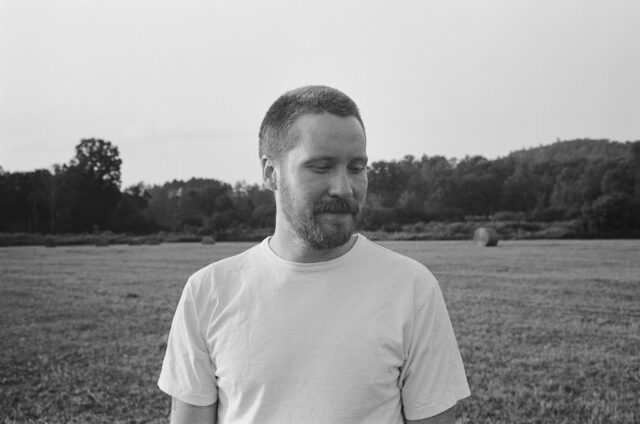
Nick Otte’s writing has appeared in Boulevard, Electric Literature, i-D Magazine, Arts & Letters, The Baltimore Review, Words Without Borders, and elsewhere. He earned an MFA from The City College of New York, and currently teaches writing at Baruch College. nickotte.com.