
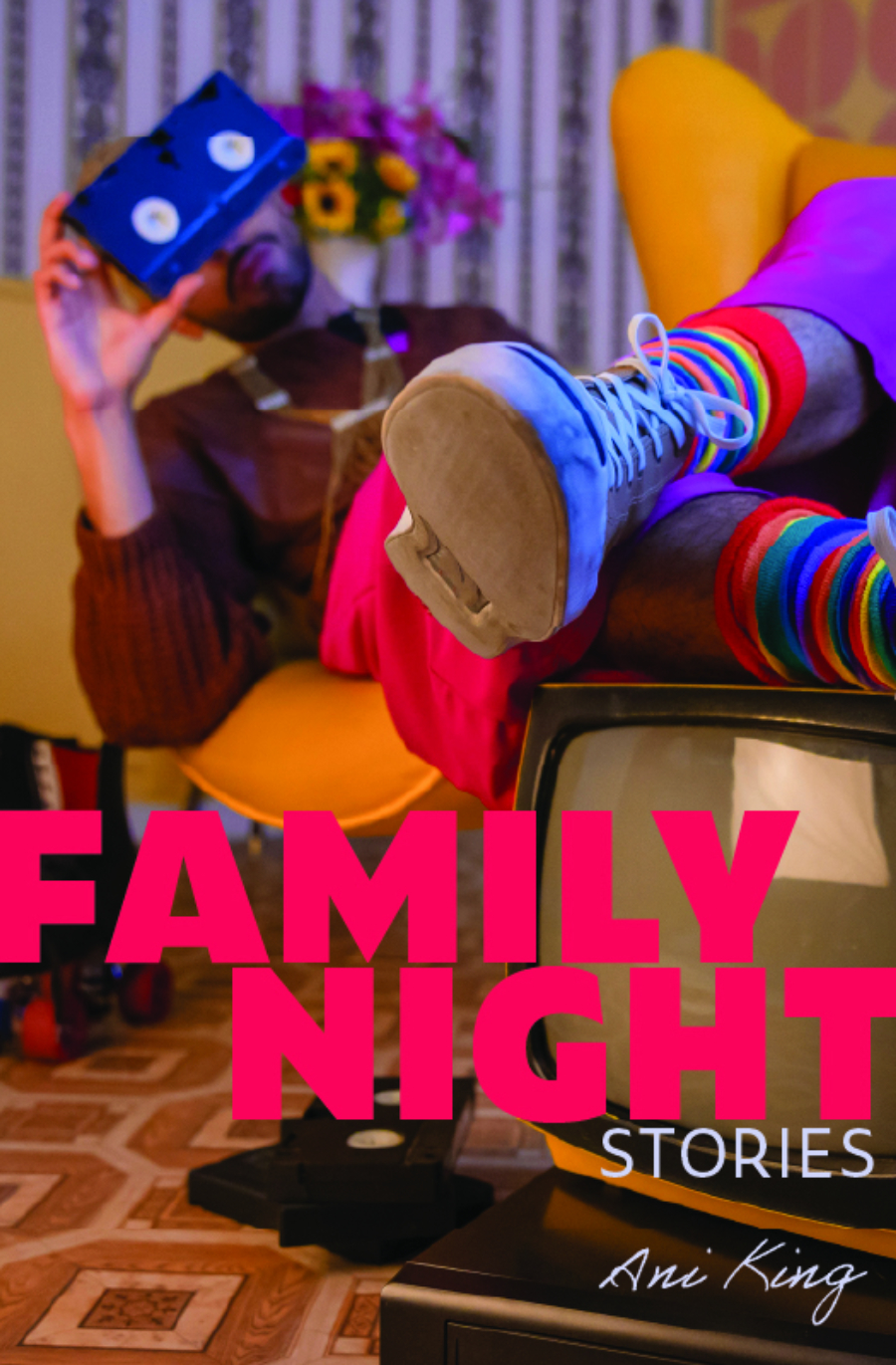
 In Family Night, Ani King assembles their collection of flash and micro-fiction, with each piece centered around family and identity—and especially where the two clash. There are stories about motherhood, sexuality, puberty, growing up, gender-identity, and more. While the book has an occasional piece of realistic fiction, it mostly weaves in and out of magical realism and surrealism, playing with the conventions of literature and the reader’s expectations. Even the length of the pieces subverts expectations, and the short works of prose often feel more like reading through a collection of poetry.
The book opens on “Mother-Mother, Wasp-Mother.” The story is told in second person, putting the reader into the perspective of the sixteen-year-old narrator who has been left behind by their mother—whether for good this time or just off with another lover is left unclear. The narrative details rituals that are used to bring back the Mother-Mother: “So you sing along with ‘Free Fallin’’ and ‘More Than a Feeling’ like they are incantations that will bring her home…you burn her cigarettes like incense on the edge of the bathroom sink.” But once the trailer has been papered with eviction and final notices thick enough to be confused with a wasp’s nest, it is the Wasp-Mother that comes to take care of everything. This story sets the tone and expectations for the collection, preparing the reader for both a closeness to the narrators and an ambiguity that is theirs to decipher.
The collection shines most when King leans further into the experimental. For instance, “Chicken Tikka Masala for Lovers” begins as a simple recipe with a list of ingredients. Alongside the ingredients are modifications for John, now crossed out, and new ones have been added for the upcoming date. This recipe tells the tale of a failed relationship in the crossed-out modifications and a relationship just on the cusp of beginning in the additional notes. It creates a beautiful image of the ebbing and flowing of one’s life juxtaposed to a constant comfort: food. The instructions follow the preparations for the date and through to its conclusion, suggesting hope after the closing of a relationship’s chapter.
Another common element in this collection is that of folktale and myth. The reader meets mothers who have turned into mermaids, an aged unicorn who will be cast off now that it has become inconvenient, werewolves who shift genders, and more. “The Minotaur’s Wife Makes a Map” is another second-person narrative, this one paired with a maze. At the center is the Minotaur, and after each short section of story, the maze reappears with another X, the point to which the Minotaur’s wife has gotten in the maze, either for exploration or escape, before she is pulled back to the center. “The Minotaur’s Wife Makes a Map” paints the picture of an unhealthy relationship, but one still filled with love. It becomes quickly apparent to the reader that the Minotaur and the maze are both metaphors. It is disappointing, then, when the narrative tells the reader blatantly and repeatedly that this is so: “and the maze is mostly a metaphor, and the metaphor is probably an obvious one.” It is, and it takes away the satisfaction when it is given away rather than feeling earned.
It is easy at first for the reader to project themselves on the characters, especially with King’s use of second-person POV throughout. However, many stories are so specific in their experiences, that pairing these experiences with the second-person narration instead feels alienating. Even some of the stories told in first-person feel like the reader is missing out on some of the pertinent information needed to feel an emotional connection or even to understand the narrator’s thoughts, actions, or the world around them. This specificity suggests that there could be something in this collection for everyone. However, between the pieces that happen to resonate, there will be sections of confusion, sections of not being in on the backstory.
King relies on repetition to set the tone of many of their pieces. In “Mother-Mother, Wasp-Mother,” parallelism marks the passage of time beautifully (“June—always rain…July—less rain…August—never rain”) and the reader uses this as an anchor in the otherwise stream of consciousness. Similarly, “Music Our Mothers Made” is punctuated by “our mothers were” at the start of each paragraph until the switch at the end as the collective mothers shift as one, creating a feeling of the repetition of similar lives lived, similar mistakes made. Often the repetition is so beautifully employed that it pulls the reader through and guides their attention to the carefully crafted themes. However, the repetition of such themes and topics, as with the reliance on myth, throughout a whole collection runs the risk of feeling monotonous in places, even too familiar.
It is refreshing to see a collection of bite-sized fiction that can be consumed in brief moments as with poetry. However, that’s how this book would be best consumed—in small moments here and there with space between. While there are certainly strong moments within the book, the stories run the risk of feeling repetitive and too familiar after reading for a long stretch. If picked up now and again, hopping around as the desire takes you, there is a lot to like here.
Publisher: Mason Jar Press
Publication Date: October 20, 2026
Reviewed by Chelsea Utecht
Chelsea Utecht is a speculative fiction writer. Her work has appeared in Bluestem Magazine, Shooter Literary Magazine, The Gravity of the Thing, Thirteen Bridges Review, and more. She lives in Sarajevo, Bosnia with her husband, two sons, and former street dog/current princess. More about her writing can be found at chelseautecht.com