When we think of teachable stories, we often reach deep into the rucksack of the literary past, pulling out classroom-tested stories that have worked their way into the canon. While there is obviously a ton to learn from these pieces, contemporary short story writers are also completing strong work built upon teachable literary foundations, while also finding fascinating ways to advance the form. In this space, we’ll highlight some of these more modern stories and explore a bit of what they have to teach us as we continue to do our part to push literature forward.
Introduction
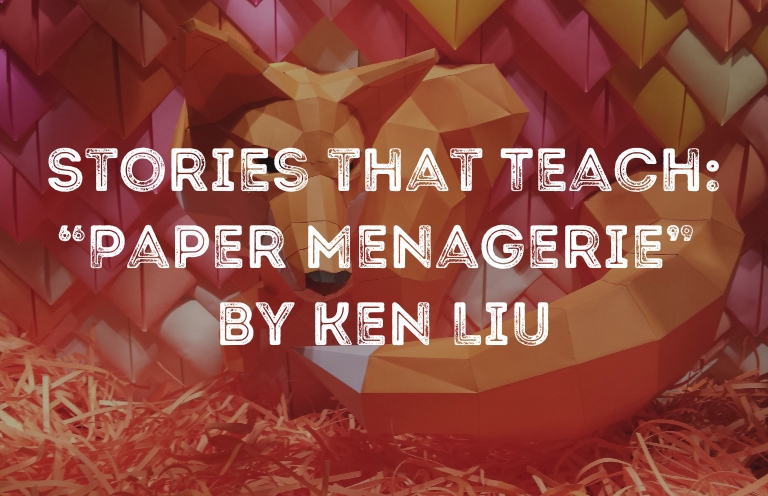
In “Paper Menagerie” by Ken Liu (published online in Gizmodo after sweeping its award season), we meet Jack, a mixed-race young man who struggles to come to terms with his Chinese mother and his own mixed identity. When he was a child, his mother had imbued old Christmas paper into living origami, building animals that came to life. This magic seemed normal to Jack right up until a friend came over to play, sporting Star Wars action figures and straightforward American popularity. The ensuing blowout, and subsequent school shaming, leads Jack to lean hard toward his American heritage, pushing aside his mother’s culture for a desperate attempt at whitewashing. He puts away the toys, ignores his mother’s attempts to speak to him, and functionally walls off that part of his life; even her sickness and subsequent passing do not stop him from living his own life and ignoring the menagerie and much if not all of her place in his memories. But eventually, he finds the menagerie again, and he unfolds his former favorite tiger, Laohu, to find a letter that his mother has written him in her native tongue, finally allowing her to reveal herself to him in all the ways she so desperately desired.
The Basics
This story is written in first-person reflective, although for large swaths of the story we’re in something almost like a present tense; the reflective voice leads us from moment to moment, but once we’re there we sit with the narrator as he was at the time, seeing his childhood awe at his mother’s paper magic, watching his middle-school frustration with the friend who downplays his animals and turns the force of school against him, and even staying with him for that collegiate wish to be away from his mother while she is actively dying in front of him. That reflective narrator allows us to skip through time, following the throughline of the menagerie and the mother. This thematic intent is perhaps shown most obviously by the fact that in-scene, we see the mother sick, and then we get narrative summary of the death, the dad’s condition worsening, finding the menagerie once again, all the way up until two years later when (harsh as this is to say) there is another reason for the mother to matter to our narrator. Our scenework is almost always built around a set piece that captures much of our focus: the wrapping paper that makes Laohu, the hospital room in which his mother tries to convince him to remember her through the menagerie. Much of this story is focused on language, on the various attempts that we make to communicate with those around us, and so the plot is necessarily pushed through dialogue and the places where the mother doesn’t know how to speak to Jake or where Jake doesn’t want to hear what she has to say.
The Control of Time and Awareness
I talked about this in my “Basics” section, but the way that we wrap through time and attention here is a huge lesson for us as young writers to take away from this piece. Ken has clear thematic intent, and wastes no time or page space in straying from it: Everything that we see in here is related to those larger beats, to the menagerie that reveals his mother and to the many ways that the mother cannot reveal herself. Each of our scenes are built around those concepts, and all information we’re given serves those thematic purposes. We learn plenty of things about other people, the dad in particular, but the story is careful to circle consistently around the ideas that animate it. (I feel like that’s a joke, because of the animals being animated, but if it is it sure a weak one…yikes.) Everything else in the story exists in service to those concerns; we meet Jack’s significant other, Susan, as part of his life outside his mother, but her largest contribution to the story is to find the menagerie again after the mother’s death. Our throughline is the menagerie, is the struggle of comprehension and of culture, and while we built the humanity of our character’s lives around that, we never let the reader forget where the true focus of the story lies.
The Magic
While this piece won all the genre fiction awards in 2012, the magic built here doesn’t play by tightly built fantastic rules. Although the menagerie is central to this story, the role of magic itself is incredibly tiny: There is magic, it only seems to exist in the town where his mother was raised, and once she’s passed the magic disappears except for how it relates to the Chinese Festival for the Dead. So, there are some rules, but this story has no interest in stopping to explain how and why it works, nor how often or how much magic exists in this world—although interestingly enough, as we’ll discuss in the next section, it does make sure you can’t simply read the magic as a metaphor; it absolutely does exist here. The who and why and how and all the rest is irrelevant, and the magic functions in relation to the story. This plays closely to what we’d often consider strategies of magical realism, but I’m not especially interested in forcing definitions. Far more important for us as writers is to see the breadth of options that exist in front of us, and to make sure that we’re using the pieces we build into our story in service to the story that matters to us. That can be done incredibly well with deeply described magic systems, with magic that imbues every moment of the story, with character- or plot-based uses of it, with magical realism, or with no magic at all.
Ending with the Mother
The penultimate section of this piece finally allows the mother to speak, as our narrator has not allowed her to do for so long. Dead for two years, a moment of boredom finally allows Jake to consider her again, on Qingming, the Chinese Festival for the Dead. She has written him a letter inside Jake’s favorite of her living origami, and to make sure she was precise in her verbiage she’s written it in Chinese. Once he’s able to find someone who can translate it, we dive fully and entirely into the mother’s tale, straight-up reading the letter she wrote. We learn who she is, where she came from, how the magic works, all the things she wished to be able to communicate to her son, and also the incredible pain she has endured from his shutting her out.
As a writer, perhaps the most important lesson to learn from this technique is that it doesn’t lead us to some crazy-dramatic turn or sudden stunning plot reversal. We understand from the beginning that the main conflict between Jake and his mother is about racial identity, his in trying to present as American and hers in watching her culture derided and ignored. Her letter changes none of that, and while it certainly presents added context to her life and her magic paper-folding, there is no sudden discovery that she was anything other than what she had always presented herself to be. The emotional heft is in her inability to be understood, not in having failed to understand any one thing in particular, and Liu’s willingness to let that guilt sit as simple guilt rather than as a narrative shock is a necessary reminder for all of us in the power of quiet observance. The epiphany that Jake takes from this letter is equally understated, as it must be: he is ashamed in front of the person who read him the letter, and he is now willing to hold onto Laohu and therefore the memory of his mother, but there’s no large change that he can make. She is gone, and his life is on the path that he’s chosen for himself. All he can do is go home, and so he goes home.
Another technique that jumps to the forefront for us as writers: I find it particularly interesting that in finally getting to use her voice, the story also uses her letter to explain pieces of the story that Jake has assumed but not been sure of—most specifically why the paper menagerie didn’t move when he found them again (“Perhaps whatever magic had animated them stopped when Mom died”; yep, apparently). These questions didn’t completely need answers, but in taking the time to justify and explain, we step away from any possibility that the reader scans those early magical moments as simple metaphor. In a certain story, maybe that doesn’t matter, but the menagerie is perhaps the one thing that Jake will always have of his mother, and her history is intertwined with a town known for those magical creations. They are not a metaphor, they are not symbolism, they are not childish whimsy; they are hers, and the memory of them is his, and that deep character trait is asked, discovered, and acknowledged explicitly in the piece exactly because it is the defining character trait that Jake will hold onto of his mother. Finding those moments, and choosing which of them hold power in the story, is an essential act of building character.
The Language
I’m not going to belabor the point, but I’m always interested in how writers choose to incorporate secondary languages. Here, Liu mostly gives us the Chinese without translation, with only a couple exceptions (“This is called origami” is the one that comes to mind). In the third paragraph of the introductory sentence, we see the mother speaking without translation: “‘Kan, kan,’ she said, as she pulled…” This feels even more relevant here than in most stories, as the central thematic element of the piece concerns communication, translation, and understanding. Moreover, we’re seeing in this lack of translation the mother’s inability to translate herself, and her not speaking English is at least one of the pieces of the rift between them. So at least for this piece, the presentation of language creates larger character, plot, and theme beats for the reader to catch subconsciously. As always, the lesson is: Make your choices intentionally. Make sure that your story is given complication with every writerly technique you employ.
In Conclusion
I love this story for its embrace of both the mystical and the straightforward. The magic is used in service of a clear conflict that doesn’t need to be anything more than it is, because it’s so devastating in its simplicity, in its clarity, in its (as much as I hate pulling this string) relatability. We have moments of true wonder, such as with the origami, that are treated as wondrous because of their humanity rather than because of their magic or their uniqueness; it was his mother doing a thing for him that made him as a child fall in love with Laohu and the other animals, and it was the memory of her actions that will continue to connect them into the present moments.
by Brandon Williams