
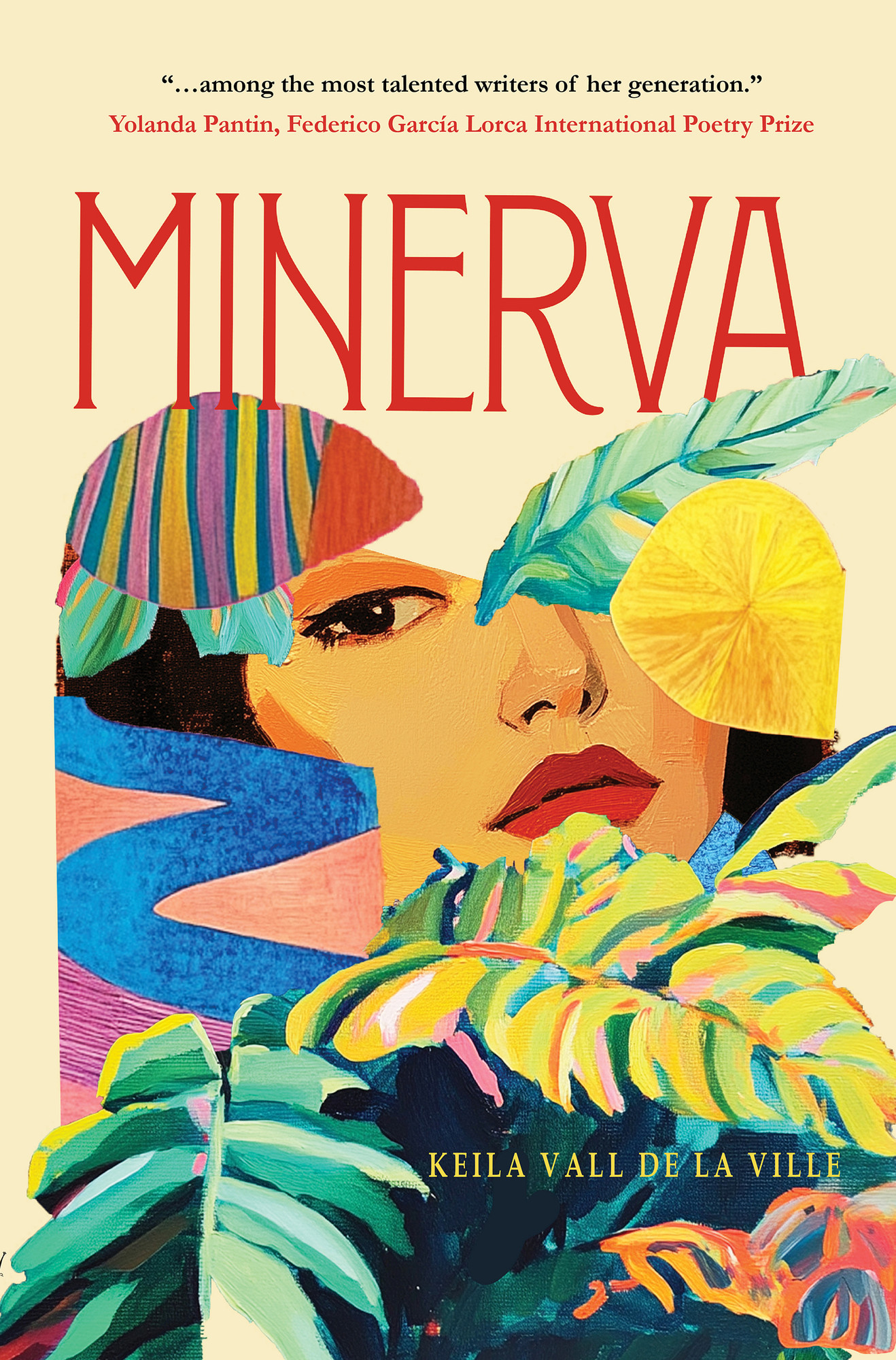
 In her second novel in English, Keila Vall de la Ville tells the story of Minerva, a girl and then a young woman who spends much of her early life in Caracas, Venezuela trying to figure out how she fits in her family among her parents. This three-parent household is made up of her mother, Lissa, the boxing-former-dancer and seamstress; Di, one of her fathers, who is a zen college professor with a past colored by political upheaval; and Martín, her other father, who is a theater art director, muse, and occasional dramatic persona called La Mimí. Early on in the novel Minerva says, “The first person plural pointed to uncertain entities. It was a labyrinth of possibles. My parents and I formed fickle sets. I orbited them. Cut across the sets they formed…I had to step out into the margin of the margin to tell this story.”
Minerva grows up within this unconventional family in the political upheaval of Venezuela. She aspires to not just dance, but to dance on the stage of the theater her family has been closely connected to. But she is first forced to stay away from the theater and then, ultimately, flee the country when the violence that threatened her father extends towards her. In Madison and then New York, she continues to dance, but also begins posing naked for aspiring artists. She sees a connection between these two activities, finding a bit of herself in each of them.
Though the book’s description hints at the loss of Minerva’s mother as an inciting incident, Minerva didn’t need the promise of drama to work. Instead, it is a novel comfortable in its own sort of stillness. It succeeds by lingering in everyday moments and challenging the reader to do the same.
At its core, Minerva is a modern Bildungsroman. However, there is more nuance in the characters than the genre has historically presented; the reader is not faced with the flat, cruel characters one might expect from the Bildungsroman, nor do they meet the dashing suitor or steadfast friend—there is neither pure kindness nor malice. The narrative evokes unexpected reactions for the reader: anger or disgust at Minerva’s closest companions, sympathy for those who would do her harm. Minerva, too, has this nuance. While the reader won’t agree with her all the time, they’ll find they are always on her side nonetheless.
Minerva spends much of the novel ruminating on who and what she is in relation to her race, ethnicity, sexuality, and even her own humanity. However, in search of certainty, she fixates on her only certain blood relations (her mother and her despised maternal grandmother) and searches for which of her fathers is “more of a dad than the other.” Instead of finding “real” family as one might expect from the genre, Minerva faces more nuanced questions of what it means to be a family when her own doesn’t fit the mold.
Minerva is not told linearly. The narrative jumps between what feels like the present—Minerva’s time in the United States sewing pillows for a yoga studio, posing nude, dancing—and her upbringing in Venezuela. In narrating her life in this way, Minerva also describes the perception of time within this novel:
“Di says that this progressive, cumulative line we call time is sheer fiction. All in our heads. He says time isn’t a line. It’s circular. Me, I think time is origami. This corner, this moment, meets this other one, that one, and when they form a shape, you enter a tunnel. The crane lands in an uncertain, often surprising place.”
The reader drifts along the edges of this origami, following Minerva’s train of thought as her mind wanders in moments of both stillness and upheaval. In one scene, Minerva may comment on a character the reader has yet to meet, only to move back to some pivotal moment in Minerva’s life.
The writing in this novel is beautifully, poetically compressed. There is a clear intentionality throughout that encourages the reader to pause and ponder diction and playfulness with syntax, though they’ll still want to keep turning pages late into the night. The symbolism in this novel, too, is expertly executed. At one point, Minerva holds her first pair of pointe shoes—she wants to hold them in reverence, but Lissa knows that they must be destroyed if they are to serve their purpose. Poor young Minerva is pained through this process of bending, soaking, and stomping her beloved first pair of pointe shoes, and begs her mother to stop, but the reader understands that the only way to go is through adversity, both in terms of the softening of her pointe shoes and the formations of Minerva herself.
There are places in the novel, however, in which this compression falters and the language expands jarringly (take, for example, the description of Minerva falling and scraping her knee that goes on for paragraphs and paragraphs, or the dragging description of her carrying groceries). So much of the novel is infused with clear intentionality that these moments interrupt the flow and may cause a reader to lose sight of the chapter’s purpose. By the following chapter, though, the narrative falls back into gorgeous imagery and slight ambiguity that invites the reader back into the story, forgiving, if not forgetting, those brief faltering moments.
In Minerva, identity is less about finding oneself than it is about forming oneself. The characters, especially Minerva, have agency. Plot doesn’t simply happen to them, which makes them each dynamic, even if they’re only briefly on the page. The novel asks hard questions about family and self that don’t have a single correct answer. Whether or not Minerva finds them for herself, this novel will leave you thinking about your own answers.
Publisher: Regal House Publishing
Publication Date: April 28, 2026
Reviewed by Chelsea Utecht
Chelsea Utecht is a speculative fiction writer. Her work has appeared in Bluestem Magazine, Shooter Literary Magazine, The Gravity of the Thing, Thirteen Bridges Review, and more. She lives in Sarajevo, Bosnia with her husband, two sons, and former street dog/current princess. More about her writing can be found at chelseautecht.com