When Ranya and Maggie go on a “meet the parents” trip to Maggie’s near-perfect family home in Joshua Tree, there’s a sense of foreboding from the moment they get in the car. With every sentence in “Banshee,” Lila-Rose Beckford creates mounting tension until an inevitable, I-told-you-so collision that has the power to either bring the couple closer together or completely collapse their relationship.

The trouble starts when I’m late picking up Maggie. 7:48. How 7:48 is late when she said “seven-ish” is beyond me, but Maggie is unyielding in her interpretation of time, of rules, of me.
“God damn it, Ranya,” she hisses. “Now everyone’s going to be asleep by the time we get there.”
“They go to bed before eleven?”
Her glare is less explanation than accusation. Of course. Larsson family values: puritanical bedtimes, identical bowls of oatmeal before sunrise. A whole clan of Margarets, red hair and perfect noses, none of them Maggie at her best.
Birdie launches forward from the back seat to deliver a damp kiss. I accept it. Maggie doesn’t. She wipes at her cheek with two fingers.
Traffic is a snarl. Then the city opens up, a warm exhale down the boulevard. She hums along to the radio, finds the harmony automatically. Neat, pretty, the kind of voice an instructor would label “placed.” Not raw. I want the crack in her throat, the scream she never allows.
We hit the freeway. I accelerate. Reckless, she says; polite, I say.
She says NPR; my music’s too loud, too angry. She watches the road like she’s grading my driving in red pen.
“Did you download the map?” she asks.
“I have it right here.”
“But is it downloaded? There’s no reception by my dad’s house. You have to think of these things.”
Her father’s house. A minor myth we’ve been orbiting all week. A lonely Joshua Tree bungalow, glittering pool despite the drought. The Larssons: early to bed, early to rise, early to judge. I wouldn’t bring Maggie to meet my parents. They’re old-country homophobes who think love is a luxury and made sure I knew it. But here I am, driving straight into hers.
I want a cigarette so bad it’s like the craving is an animal in my throat. She made me quit last month. She went on strike, basically, and withheld her mouth until I stopped. I breathe in the ghost of it, the smoke still faint in the leather seats.
I switch lanes. Too aggressively, for real this time. My rear tire clips the lip of a pothole, and the truck comes down with a noise like a gunshot.
We pull over. The shoulder is a narrow refuge. Maggie sighs, long, operatic. “This is exactly what I was worried about.”
“Potholes?” I’m already pulling the jack from behind the seat. “Very specific anxiety.”
She doesn’t answer. The lesson is obvious: She is right, and the universe has the manners to confirm it.
I swap the tire with the spare. My hands are black with grease. Birdie stands sentinel by the bumper. I tell Maggie we’ll fix it properly in the morning. I tell my blood to cool.
The highway goes from gray to navy. In the passenger window, my face is hard, my jaw set. I look like a criminal.
“Please slow down,” Maggie says. “We’re on a spare.”
“For ten more miles,” I say. “Then it’s Larssonland.”
She presses her lips together. She’s swallowing entire arguments to spit back later, fully formed and sharp.
I pull off for McDonald’s. Maggie doesn’t want anything. She watches me house a double cheeseburger with disgust.
“I don’t know how you stomach that shit.”
We pass a billboard where a smiling family holds reusable grocery bags like Olympic medals. “That’s going to be my dad,” she says, soft, traitorous. “He’ll want to know how you feel about water reclamation.”
“I feel it should be reclaimed, by all means.” I wipe my hands on a napkin, grease making Rorschach blots on paper. “But I’m not doing debate club at bedtime.”
“He’ll just ask questions.” She looks at me. “We ask each other questions.”
“That’s not what you do. You issue citations for sport. You’re litigious.”
She exhales. “You’re the only person I know who takes a muffler off and calls it a personality.”
“You’re the only person I know who has a problem with it.” I shrug. I’m too tired, and if I talk, the wrong thing will come out—and the rest will follow.
The highway unfurls into night. The cabs of other cars glow like lightning bugs. Birdie nudges my shoulder from behind, sighing into my neck.
We get there just before midnight.
* * *
Father Larsson’s house is all clean angles. Low roof. A pool in the back lit turquoise. I wonder how much it costs the desert to pretend it’s an ocean. I see my parents’ apartment, the heavy curtains, saints on fridge magnets. I feel ungrateful and relieved in the same breath.
Inside, the place is asleep. Even the AC hums discreetly. We shoulder through shadows with our luggage, the wheels on her suitcase doing a guilty rattle. Birdie bounds ahead and hops onto the couch, hopeful.
“Shh,” Maggie says with her entire body. Her fingers snap and Birdie slumps to the rug, a circle of dog that takes up exactly her advertised space.
We unpack. She has pajamas that match each other but don’t match her, stripes and buttons. Dresses I’ve never seen her wear, flowy things that drown her lean body.
I crack open my backpack and pull out what I always pull out. Black T-shirts, a sweatshirt that smells like my truck, a Ziploc bristling with kibble and treats. I’ll wear the sturdy cargo pants I have on now and these shoes that can survive flash flood or fire, whichever gets here first.
In the half-dark, we whisper the fight we’ve carried all the way to Joshua Tree. She draws circles with her arguments. The things I’m not: organized, punctual, properly aspirational. “It’s not that you don’t have a career,” she says. “It’s that you don’t seem to want one.”
“I’m finishing my master’s,” I say. “I’m bartending to pay for it. I’m tattooing for fun.”
“You’re finishing your master’s the way people say they’re almost done with a novel,” she says, and I see her future self reporting these lines back to her sister.
“You sold your car,” I say, “so I drive you to everything, but I’m the one destroying the world.”
“I sold my car to make a point about public transit,” she says.
“I know,” I say. “I drive the point around.”
“You took the muffler off.”
“I like the sound better,” I say, and we both know I mean it even though that reason wouldn’t survive her family’s dinner table.
“You don’t take care of yourself,” she says. “You don’t make lists.”
“I can’t believe you want me to be a bullet journal,” I say, and we almost laugh, but the smile dies fast.
She rubs her temples. “I’m tired of being the only adult in this relationship.”
She’s one year older, and I think I want to choke her with it. “Why even bring me,” I ask, “if I’m failing quality control?”
“I love you the way you are, Ranya.” She stares at the pool light warping across the ceiling. “I just want this trip to be perfect.”
I think a thousand true things I don’t say. You are ruining this trip, Maggie. I’m starting to think you will ruin all of them.
I think about my parents, old-world and iron-shut. The way my mother pretended I’d never said the word girlfriend, as if silence could wash it off. A stain that would eventually surrender. How I had the balls to disappoint her. How Maggie is too much of a coward to bring home a bartender.
Instead, I say, “I’m taking Birdie for a run.”
“It’s late,” she says. “And you don’t know this area. It’s weird.”
“She needs to shit and I need air,” I say, fitting the leash over Birdie’s head, her entire body wagging.
“I wish you didn’t run at night,” she says, and because she looks sad in the way that makes me want to forgive everything, I kiss her. On the corner of her mouth, because she doesn’t like to kiss me before I’ve brushed my teeth. She turns into it and then away like she wants to save it for later. “I’m going to get ready for bed.”
* * *
Outside, the air is frigid and dry. I think about stashing Birdie in the truck and heading back toward the Valley—depriving perfection of an audience. Instead, I run.
Maggie says I’m finally taking care of myself. Says it like a gold star. She doesn’t like it when I run at night, though, because she thinks the dark belongs to men or to accidents. It also means we don’t really have sex anymore. By the time I get back, she’s too tired or I’m too sweaty. I’m not as frustrated as I should be.
Birdie’s collar jingles an accompaniment. I don’t see another house for a stretch—just Father Larsson’s place islanded in desert and, down the road, only one dark bungalow with a yard gone to sand. My headlamp throws a nervous beam. I run until my blood warms.
That’s when the brown dog appears.
It’s out in the road, a static thing, its back arched like a question mark. I slow my pace. The dog turns its head toward my light. Its face is wrong. Not just scarred—revised. A chunk of its mouth gone so it can only snarl, like someone punched out the possibility of neutral.
“Hey there,” I say, in dog diplomacy. Birdie goes full porcupine, hackles up. She presses herself against my calves.
A white dog steps out of the other yard and becomes a problem instantly. It’s quicker than the brown one. Its movements aren’t wild. They’re practiced. Square headed, heavy-jawed. Built for damage.
“Excuse us,” I try, absurdly. “We’re just gonna get out of your way.”
I back up and the dogs stay. For a long second it’s a stalemate I hope is mutual respect. Then I turn, just slightly, just to see how much ground I could take. The brown one ghosts forward, giddy at the excuse to stretch its legs, and nips my ankle. It doesn’t draw blood, but it asks for it.
I whirl, shout. It hops back two steps, so light-footed it almost looks like flirting.
We’re only a couple blocks from the house, close enough to have a chance. I start the slow retreat, facing them. The white one glides to our left, circling, interested in Birdie specifically. The brown one plays me from the front, waiting for the moment my eyes go somewhere else so it can go for soft parts. We do this dance down half a street. Each time I shout, the brown one slinks back, then angles in like my performance isn’t quite convincing.
I am losing ground I have not surrendered. I am yelling with less and less voice, more rasp. Birdie gives the white dog a bark that pulls pride out of me like a thorn. She looks small and heroic. A bad epitaph.
I try to be clever and fail. I fake left and take one hand off the leash to grab at a rock and realize I don’t have three hands and the rock is too heavy and these fucking animals are smarter than me.
The white one darts. Birdie charges it with a new growl, not wasted on mailmen or motorcycles. The brown one takes the opening, runs behind me quick, low, aiming for the tendons, the part of me that would make me stop moving forever. I spin on instinct and kick hard. My foot connects with ribs. The noise is a hollow instrument.
“Go!” I scream, hoarse. “Back off!”
The brown dog hesitates, reading weakness in the way I yell.
We inch toward the corner, toward the Larsson house, still just too far to make it. “Maggie!” I cry, desperate.
My chest claws at air. I taste metal. My scalp prickles. Birdie is barking in responsible bursts, as if rationing her bravery. I am about to cry and about to laugh, the stupid manic laugh I get when the options shrink to bad or worse.
The brown one is on me. I kick, and I kick, and it barely breaks stride.
“Help!” I shout. “Maggie!”
“Ranya?” A question floats out of the quiet.
“Maggie,” I scream, and my voice tears. “Help.”
The front yard of her father’s house goes bright like a stage. A figure comes out hot. For a beat I think she is burning. She moves the way fire does; she eats the distance.
Then, the moonlight bounces off a torso, bare breasts brandished like armor. She is barefoot. She is only wearing those stupid striped pajama shorts that made me roll my eyes an hour ago. She is all limb and fury, the length of her magnificent.
She opens her mouth and the sound she makes is not her. Maggie does not make this noise in any universe where she has a twelve-step skincare routine. It is a torn-from-the-ground sound, ugly and bestial. I wanted the raw; the raw arrives, screaming. The white dog looks at her and understands immediately that it has miscalculated.
She charges that one first, arms out like weapons. The dog pivots and flees, quick accounting.
The brown dog holds its ground and snarls because some animals weren’t allowed the option to lose and live.
Maggie grabs a rock from the landscape like she has been memorizing where rocks live for this exact moment—like she made a list. She throws without warning. It lands on the ruined part of the brown dog’s face, catching teeth with a sick crack.
It yelps once, small and shocked. It backs up and looks at me and at her and at Birdie like we’ve broken the rules by being three.
Maggie herds us backward through the gate and snaps it shut. We stand there breathing, three creatures arranged in shock. She looks over the gate like she’s ready to kill for me, but the dogs are gone, absorbed back into the night.
She swallows. “You can’t run at night here,” she says, but it comes out like love, like relief disguised as scolding.
* * *
In the guest room, Birdie circles three times and collapses. I rest a hand on her back, feel the stunned drum of her heart. Maggie pulls me into bed.
Beyond the fence, the desert keeps its own watch. The brown dog limps into shadow, pain gnawing at its half-face. The white one trots restless circles, still hungry. They know only the next set of teeth.
Birdie dreams at my feet, soft and trusting. Same species, different lives.
“I love you,” Maggie breathes against me, already steady.
“I love you, too.” Same word—how different it sounds in each of our mouths.
We wait for morning, knowing what daylight puts back into place.
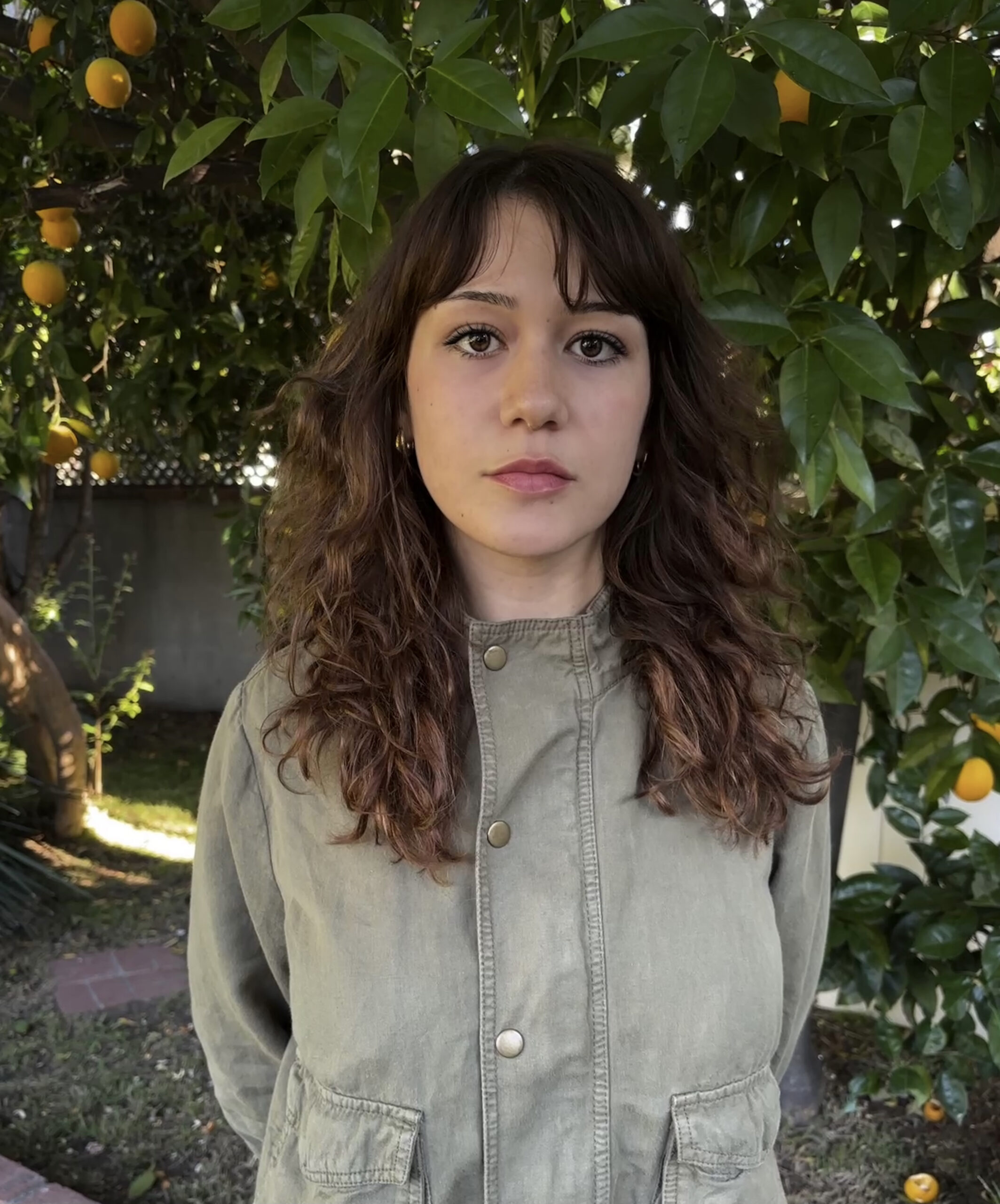 Lila-Rose Beckford is a fiction writer from Los Angeles whose work appears in Hobart, X-R-A-Y, JMWW, and Maudlin House. She is an MFA candidate at Vermont College of Fine Arts and is at work on a novel in stories.