
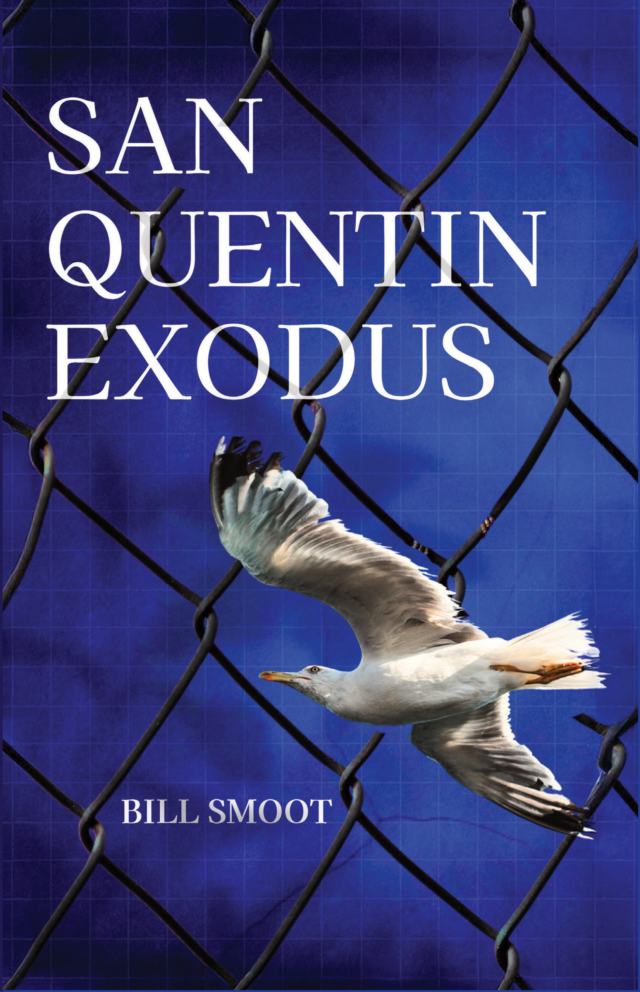
 Bill Smoot’s San Quentin Exodus is a masterclass in intertwined perspective, exploring the lives of two vastly different characters—their thoughts, failures, and the injustices that ultimately bring them together. The writing is mesmerizing: restrained, patient, and emotionally devastating in its simplicity. Told through a series of intimate vignettes and alternating POVs, the novel unfolds through moments of reflection and decision, each scene carrying its own emotional weight while gradually building toward the climactic conclusion. Smoot has an extraordinary ability to make ordinary moments feel profound. The past is remembered, but not lingered on. The future is not an aspiration but an action.
At the center of the novel is James Fields, a convict known among his fellow prisoners as “Shakespeare.” James is soft-spoken, intelligent, and profoundly misunderstood—a Black man from Oakland whose mistakes have condemned him to a thirty-years-to-life sentence in San Quentin. After nearly three decades as a model prisoner, dedicating himself to education, self-reflection, and rehabilitation, he is denied parole due to the mismanagement of his original conviction as well as his failure to perform guilt in the way the system expects him to.
Parallel to James is Allison Anderson, a strong-willed schoolteacher whose childhood admiration for Nancy Drew shapes her fierce commitment to justice. Feeling disillusioned by the rampant corporatization of her school, she begins volunteering at San Quentin’s college program, where she meets James as her tutee.
Despite their numerous differences—James as a straight black man from Oakland’s inner-city, and Allison as a white, middle-class lesbian from the suburban Midwest—they discover a profound connection rooted in empathy, intellectual curiosity, and a resentment towards the structures of power which prioritize image and profit over truth. Ignoring aspects of social identity, James and Allison are, deep down, very similar people. In an interview with the online book review platform, Readers’ Choice, Smoot notes, “In terms of demographics, yes, James and Allison are polar opposites… But in another way, they’re the same person: introverted, watchful, a little nerdy and shy. For each, their isolation gives them a kind of freedom to grow and develop, unshaped by forces of conformity.”
As the elite private school that Allison works at begins to focus more on image and profit rather than education, James faces a justice system that cares more about how he expresses his guilt, rather than what is actually true and just. When Allison learns of James’s parole denial, she channels the investigative instincts of her childhood hero and plans to help him escape, which gives James the first genuine opportunity for freedom he has ever known.
Allison’s motivations are particularly compelling because Smoot frames them not as grand heroism or a sense of “white guilt,” but as moral consistency. She possesses a deeply logical sense of justice, and a puzzle-solving mind that informs every aspect of her life: from her studies, to her personal relationships, to the radical decision to arrange a prison break. One of the best summaries of her character and motives comes from something she says during an argument with her wife, Meagan. Meagan is confused about why Allison would risk not only her own life but also the life they built together for the sake of a man convicted of murder.
“It’s like seeing someone with a flat tire on a lonesome road,” Allison describes matter-of-factly. “You can stop and help them, or you can keep right on going…So, I’m going to stop and help. If I drove past, I would betray who I truly am. Simple as that.”
That passage encapsulates one of the book’s central questions: What does it truly mean to be good? Throughout the novel, Smoot interrogates ideas of morality, justice, cowardice, and responsibility. In a world where many people say the “right” things or adopt the “right” politics, the book stresses the importance of understanding, solidarity and action as true justice, rather than performative morality with no real structural change.
One of the novel’s most memorable sections follows James’s participation in a Shakespeare acting program inside the prison, culminating in his portrayal of Hamlet shortly before his parole hearing. Believing he will soon be released, James views the production as a “final swan song” to his life behind bars. These chapters are among the most emotionally resonant in the novel, illustrating how art and education can become vehicles for rehabilitation and self-understanding. Through their roles in Hamlet, the inmates confront their traumas, crimes, and identities in ways the world often doesn’t allow incarcerated individuals. For James especially, literature becomes a means of self-recognition. Nicknamed “Shakespeare” for his love of books, he comes to understand literature not as stories about distant, exceptional figures, but as mirrors through which ordinary people can better understand themselves: “It’s an invitation to see reflections of oneself—as Hamlet says, a mirror held up to nature.”
This idea—the Rorschachian nature of literature and art—echoes throughout the novel and encapsulates the greater theme of empathy. James may not literally be Odysseus, Hamlet, or Gatsby, but he is still able to see himself reflected in them, including the good and the bad, and he comes to better understand himself in the process. Likewise, despite their vastly different identities and experiences, James and Allison are able to understand one another because they recognize a shared humanity beneath the surface.
Later in his Readers’ Choice interview, Smoot says, “Like any novel, San Quentin Exodus is a bit of a Rorschach. Perhaps some will see there some moment of recognition, or empathy, or inspiration. That would be my hope.”
This hope is exactly what makes San Quentin Exodus so effective. It is not simply a novel about prisons, injustice, or escape—it is a novel about empathy, action, and the courage required to live according to one’s convictions.
Publisher: Apprentice House Press
Publication Date: June 9, 2026
Reviewed by Emi Craig
Emi Craig is a writer and literary translator from Vermont, currently based in NYC. He is a 2025 alumni of the Oberlin College Creative Writing program. He has been published in The Limelight Review, and self-publishes work on Substack at @emicraig. You can find more of his work at emcraigwrites.com.