As bomb sirens fill the air, a little girl and her mother make cherry jam—juxtaposing the harshness of war against the ordinariness of daily life—of the fact that unbearable things, in some circumstances, becomes normal. In this story, it’s the innocent pleasure of a child’s daily life that makes the turbulent reality such a gut-punch.
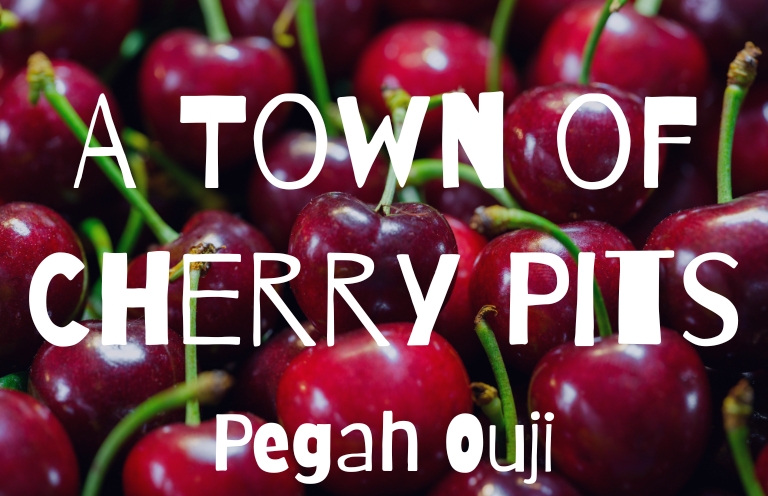
“When will Baba come back?” Zahra asks her mother as she piles cherry pits, building a town scattered across the kitchen’s gray stone floor. By the stove, her mother pits cherries, drops them into a dented aluminum pot, and writes labels for the ruby-red jars of jam piled into a pyramid. Zahra’s cherry-pit town has one small hill, a fence all around, and a narrow road. In this town, Zahra imagines mothers roasting chicken every night, slick with fried cinnamon and mint. Clouds are made of saffron cookies. It only rains sweet nabat. Fathers always stay put.
“He’ll be back when this is all over,” her mother replies, palms stained scarlet with cherry blood.
From the living room, an old radio sputters: “The Iraqi army is advancing closer to Khorramshahr. Our brave soldiers defend Iran with honor.”
A siren blares. Zahra stops building her town as Maman grabs her hand and runs toward their apartment’s bomb shelter on the first floor. Zahra loves the bomb shelter, how everyone becomes softer there, the furrow-browed neighbor now a bundle of hugs and smiles. Zahra’s mother cradles her cross-legged on the cold stone floor and hums Zahra’s favorite lullaby—the one she has been too tired to sing lately.
After the siren stops, later that afternoon, Zahra stands at Bahar intersection with her mother, drawing big red letters on a piece of cardboard: Cherry Jams for Sale! Her mother piles jars onto a white cloth stretched across the sidewalk. Zahra adds cherries to the sign, next to a dancing worm in sunglasses—like the worms her mother finds and tosses away.
The street is packed with other sellers: a man with jade necklaces from Mecca, another with rose petals from Mashhad, a toothless old lady with apricot lavashak hanging like bruises behind her. It’s hot. Zahra runs her tongue over the roof of her mouth, cracked like her mother’s pumice stone, and watches a young boy juice pomegranates, crimson drops shining on his hands.
Without her cherry pits, Zahra builds another town from sticks and gravel on the sidewalk: a bridge, a hut, even a tiny bomb shelter lined with dried grass.
“I guess no one wants jam when there is war,” Zahra’s mother grumbles. “Stay here.” Her mother walks across the street toward the toothless lady with a jar in her hand.
While she is gone, a little boy with porcupine hair walks by holding his father’s hand. His father’s tie hugs the curve of his belly like a question mark.
“I want a cherry jam, Baba!” the boy says, tugging his sleeve.
“Absolutely not. Khoda midoneh. Their kitchen is probably full of cockroaches.”
How does he know? Do cockroaches leave a scent?
The day after Baba left, Zahra found a cockroach turned on its back in the bathroom. She carried it in her palm, her index finger tracing its shiny shell. “Cockroaches are among the most resilient creatures on earth. They have been around two hundred million years,” Mrs. Rahimi had taught them at school, and they had copied resilient across an entire page.
Holding the cockroach, Zahra imagined entire towns underground. She laid it on a bed of cherry pits and drew a mother and father cockroach beside it. When her mother found Zahra’s insect family, a frown folded across her forehead.
“No one will buy jam from a kitchen with cockroaches.” A few strokes of the broom swept the entire town into the dark belly of the trash can.
Just as the intersection light turns green, bomb sirens shriek again and the street erupts with movement. Mothers yank children by the wrist, and fathers shout after sons. Zahra searches for her mother and catches only a glimpse of her before the crowd swallows her.
Zahra pushes through the hurrying bodies toward where she last saw her mother, then stops.
What about her town? The jars her mother burned her hands to make?
She turns back, throwing jars into the box alongside her sticks and stones. A few jars shatter, maroon syrup snaking across the pavement.
“Zahra!” she hears her mother shout, though she cannot see her.
As Zahra reaches for the broken glass, a shard slices her thumb. Blood mixes with the syrup.
I’m here, Mama, she wants to shout, but her voice disappears beneath the sirens, so loud it feels as though the entire town of Khorramshahr has been crammed inside her head. She lifts the box of broken glass and leaking syrup and squeezes through bodies pressing against her from every side.
Do cockroaches know how to build bomb shelters? Where is her mother?
Honor, the word from the radio, shapeshifts—was it honor or on her? Will Baba come back?
A loud explosion down the street sends the crowd into a frenzy. Zahra drops to the ground and curves her body around the box, becoming her own bomb shelter.
She imagines her curved back, strong and sturdy.
How long is even two hundred million years?
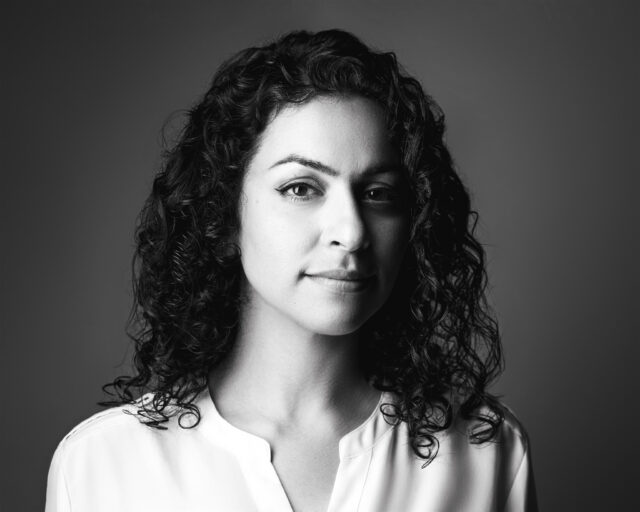 Pegah Ouji writes stories in Farsi and English. Her work has appeared or is forthcoming from the Hudson Review, Epoch, Joyland, Epiphany, and Split Lip, among other publications. She was a 2024 Emerging Writer Fellow at SmokeLong Quarterly as well as a PEN America Emerging Voices 2025 Fellow. She is an MFA candidate in Creative Writing at NC State University.