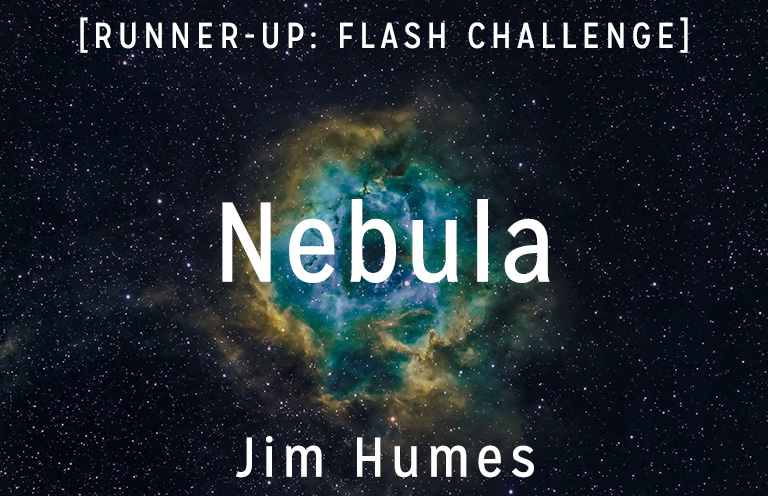
“Nebula” by Jim Humes is the runner-up from our Flash Challenge! In “Nebula,” the narrator copes with his unimaginable diagnosis by casting his brain tumor as a celestial object and disassociating. “I find myself between my wife and the doctor. They are making a plan. My input is not required so I float up to the ceiling and look down.” He is both detached and already mourning. How else do you wrest control over a force of nature?
I sit beside my wife in the doctor’s office because my brain has given birth to a nebula. There it is, on the screen, at the tip of his finger, a blossom of white in my left occipital lobe. This is very serious, the doctor tells me, and who am I to disagree? My wife and I have two sons. We know the work of bringing life into the world. I just never imagined that I would be the vessel.
The doctor clicks through the gray images, pointing out small tendrils that have burrowed across my garden rows. He stops at a cross-section where I am surprised to see the nebula gyrating, counterclockwise, like a hurricane, with red and blue pulses of lightning shuddering through it. But it’s missing an eye. Maybe this explains the scrim that so often clouds my vision. A breath against a window. A cataract that allows dim outlines to emerge: sad wisps of hair falling over my father’s tall forehead, our clever son’s gapped teeth, the scar beside our troubled son’s almond-shaped eye, the mouth of my first love, a girl who now makes daily visits, her smile cautious, her lips barely parted.
My wife squeezes my hand like a worry stone with every beat the doctor maps out: open-skull surgery (painful), laser-knife radiation (futuristic), chemo (one-star reviews), and life expectancy meted out in months rather than years (generous). He makes no mention of mental capacity or autonomy, and I receive a shrug when I ask if this condition might magically gift me the ability to play the piano. He doesn’t detail what will become of the nebula. Will they send it back into space? Or will they nurture it to good health for a return to the wild?
I turn my eyes to the window, and there the girl is again, looking back at me from somewhere just beyond the glass. I want to reassure her. We’re both remembering the day that we stood above a river, holding hands, feeling the heat of baked rock beneath our feet. We counted to three. When she jumped, I turned to stone. Her fingers slipped away, and she disappeared beneath the green current before bobbing up a few long seconds later, just a head being ferried downstream. The water had spoken to me. It whispered, You’ll be swept away. She climbed up the trail to where I stood, again and again, asking me to try, and then leaping with an unguarded cry that still rings like a bell. Again and again, I refused. The delicate braid between us frayed with every plunge. She finally sat next to me, our feet dangling over the ledge, a wet tangle of her hair clinging to my shoulder. The best part, she told me, was being held down by a force so quiet and powerful that all you could do was give in, relax, and wait for it to send you back to the surface. It’s all a metaphor, now. She forgave me. Years later, I forgave myself, which is why I see her in this memory with a softness that blooms into love, too late to matter, too distant to be real, too long after that day’s water escaped into the ocean.
Then she is gone, and I find myself between my wife and the doctor. They are making a plan. My input is not required, so I float up to the ceiling and look down. There I am, frozen in my chair as if surrounded by bolts of fabric, pins sticking out of my shoulders, the doctor making razor-quick slices with wax chalk to mark the cuffs and how the shoulders should hang. My father always told me to own a good suit, one that made me feel as special as the occasion. Don’t worry about the price, he told me. And between the doctor and my wife, there’s no talk of costs or coverages or the calculus of my remaining value. They agree that we have a good plan of attack, and at that word, I feel the nebula twirl inside my head.
We will head straight to the hospital. There will be people waiting for us, the best of the best. I’d prefer to go home first, to place notes in the pockets of my shirts with reminders of how I came to own them. I want to rifle through the dusty tubs in the garage and remember how we danced in the old costumes we never modeled for the kids. I need to find a molded leather coin purse made in Florence that still holds a few mille lira notes, along with the petals of a white lily that grew in a box outside the hotel. It’s the troubled son I worry about. He will rummage through cabinets and shelves, pocketing rings, watches, and trinkets that might impress a stranger or form the basis of a barter. The clever one will roam around my computer in search of secrets. The good stuff is bundled away in a banker’s box that even the clever one won’t know how to decipher. The way the pen presses lighter as the words start to flow, how the ink rises into standing waves that ripple across the paper, how the cursive stretches to breaking against the banks of the page, then eddies out into swirls of thinking of you, hope all’s well, happy birthday, as always, love, love, love, and her name, again and again.
My wife is signing papers. I hold up a finger to excuse myself. I bumble out to the beige hallway, take the elevator down, and step into the blinding sunshine. It’s a good day for walking. Maybe I’ll find the edge of the water. Maybe this time I will fall.
Jim Humes was raised in Texas before heading west to earn an MFA in Fiction at San Francisco State University. He has been recognized with the Henfield Prize, the Katherine Anne Porter Award, the Herbert Wilner Award, a Pushcart Prize special mention, and a fellowship from the MacDowell Colony. His fiction has appeared in publications that include Fractured Lit, Nimrod, Fourteen Hills, and Writer’s Harvest. He lives with his family just north of San Francisco, where he enjoys getting lost in the redwoods.