
Writers pour so much energy into their craft that sometimes we forget that creative pursuits other than writing can fill us up in other important ways. Here, we’ll look at what writers do when they aren’t writing, and how those pursuits affect the return to the page. This month, we hear from two writers—Jeremy Mauser and Kate Blakinger—who find their creativity by performing stand-up comedy and parenting a tween.
What fills you up creatively when you’re not writing? If you’d like to contribute to the Writers on Not Writing series, email jen@mastersreview.com. We can’t wait to hear from you!
You stand in front of a group of strangers and fish for their laughter, and they know you’re fishing for it, but they don’t make it easy. They only laugh if you genuinely made them laugh. They don’t show any pity if you’re flailing onstage, and a lot of the time you are flailing onstage. You keep going back because when your jokes do land, it’s one of the greatest feelings, and those fleeting moments of connection make all the flailing worth it. Stand-up comedy is a humiliating ritual, but I’ve dedicated the last two years of my life to it in Tuscaloosa, Alabama.
I stumbled into stand-up by chance. Before I ever took the stage, I attended a few shows at Comedy Cellar in New York and watched some Netflix specials, but I had no desire to try it out myself. Not until my friends and I found ourselves at a bar that was hosting a comedy open mic a few weeks after we moved to Tuscaloosa to pursue an MFA in Creative Writing. Only two comics signed up to perform, and neither of them elicited more than weak chuckles. At the last possible second, and with one Dark ‘n Stormy in my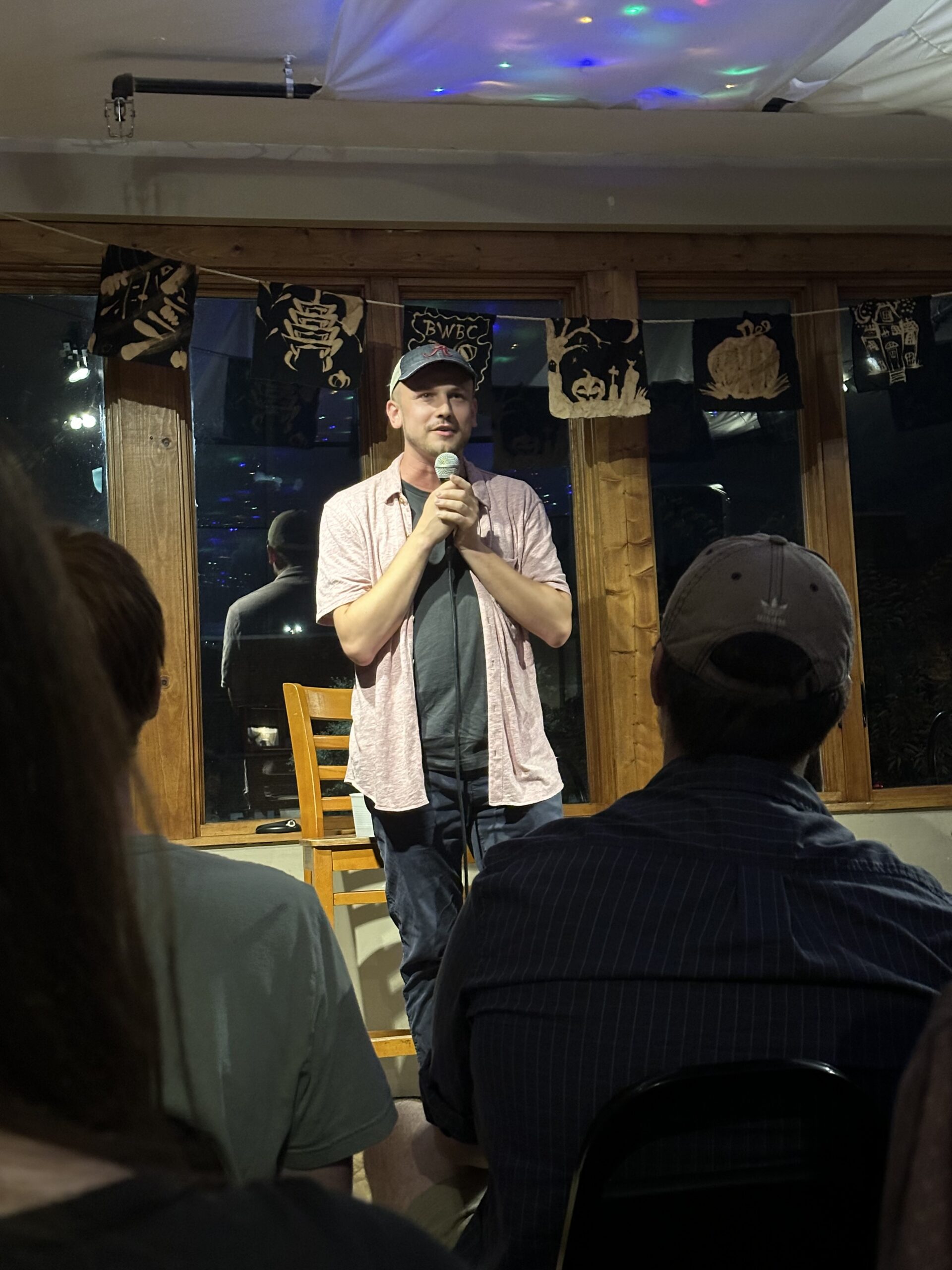 system, I asked if I could tell a few jokes. That night, earning a couple of guffaws from the six-person audience gave me a high that I’ve been chasing ever since.
After that first, spontaneous performance, I started hitting one, two, three open mics every week. Then I was asked to perform in the occasional show. Then I was asked to host an open mic. Then I started my own mic at a peanut bar. All of a sudden, my non-comedy friends knew me as the comedy guy, and my fellow comics considered me a leader.
I’ve experimented with different comedy styles and personas, as well as various methods of preparing for sets while still leaving room to improvise. While most of my fellow comics treat each set as a series of unrelated jokes, my writing background inspires me to treat every set as a story with frequent punchlines. But unlike prose writing, with stand-up I get live feedback at every stage of every draft. So, when a joke gets more laughs than I expect, I tailor the rest of my set around that particular audience’s preferences. But even if something gets rapturous laughter, I might not be able to replicate the joke exactly on the next attempt.
Meanwhile, when I treat a short story like a stand-up set, it ensures that every detail serves a purpose. I consciously incorporate punchlines and callbacks into my prose while trying to make every beat solicit the strongest possible reaction from the reader. I often write sentences that are funny by accident, almost as if stand-up is bleeding into my writing. And I’m less afraid to fail on the page since it’s significantly less humiliating than failing on the stage.
One of my MFA professors said that every writer should have another creative outlet, and comedy has become mine. Being a comic has made me a better writer, and being a writer has made me a better comic.
Through comedy, I’ve made friends I never would’ve met otherwise, learned to work hard without sacrificing enjoyment, and been awed by the talent of other comics. I didn’t expect Tuscaloosa to be so funny, but then again, I didn’t expect myself to be so funny. I didn’t expect comedy to strengthen my creative and professional endeavors, but then again, I didn’t expect to become a comic in the first place. Moving forward, the only thing I can safely expect is that I’ll keep surprising the audience as often as I surprise myself.
Jeremy Mauser
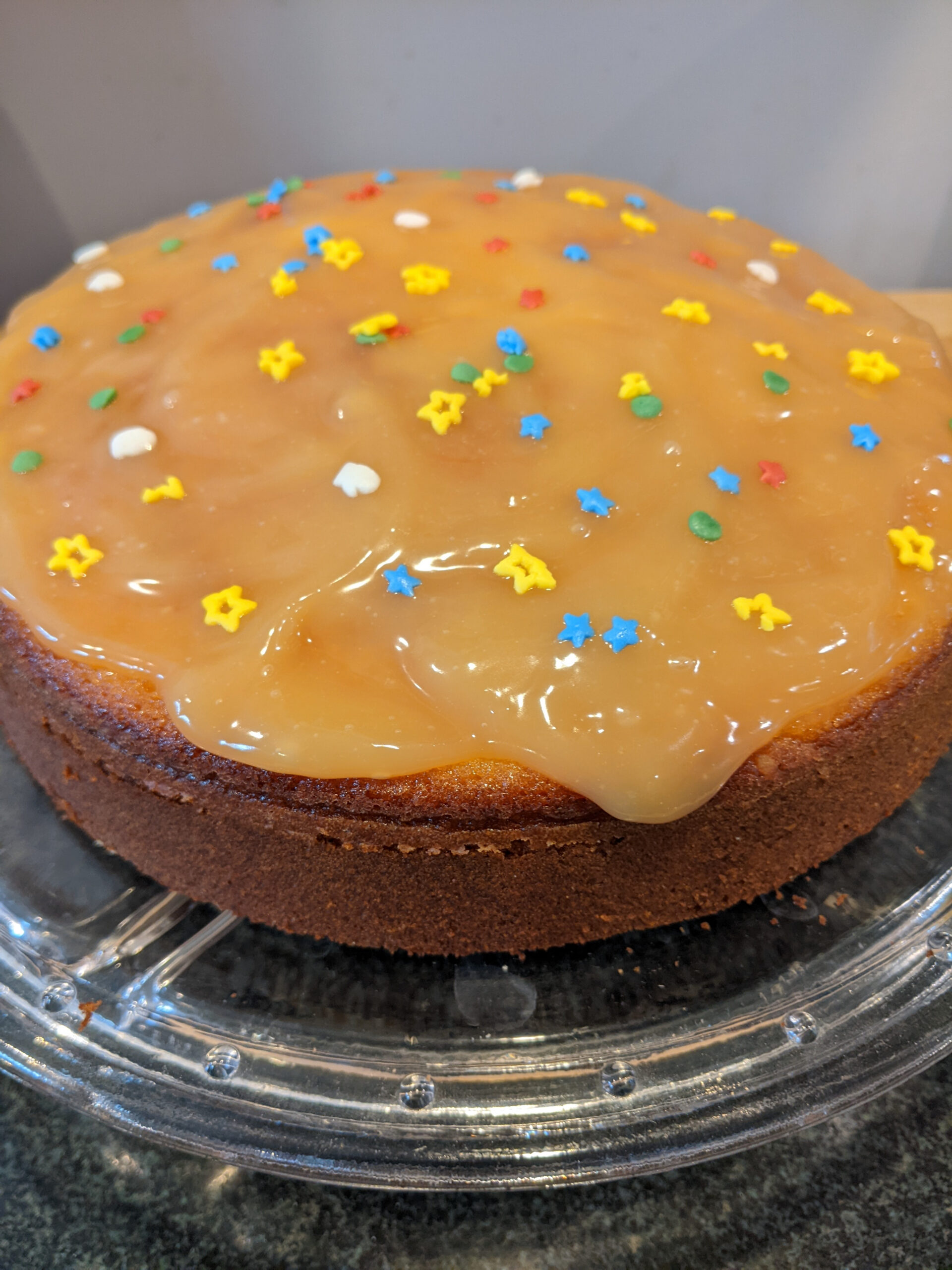
When I’m not writing, I’m parenting. My son is a tween now, and lately we’ve been spending time together making things with our hands. This is our small stand against screens, our way of embracing the inefficient magic of human creativity. We weave friendship bracelets from embroidery floss. We draw tiny, outlandish villages in a style reminiscent of the illustrations in his Where’s Waldo? books. We fashion our own lava lamps with oil, water, food coloring, and Alka-Seltzer tablets. We bake lemon cake. These projects are enjoyably tactile in a way writing mostly isn’t, and I feel freed from the burden of expectations. When I’m writing, it takes real effort to shake off the pressure to produce something “good,” but a lopsided cake is still a bounty to celebrate and devour.
 My son and I also escape the lure of screens by spending time in nature, just being outside, listening and looking. Planting seeds in our small garden or strolling alongside a creek. Hearing the flow of water, the breeze in the leaves, birdsong. Seeing the sky. Something in me unclenches outdoors. This relaxed state isn’t writing, but at times it yields material for writing. Ideas bubble up. A character or situation will spring to mind. A solution to a plot hole will suddenly reveal itself.
My son loves the outdoors, and after a trip with his grandparents he has developed a boundless enthusiasm for camping. “We should go camping,” he says again and again. We have never camped as a family.
Before we had our son, my husband and I did camp once at the Mojave National Preserve. We reached the park in the early evening and chose a campsite with scenic desert views. We had the whole stark and alien landscape to ourselves. None of the surrounding campsites had been claimed. The dirt was packed so hard we couldn’t properly stake our tent, which came with blunt plastic stakes that broke against the ground. We improvised, tying the tent’s cords to rocks. We ate, though I don’t really remember the meal. What I remember is the rising wind. We huddled in our tent. The wind howled so loudly we couldn’t fall asleep. The tent’s fabric flapped around us madly. At some point, we realized our two bodies inside the tent were all that prevented it from being borne aloft. Unnerved, we hurriedly packed the tent back into the rental car as the wind whipped grit into our faces. We drove across the park to the other campground ten miles away. Site after site was occupied. Now we knew why everyone came here: pinyon pines and junipers sheltered these campsites. We peered through the darkness until we finally found an open site, and at two in the morning, heavy with exhaustion, we pitched our tent again.
It’s not surprising this experience didn’t lead to further camping, but now with a son who loves it, I find myself investigating nearby state parks and assessing the condition of our gear. We still own the tent that nearly blew away in the desert. Someday soon, instead of writing I’ll be figuring out how to pitch this tent again and watching as my son demonstrates the best way to build a campfire. Parenting stretches me, pushing me to try new things and feel new things, and, in widening my life, even as it sometimes pulls me away from writing, being a parent gives me more to draw upon when I do find my way back to the page.
Kate Blakinger
Jeremy Mauser is a Pennsylvania-born MFA candidate in Creative Writing at the University of Alabama. His writing is featured or forthcoming in Sonora Review, Pithead Chapel, Flash Fiction Magazine, fifth wheel press, and New Delta Review, among other publications. He is a Reader at The Masters Review, an Assistant Fiction & Nonfiction Editor at Black Warrior Review, and a stand-up comic who can be found on Instagram @jeremymauserwrites and Bluesky @jeremymauser.bsky.social.
Kate Blakinger is the author of the story collection How to Court Disaster, which won the Iowa Short Fiction Award and is forthcoming in November 2026 from the University of Iowa Press. Her stories have appeared in Alaska Quarterly Review, Catamaran, Epiphany, The Gettysburg Review, The Iowa Review, and other publications. Kate lives in Philadelphia, where she works as a freelance developmental editor. She’s also a guest editor for The Masters Review and CRAFT. Find her online at kateblakinger.com.