
 One of my favorite tourist destinations in the greater Washington DC area, a place I call home, is Mount Vernon, the historic estate of George Washington. When I visit, I’m reminded that the histories I’ve read were not always written. Instead, they were actively assembled and negotiated by real people, and who their subjects really were has been lost in the thesis statements and oversimplifications of sanitized history textbooks.
For instance, the colors of the walls of Mount Vernon are based on painstaking work by archeologists and historians. The guides and docents are quick to tell visitors this because the bright and vibrant colors agitate some. The aesthetic violates the gray-and navy-blue sensibilities conveyed by long-dead artists who were projecting their own ideals onto myths rather than men.
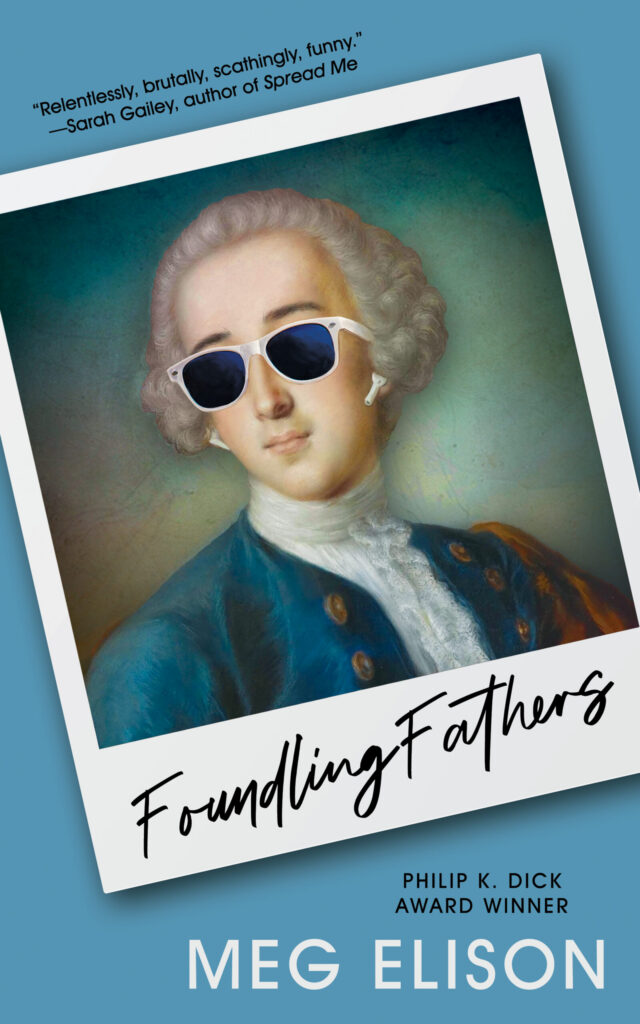
Meg Elison’s Foundling Fathers is a hilarious, satirical novella that captures the uncomfortable tension that some of these Mount Vernon visitors feel when asked to take in the marble stoicism of George Washington busts alongside the physical evidence of his eye for flamboyant jewel tones. The book’s premise is delicious and timely: Four of the founding fathers have been cloned and are being raised on a covert private island by a radical think tank. The goal of the think tank is to groom these boys into the men who will eventually take back power and “save” the United States from collapse. But when the clones prematurely learn their true identity, the grand plan runs off the rails. Elegant and accessible, Elison’s razor-sharp satire brilliantly questions our cultural obsession with the “great men” theory of history.
“It took Benjamin Franklin twenty-seven minutes and fourteen seconds to discover there was pornography on the internet,” reads the novella’s banger of an opening sentence. The book is incredibly funny. Imagining the founding fathers as teenaged boys is one thing but trying to imagine them interacting with modern technology as well as modern ethics and sensibilities takes the “great men” question to an entirely different level. Elison does an amazing job thinking through the personalities of the four founding fathers featured here. Ben Franklin is clever, curious, and well-spoken. George Washington is a quiet and thoughtful elitist. Thomas Jefferson is red-haired, smart, and a sex pest. John Adams is a striver, always feeling a little behind his older “brothers.” For people who know American history well, particularly as it pertains to the personalities of the founding fathers, the book is immensely rewarding, blending historical understanding with subtle gags that feel like inside jokes. The boys’ mother is another brilliant commentary on American mythos: She’s not real. She isn’t their biological mother, rather she is a hired-on caretaker who is forced to keep her identity a secret. Even the name they know her by—Mary Libertas—is a made-up ideal. Much like the representations of women in early parts of American history, she exists more as a symbol, a modern goddess who is imbued with impossible virtues, ready to be discarded the moment she steps out of a John Gast oil-painting. Likewise, the book rewards readers who are in tune with modern political discussions online, particularly in more reactionary circles. Here, Elison’s satire makes no attempt to disguise the awful, bigoted personalities that inspire the think tank baddies on a mission to clone the “great” men from far more distant, and even more recent, pasts.
Humor aside, I commend Elison’s restraint in keeping this a novella. The idea of what the founding fathers would make of our current state of affairs could easily fill a door-stopper-sized trilogy and I think at some point in the book, I wished that was what I was reading. But as the book came to its climax, I realized Elison made exactly the right choice. What I wish is that I had a community to read this book with. It makes for an excellent book club pick because Elison uses the novella to raise questions that need to be discussed right now, neighbor-to-neighbor, friend-to-friend. There are the usual nature-of-self questions that arise in any clone story: Is Ben Franklin’s gift for gab hard-coded in his nucleic acids? If so, is the same true of Jefferson’s sexual aggression? Why are certain portions of the political spectrum so convinced that if you can just find that One Great Man, He will make everything okay? And is it The Man that makes their times great, or does the time make The Man? The fates that await the foundling fathers posit a hypothesis that is sure to generate discussion as some of the fathers find their way back to their original calling, while others find that America has turned its back on boys who perhaps grew up in the wrong place. Most of all, the book asks whether truly Great Men would pursue our modern conceptions of power and all it entails. Perhaps the Great Men know that in a world where you can have anything, few things beat chilling out while shaded from the sun with a book in hand.
Publisher: University of Chicago Press
Publication Date: May 1, 2026
Reviewed by Marjee Chmiel
Marjee has twenty-plus years of experience as a writer, researcher, and documentarian at organizations such as National Geographic, PBS, and the Smithsonian. Always a Chicagoan at heart, she’s lived in the DC area for over twenty years with her spouse and their fluffy, little dogs named for Nintendo characters. She is a fiction reader at The Masters Review and social media co-director for Split Lip. Currently, she is the inaugural Presidential Fellow in Fiction at George Mason University. Her fiction has appeared in Maudlin House, BULL, Flash Fiction Magazine, Literary Garage, and The Literary Hatchet. She is terrible at crocheting but does it anyway, no one can stop her. Read/watch her stuff at marjee.org