
Abhijith Ravinutala’s novel excerpt, “Until She Says So,” examines the power imbalance between castes in Indian society. Rani, a former sex worker, becomes pregnant by her lover Sathish. Although Rani is allowed to live in his house, she’s forced to pretend she’s nothing more than a servant to his family and a nanny to her child. But the ties of motherhood prove to be stronger than the rules of society dictate.
Rani gave birth to the daughter that would not be her daughter on a Friday morning. She came on the Goddess’s favorite day, for that was how such fates became intertwined—the Goddess gave no subtle signs. She watched the father and his wife take the baby from her arms, her mouth sewn shut by the threads of promises made. Sathish looked caring enough, his eyes made tender by his daughter’s mushy features. But Nirmala, and her young son, fawned over the baby like it was truly theirs. Perhaps her girl would also have the boon of several mothers, as Rani had. A mother who’ll provide need not be the one who carried her for nine months. There would also be the mothers in the neighborhood who taught her how to wear saris and avoid the looks of boys. And the mothers in the upper-caste temples she’d visit, behind their elaborate stone archways, eager to teach her prayers and songs. Yes, Rani decided, only good could come from this hidden Dalit having many Brahmin mothers.
Sathish’s parents entered the hospital room, too, hands held behind their backs in reservation. The grandfather showed his disappointment in the child’s gender, but fortunately, the grandmother smiled. She waved her hands over the girl’s face and cracked her knuckles on her temples, dispelling any evil eye that may have attached itself to the girl from the doctors, the nurses, the casteless woman who’d just given birth to her. The girl could start anew.
Before exiting the hospital into a world that would never know about this birth, Sathish asked if Rani would like a photo. His father bristled at the idea, but Rani nodded vehemently. When it was time for the baby to feed, the others left and Sathish stayed, caught between two families, and raised the camera. Rani kept her lips closed because her teeth were nothing to show. She positioned her hospital gown so the suckling baby would be visible. Click. The flash was new to her and she had to blink several times. He handed her the Polaroid, instructed her to shake it well after the image materialized. She would keep it at her breast for the next decade, shaking it well after the photo had appeared, hoping the moment would fly out of the film and manifest again.
For the first year, when they allowed her to breastfeed, Rani experienced her first profound silence. No one in the house deigned to witness the secret they strove to conceal, behind a brick wall of carefully-laid excuses, cemented by delicate phrases. She thus enjoyed a solitude with her new infant that she never had with Vijay, amid those worn-out green doors where men solicited her. So, Rani took her time with the feeding. She trained the girl’s ears on the lullabies her own mothers had sung, and they napped together after feeding, before Rani had to return to being a servant and her daughter had to return to being someone else’s.
Otherwise, there was always something to do. High-caste people, Rani learned, had more occasions to mark their calendar, as if they couldn’t bear to sit with themselves.
On the eleventh day, they hung a swing from two hooks in the living room and took turns nudging the baby back and forth. Sathish told Rani to watch from the kitchen, and be ready to serve snacks to the guests, who were told the child was adopted from an orphanage. “Rescued from a poor mother,” was the phrase they used, in hushed tones, imploring the guests never to tell the child or invoke poverty in their house again. The onlookers nodded, willing accomplices all. More bricks and cement atop the wall of secrets.
On the twenty-first day, the same guests came for the naming ceremony. Sathish had just invited a few of his superiors from work, and a sparse pick of distant relatives. They still didn’t know many people in Hyderabad, which helped their secret. Sathish’s father named the child Veena, after Saraswati, the goddess of education and learning. From the kitchen, Rani was overjoyed to hear that learning was in the girl’s very name. She had prayed for as much.
At three months, the baby rolled over for the first time, which turned out to be another occasion, to Rani’s surprise. The grandmother made boorellu, a sweet Rani hadn’t seen before, and passed it out to the few neighbors they had in the still-developing housing colony. Rani stashed the sweet between her breasts as Sathish instructed and snuck away to eat in her servant’s quarters, where no one would see. The hot ghee and palm sugar were intoxicating. The shame of darkness made her cheeks hot and she prayed her Veena’s life would be full of such rich, indulgent ingredients.
At six months, they held the Annaprasana for the baby’s first taste of rice. It promised to be a grand affair—they’d even organized a tent outside the home to accommodate all the party guests who were arriving from Tirupati, their hometown friends and relatives, who would lay additional bricks. In the early morning, when the sun was still contemplating its arrival with burning streaks in a gray sky, Sathish woke her, tapping her shoulder like a child eager to play.
“What?” Rani grumbled.
“Everyone went to the station to receive the relatives. Come.” He took her hand and forced her up, across the ten eternal steps of dirt she traversed every day between her quarters and the main house, and then to his bedroom. He was ravenous, full of nervous energy for the gathering. He sucked on her neck and the tops of her breasts, squeezing them like fruits. She shook off her grogginess and kissed him while she could, lapping up any stolen moment of pleasure. Her hands were raw from washing dishes and clothes, her hips sore from bending to clean the nooks and crannies under their granite furniture, but she focused on him, the man she’d fallen for, moved here for, and tried to rekindle the love that once made Veena. His wife’s bed wobbled as they enjoyed each other with the intensity only perfidy could provide.
When she was still in the hospital, Sathish had told her to stay overnight an extra day while they took the baby home. “Tomorrow, after you rest, the doctors will do a surgery for you,” he’d said.
“Do I have another baby inside?” she patted her stomach.
“They’ll do a small operation and you won’t have to worry about getting pregnant again.”
“H-how? Maybe I still want—”
“You said you’ll do what is needed, right?”
“But—”
“Yes or no?” He interrupted her again, holding a finger in front of her lips.
“Yes,” she’d muttered, cementing another row of bricks.
He groaned as he finished in her without fear, his body shaking. She needed longer. They rarely finished at the same time anymore. He slid off her sweaty torso and slapped her thigh, smiling. “Still got it.”
“Mm,” she agreed, preoccupied with admiring the crown molding on the bedroom ceiling. It struck her that all women end up on their backs but some have better sights to admire. She preferred when Sathish brought her to the bedroom for this purpose. Lately, he’d taken to sneaking her all around the house, taking her under tables, or on their cold, tiled balcony floor, careful to keep their undulating bodies below the sight line of the ledge. He reveled in having more secrets to hide. She didn’t mind either, as she took some pleasure in seeing the others in the home walk over spots where Sathish once made love to her, even as they barked orders at her or refused to sit beside her for a meal in those very places.
Rani knew he was pleasuring his wife as well. The nights when she couldn’t sleep, she would sneak into the house to sit on the couches and watch the TV on mute, as if she belonged, and on occasion, she tiptoed towards the bedroom and heard the bed squeaking. If the door was slightly ajar, she lined up her left eye just so with the gap and watched them. The wife didn’t seem to moan much. They rocked in silence like they were cradling themselves to sleep, until Sathish finished with a forceful grunt. Then, she would stare up at the ceiling, waiting for him to alight, and once he did, he would light a cigarette, just as he used to when he visited Rani’s house. But he would smoke it in silence, not asking interesting questions or spewing philosophies. The ashes would fall neatly into a porcelain bowl, not rest on a window ledge as they had in her bedroom, where she could smell them, feel his presence for days after. She could bet that he yearned for Rani instead, kept her enticing image in his mind while he slept with his wife, and the thought helped her pleasure herself as she looked in on their naked forms, the subdued light of his cigarette, and the life she could’ve led.
“Rani?” Sathish sat on his calves in front of her, glancing at his watch. “It’s getting late. Go get dressed.” She bounded from his bed, cautious of overstaying and knocking a brick loose.
* * *
Hours later, the guests were arrayed like rice grains in a pot, shoulders touching as they crowded around the all-important scene. The baby was placed in front of five items, each depicting a life path she would choose.
A bowl of payasam, symbolizing a love for food and abundance. A gold chain, for wealth. It shone unlike anything Rani had seen on her friends’ necks. A wad of clay to represent property. A bright, silver-coated pen to mean creativity and wisdom. A tome of the Ramayana with a brilliant, multicolored cover, to indicate a love of learning.
Nirmala set the baby in front of the items and the cadre of guests beckoned Veena to crawl forward, calling out their preferred paths for the child. Most yelled for clay or gold. But Rani watched from the kitchen as ever, her back against the door jamb, and whispered over and over to her baby girl. “Book, book, book. Gangamma, please make her choose the book.”
Veena crawled forward, angled toward the shiny jewelry, and her grandfather beamed. The crowd egged her forward, pointing toward the gold, and the baby made slow progress, its infantile limbs buckling every few movements. She was dressed in a gorgeous fuchsia dress and already wearing heirlooms. Rani felt her heart cinch with pleasure like the clasp of her blouse—her child was already more ornamented than she would ever be. She was like a little Lakshmi, or one of those other wealthy, caste Goddesses, save for her color being a bit darker than the deities. She closed her eyes and wished harder on Gangamma, her own Gangamma who these people hardly knew. The crowd groaned.
Rani gazed at her baby patting the cover of the book, enthusiastic to know what lay inside. She slid down the door jamb and let herself bask in her joy. Her girl had listened to her even through the brick wall, through the space that separated guests from servants. Veena was her child, truly her own.
“Rani!” Sathish called out for her. “Bring us some water.”
“Shall I bring the rice, saaru?”
“Voddu,” he blurted out. “Don’t touch it.”
“As you say,” Rani replied, casting off her ecstasy. She watched him turn away to receive congratulations on their daughter’s milestone, and she envied him in that moment, for having space in his heart to accommodate so much duplicity.
While she was focused on filling a pitcher of water, she felt a presence in the kitchen. “Be patient,” she said, turning to chide Sathish, but another man stood there. She nearly dropped the copper jug. It was the same man who’d brought Sathish to her for the first time in Allagadi. Now prim and proper instead of whiskey-soaked. The man rubbed his chin, searching drunken memories for any recognition, as he picked at a plate of chekkalu. Rani could only avert her eyes and let out panicked gasps, searching for ways to protect the secret.
“Manohar?” Sathish stood at the kitchen entrance and raised his eyebrows at the two of them being together. “This is our maid, Rani.”
Manohar waved. “You look familiar, why is that?”
Sathish answered for her, saving her. “She used to live in Tirupati, maybe you passed by her at the grocery. Come, come, don’t fill up on the snacks, lunch will be served soon.”
Manohar addressed Rani again. “If you’re in Tirupati soon, let me know. I’ll be running for an MLA seat again.” He turned away and placed an arm over his friend’s shoulders, whispering something as Sathish shot an alarmed look at Rani. For her, it was all too familiar that the dirtiest hearts go on to wield the greatest power. A person becomes addicted to making others less human, whether they’re turned into servants or votes.
* * *
The next time Sathish had the house to himself, it was an unseasonably hot day in January. Veena was seven months old. He led Rani to the cold tiles of the second floor balcony and they took each other to climax, their bodies kicking the plastic chairs of the table where Sathish played cards with his coworkers. It was only in the silent clarity after orgasm that he would speak to her as the mother of his child and pass on decisions that had been made without her. “We’ll take Veena to Tirupati in March to have her head shaved. It has to be done before her first birthday as per tradition.” He dressed and sat on a chair, catching his breath.
“That’s good. I want to take her to Gangamma temple also.” Rani donned her blouse and sari slowly, appreciating the humid air on her body. If she was at home, amongst her own, she would hardly have worn a blouse or petticoat in this weather but the bounds of proper dress were more strict here. Everything was more strict, in fact, as demarcations seemed like a hobby to these people.
“No, that can’t happen,” Sathish stated. She stayed silent and rose to sit in a chair across from him. “Voddu, voddu,” he denied her movement. “Stay low so no one can see.” He turned his head side-to-side, checking for neighbors peering from their own balconies. She sat at the foot of the cards table, looking up at him smoking in his chair.
“At least offer me one,” she demanded, watching him blow in her face.
“Just have some of mine, like usual,” he offered. She inhaled too deep and coughed for what felt like minutes, gasping for air. He tutted and said he told her so. “You’re practically breathing the ashes inside of you if you do it like that. Just a light inhale and only the smoke goes inside, makes everything calm.” She made another attempt. Hot ashes dripped onto her ankle and she brushed them off. “There you go,” he continued. “Tirupati is old-fashioned, understand?”
She wanted him to just blurt out that her kind couldn’t possibly ascend to that temple on the hill and walk those hallowed grounds. Without whiskey in his blood, he wouldn’t be direct. She egged him on. “No, I don’t understand.”
“Venkateswara Swamy likes things a certain way. That’s all. Even for us, it’s not always easy to go. But my friend Manohar has connections now.”
“Okay, I’ll wait for you at the Gangamma temple the next day and Veena can have darshan there, too.” They both took slow drags, him tapping ashes into a bowl, her onto the floor, as they passed the cigarette and sized up each other’s resolve.
“Rani, my parents will never allow it.” This from the man who’d practically forced his parents into accepting her into the house. Elites love to claim powerlessness, as they’ve never felt its true effects. “They won’t want the girl to enter that world, your world, at all.”
“It’s a temple. Not like we’re taking her to where she was conceived.” The thought of her child not receiving Gangamma’s blessings at least once was odd. Though she wanted her to have different gods, different needs, she at least wanted to take the child to her temple once, to thank the Goddess for Veena’s life. Rani was livid. She emptied his ashtray onto his pants.
“Hey!” He rose and checked his damn Timex again. “Clean up those ashes,” he ordered, and went inside. It had to be his way, for now.
Upon the family’s return, the baby looked adorable without hair, like the Goddess stripped of her ornaments—it made her eyes look even bigger and her gold studs more prominent. When she could bring Veena back into her outhouse to nurse her, Rani pointed out her small clay idol, smudged together with her fingers and anointed with kumkum and pasupu to sanctify the mound. She would teach her daughter what she could. “This is Gangamma,” she revealed. “Our Gangamma. She will always watch over you, no matter how far you go, no matter if you pray to other deities.”
“Ga, ga,” the baby babbled. Beside the makeshift idol, a mirror with blackened, worn-out edges showed mother and daughter as one.
“Shh, shh,” Rani said. “It’s our secret.” Another brick was laid and cemented.
* * *
At the end of her first year, Veena was subjected to another major ritual. An ayush homam to wish for the child’s long life. Two rows of bricks were laid in the living room in the shape of a small square. Brahmin priests with gravelly, nasal voices lit a fire in the middle of the bricks and intoned mantras. They began with the family’s names, then listed the lineage of the father’s family, his wife’s family. They listed the birth star of each member, too, indicating the depth of the cosmos surrounding them.
Rani was made to stand outside the house entirely, far from the priests. She spied through slats in a side window, witnessing an alien ritual. The insiders looked sleepy. Rani glimpsed her short-haired baby in another new set of clothes, held before the fire by Sathish, and whispered out her own lineage. “Your mother’s name is Rani. Your lineage is from all the mothers before you, Janaka, Maisa, Aruna, Suguna.” She felt her voice choke up as she grasped desperately at the window slats, her vision starting to blur. “Your star is Gangamma. Your sky and sun. I will be the air—” she stuttered, and fell to her knees, her back against the wall that kept her from her own daughter.
“I will be the silent air you breathe in your life. The blood that brightens your cheeks and makes your hands strong.” Her breaths became feeble, halting as if she’d lodged something terrible in her lungs. “One day, kanna.”
When the ritual finished, Rani saw them applying the ashes from all the burnt offerings of ghee, honey, rice, coconut, marigolds, and incense as a bottu to Veena’s forehead and the notch under her miniscule neck. They saved the rest of the ashes in a bag and deconstructed the fire pit, leaving it outside the house to cool off. When the insiders were distracted with their meal, which she couldn’t join, Rani turned over the hot bricks with the tips of her fingers and picked off whatever ashes were left. She couldn’t let them see her wearing the bottu, they would surely punish her. She placed them on her tongue and gulped down the ashes inside of her, tasting sweet smoke on the way down and wishing for Veena’s long life.
After the homam, they stopped allowing breastfeeding. She resigned herself to being everything but a mother to her child, more of a playmate, a distant well-wisher, an occasional aunt. She saw the girl take her first waddling steps when the rest of the adults were napping, and she kept the moment to herself because it was one thing she could keep. She let the others re-discover it on their own. When they celebrated Veena’s first word, “Nana,” for father, she didn’t tell them “Gangamma” was the first thought she sought to echo with her “ga, ga.” As Veena grew and needed help with getting dressed or cleaning a wound or taking a walk, she was soon calling for Rani more than she called for anyone else in the house.
When she could, Rani sought Sathish’s help in taking photos of the child. No longer with Rani in the frame, for the brick wall of secrecy had grown too large and firm, but simple mementos of days that had come and gone. One copy for Rani, and one photo for her to send along with a letter to her former housemates. The little writing Rani had learned before she was taken to the brothel was not strong enough for the letters, however. Instead of divulging her trials, she sent only the messages she could bear to dictate to Sathish—happy notes of the girl’s growth, enclosed with rupees. Indeed, the money was plentiful. She scarcely needed any for herself. Most went to her son’s school fees, and the rest was saved in a steel tin with a lock, which one day compressed so many 100-rupee bills that the money expanded like a pillow when she opened the lid.
Rani would’ve sent the money to her aunt, Suguna, as well, but she passed away soon after the child’s first birthday. She traveled to Tirupati for the funeral, leaving Veena for the first time, and understood her aunt better than ever, how she had dedicated her to the Goddess to save her from smallpox. Her aunt had doomed her to a life of serving men with money, but she had granted her life nevertheless. Rani, too, sentenced her first child to a life apart, so she could send him money from the family she served without question. She sentenced her second child to a life with her self-absorbed father, to these people with all their obsessions with time and place, cleanliness and purity, never to know what kind of conditions she had come from, what other kind of life she could lay claim to when she needed it.
Time passed and the family grew accustomed to Rani moving around the house, in the way that a person accepts a blemish on their cheek. Even the grandmother softened enough to teach Rani how to cook their usual meals, which saved her more time to watch TV, and as long as the servant left the finished product on the stove, instead of transporting it to their dining table with her hands, all parties were quite pleased. Rani, too, enjoyed another task that kept her busy, and inside the house, where she could hear Veena’s tiny anklets jingle around the furniture. Sathish also hired a driver, another Dalit, because once they had one, they figured they could bear another. Kumar ate beside Rani on the steps that faced her quarters, so that even on the days that were scalding hot, she never suffered the heat singeing her skin alone. Rani didn’t know it at the time, but in the years to come, when Sathish and her daughter were long gone, Kumar would be her only true friend.
At nearly four years old, Veena started kindergarten on a Monday in April, 1995. Rani was thrilled that it didn’t have to be a negotiation. Everyone assumed the girl would attend school as soon as she could. The first time that Rani got her ready in the morning, just like the thousandth time she did, she felt an immense pride in seeing her dark blue uniform. She oiled Veena’s hair into two pig-tails, which would help it grow even as it kept her head cool—Rani and the grandmother agreed on this fact.
“Ay Rani!” the little girl would yell in her sweet but strong voice, calling her by her name because she didn’t know any better.
“O Veena!” she would respond, with all the tenderness of a mother, because the girl didn’t know any better.
“You forgot my hair clips!”
“How could I?!” She would feign shock and place the clips in the hair above her temples. On especially good days, the best days, Veena would give her a sloppy kiss on her cheek before she bounded toward the autorickshaw for school.
When she returned in the afternoons, Rani would prepare a snack for her along with a glass of warm milk. When she tried to help Veena with her lessons, though, the wife bristled. “Did you attend a private school?” Nirmala asked, though she knew the answer.
“I know the alphabet.”
“How they teach in government schools is different. Don’t confuse her.”
“Why don’t you help her, then?” Rani was no fool. She’d caught the subtle preferences the mother gave to her own child.
“Telugu letters won’t even be of much use once we move to the U.S.” Rani’s eyes betrayed her dismay and Nirmala drew close to whisper so that the child couldn’t hear. “I don’t want to compete with you anymore.”
In that instant, Rani thought of breaking down the brick wall and setting herself free with her daughter. There was even news of a Madiga Dandora the year before, political agitations that would improve her children’s chances to succeed in school and survive. But Rani found it hard to trust a world that was only now defining the term Madiga to be more than a slur, and thus left the bricks intact.
Fortunately, it took longer for them to move than Nirmala’s confidence evinced. For the next four years, Rani soaked up any moments she could with her child, and Veena, observing that no one doted on her quite the same, returned the love. When the girl came home with bruises, Rani rushed to dab the skin with aftershave and blow cool air through her lips. Mother and daughter took frequent walks through the housing colony to the park, where Veena played with the other children and Rani exchanged gossip about homeowners with her fellow servants. When they were done with their separate affairs, they would trade stories on the return journey. This often landed Rani in trouble, as Veena would pipe up and say that she heard so-and-so uncle was cheap, or another didn’t come home every night, and Nirmala would frown about the girl being exposed to vulgar matters too early. So, Rani just taught the girl to hide such matters from Nirmala. Because, if she didn’t learn about those realities, how would she ever grow?
On rare occasions, if Veena threw a major tantrum, the family would agree to take Rani along to the movies. The industrial A/C felt like the chill breeze of heaven on summer days. The actor Chiranjeevi was still putting out hits, though he’d grown rounder at the sides, and when she saw his movies, Rani still couldn’t help but think of Sathish and the passion that had fallen into an invisible gap. He worked all the time now, late into the night on phone calls with Americans, and rarely touched her anymore. The distance between her quarters and his marital bedroom felt unfathomable on nights when she listened to the chirping crickets. There was a time when he knocked on her door at midnight, holding a wad of cash, and the rest of the world had melted away under candle flames and a blanket of liquor. Now, all she could enjoy were the occasions when she searched for his eyes in the theater, to liken them with the actor on screen, and caught him stealing a glance at her, too.
The night of one such furtive look, he appeared at her bedside and woke her up without a word. Her meager cot’s threads were stressed by their combined weight. Rani enjoyed the hushed, creaking sound of their union until they finished and he finally spoke.
“I’ll miss you.” He surprised her. She glanced around at her gray, cement room, just big enough for her cot and essentials, at how the walls were turned nearly purple by the moonlight, like the bougainvilleas near the Birla Mandir. He withdrew from her and sat at the edge of the charpoy, fumbling with a match. The light of the cigarette engulfed his face, a lantern that revealed moist eyes. “They’ll send me to the U.S. next month.”
“Don’t go,” she blurted out. She’d waited years to protest this move, but she was always going to be too late, or not matter at all.
He scoffed. “Nothing stays the same.”
She pulled a strand of hair away from her face. “You never look at the same river twice.”
He lights another and hands it to her. “Is this what you wanted?”
“I wanted to see the girl grow in front of me while I put my other child through school.”
“Do you want to see her grow, or see what she can become without you?”
The answer was clear, of course. She wanted to have it all. That was only her right as a mother. One only captures lightning for as long as a blink. But somehow, she’d held it for nearly eight years and grown addicted to Veena. She breathed in the smoke too deep again, setting off another coughing fit, and she wanted to burn inside, raze what was there as preservation became pointless in the face of ultimatums. “I want to know what she can become,” she wheezed.
He patted her back. “When you came here, I was happy.” He removed a brick from the secrecy and spoke through the gap. “I think I half-wanted you to get pregnant, back then.”
“The child will always be ours. You and me.” She felt his stubble. “Are you going to fly over the Alps? I want to go there one day. Take me.” He laughed at her, which made her feel small. She asked the question she would not get another chance to ask. “Why didn’t you run away with me when I asked you?”
“You’re naive, Rani.” He tilted his head away from her touch. “You don’t understand what I carry. I don’t understand you. I never planned on being so full of secrets.”
“So you won’t take me to the Alps, huh?” She joked to brush off the topic. The cigarette felt easier as she blew out a large puff. “You never look at the same river twice,” she repeated.
“In our Mahabharata, before it even introduces the Gods, it says, ‘Time cooks all things.’ This is what’s happening to us. We’re being slowly cooked. So slow we don’t notice the heat. But it’s there, frying us, flipping us like vadiyalu. And sometimes, Time receives special help.”
“Like America.”
He leaned into her bosom as he used to before Veena was born. “I have no idea what the girl will turn into.”
“I do.” Rani ran her fingers through his curly hair once more.
“Gangamma told you?” he asked, wise to her tricks.
“No. As her mother, I know.”
He let out a chuckle. “Goodbye, Rani.” They kissed long and slow, each craving the other’s lingering, for what would be the last time either of them truly enjoyed each other, and in some sense, in the pit of her stomach that caught the fractured shards of her heart, Rani felt it was a kiss between two partners.
* * *
The real goodbye took place a month later, at the Rajiv-Gandhi terminal in Begumpet. Rani was enthralled at first by the airport’s bright lights and disorderly queues. Veena insisted on holding her hand, which stirred the elder’s emotions like the whirlpools that formed on the streets during the monsoon. Rani smiled to keep her daughter, who had become her master’s daughter, who would soon not be related to her in any sense, ignorant of the day’s finality. The family obliged, which was kind in their own way, and allowed Rani to take the girl around in public on that last day, since they, too, could see the hole beginning to tear Rani apart like a moth-eaten cloth.
America was a place meant for forgetting—everyone admitted this much. The past didn’t stick to anything there. It simply bounced off the walls of new immigrants’ homes before flying out of their lives entirely. In India, every damned thing harkened back to some event—memories permeated like pollution. There would be a way for Veena to know who she was if she stayed here, even without ever being told the truth. But America would be beyond the reach of truth. Only plans and aspirations mattered there, and well-laid plans have no margins for the truth.
In the past month, Rani had enlisted Kumar for English lessons. He’d graduated from government schools in the city and read many books. Despite the way the younger man made eyes at her, she sought his help during the lull periods of the day, when none of the family needed an errand done. While he taught her the alphabet or bought her books, she even conjectured that a kind, educated man like this might make her a married woman someday.
“Have safe flight,” she started telling her daughter when the boarding gates opened. “You study well America. Rani Aunty proud of little Veena.”
“Rani, where did you learn English?” the little cherubic voice asked.
“I learn from book, kanna.”
“You’ll learn it much better in America.”
“Ledhu, ledhu,” Rani shook her head. She squeezed her child into an embrace so tight it closed their eyes, a touch that existed outside time and space.
But Nirmala, the mother-to-be, had enough of the affection and pulled at Veena’s shoulder. “Come now, Veena, it’s time to board the plane now,” she said in Telugu.
“Come, Rani,” Veena asserted as she rose from her seat.
“No, Rani is not coming,” Nirmala replied, setting off an argument that led to tension and then tantrum, as the child threw herself onto the floor and wouldn’t be yanked away.
“But you said!” was her chant of protest. Sathish rushed over to coax her with tales of America being a far away place, where they couldn’t bring everyone, not even her grandparents, and this only made her cries louder, so that by the time he picked her up, she was kicking at his back and causing shame for the family, who looked at their toes to avoid the stares of others.
Rani, however, felt the truth swelling up in her throat as if she could vomit it out right then and there. If the child were leaving anyway, couldn’t she leave with the truth? Veena was old enough to remember, even if only in her dreams, that such an incident had happened and a few words had shaken her entire reality. Or, Rani could just provide her a germ of what she must know, like the Polaroid from the hospital, a hint stuffed into her pink backpack, that might grow into an answer as the girl herself aged. The child would grow into a scholar after all, surely she could surmise everything Rani couldn’t say from that photo.
Veena slipped free by biting her father’s finger. Her older brother looked on in amusement, wondering what the big deal could be about leaving the servant behind, while she ran and bounded into Rani’s arms again. Rani could sense the leers of the family and imagined they would be willing, in this moment, to abandon the child even after everything that had been done. There was a ruthlessness to them, one that she couldn’t comprehend even though she could experience it. Like a snake, its jaw could stretch as needed to swallow its target whole. She divulged nothing to the child.
Nothing as they finally pried the delicate, tired body from her arms and showed her boarding pass to the gate agent. Nothing as the last sight of them, the pink shine of her backpack, disappeared into the chasm of the jet bridge. Nothing as she pulled the Polaroid out of her blouse and beheld it in her open palms, like a delicate fruit soon to decay from life’s pressures.
Bright white lights shone down from the ceiling, lighting the path to forgetful America, and Rani watched them close the doors, for until they did so, she harbored a hope in her veins. When they shut, then she was destitute, finally, no longer gripping to anything in the world. Kumar came and gently pushed her outside. When she dragged her sandals across the cold, unfeeling tiles of the sterile airport, it sounded like a bricklayer, scraping cement on a fresh row. By the time she shuffled to the car, and sat behind her masters, arms hugging her knees, the final bricks had been laid and sealed over her great secret. Within those walls, she took out the Polaroid again from her blouse. But it was too dark to see.
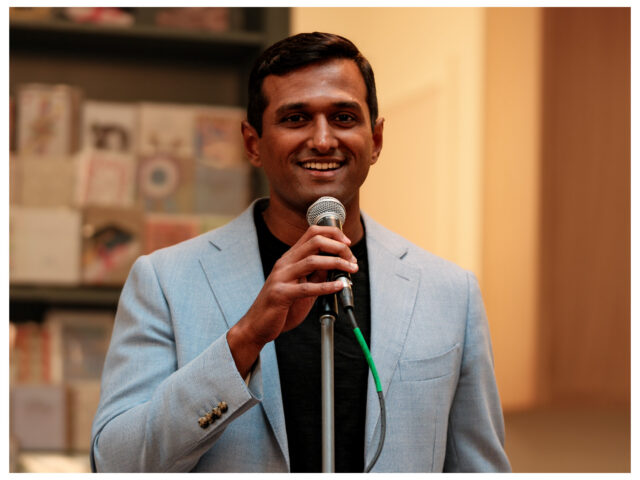 Abhijith Ravinutala is an Indian-American writer based in Austin and a 2026 Writer’s League of Texas Fellow. His work explores the intersections of culture, faith, and loss in immigrant identity. He’s been a finalist for the Nelson Algren Awards and the Missouri Review’s Editor’s Prize. Abhijith’s fiction appears in The Southern Review, Glimmer Train, CRAFT, and elsewhere. He’s currently seeking representation for his debut novel, excerpted here. Find out more at abhijithr.com.