
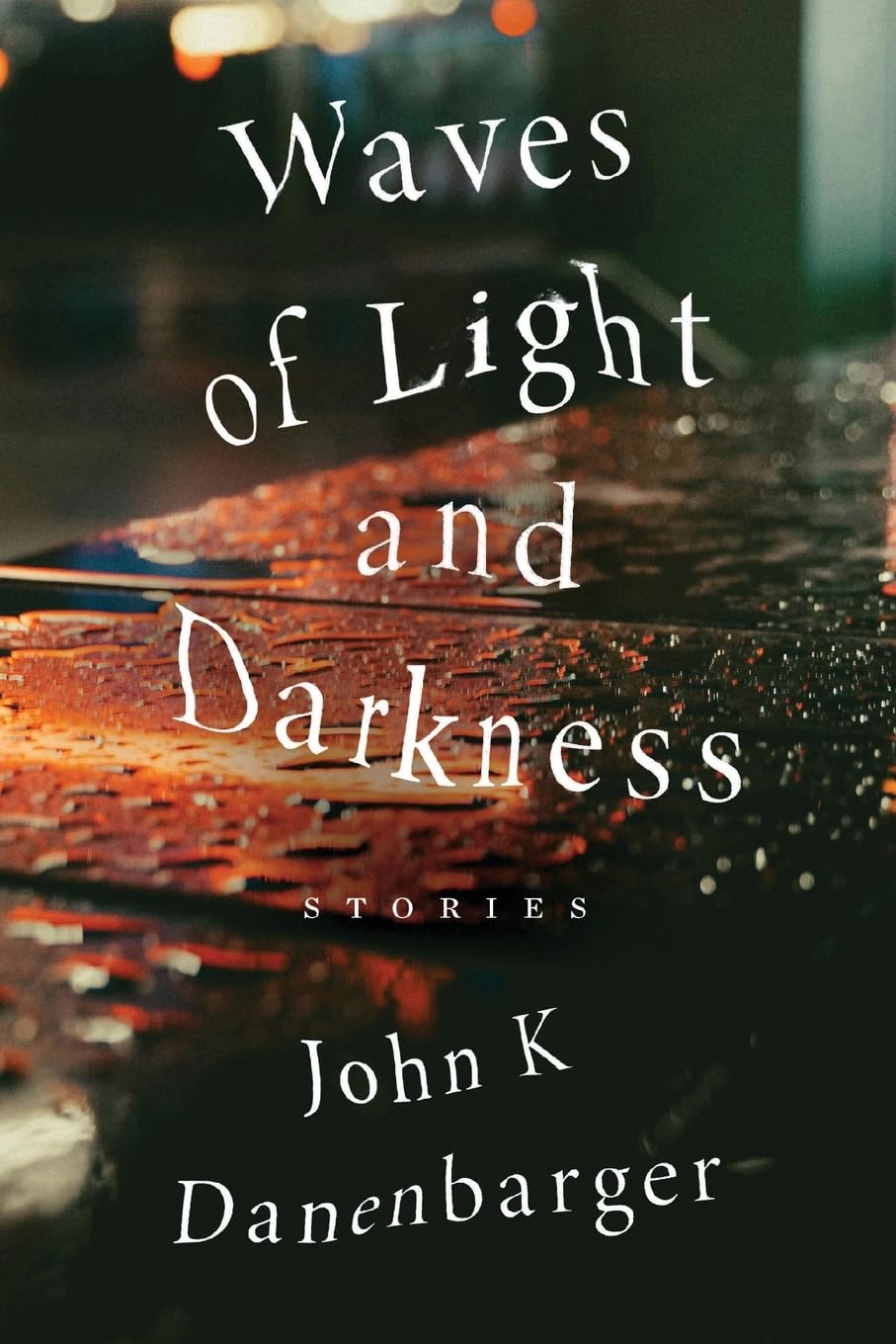
 Consisting of twenty-three short stories that run the gamut of length, tone, and emotional register, Waves of Light and Darkness by John K. Danenbarger is an ambitious, if inconsistent, sophomore outing. At nearly 300 pages, the collection makes its patterns hard to ignore: Some pieces crest with real imaginative force, while many collapse under overdetermined plotting. Overtly existential, the stories circle grief, decay, moral failure, and aborted intimacy.
Danenbarger writes with purpose, efficiency, and a clear sense of narrative shape. Even the weaker stories often begin with sharp or emotionally fertile premises, ranging from divorce and self-discovery to serial killers and superpowered AI. He is especially good at writing from the point of view of offbeat, socially stranded, or eccentric souls whose vanity, grief, or resentment make them difficult but still compelling. One of the strongest impressions is left by “Her Hands,” a two-page story from the second half of the book that consists entirely of a man regretting his lack of agency during a date. Danenbarger is also capable of beautiful imagery and sensory detail, and at his best he can create strong feelings of both absurdity and claustrophobia.
The collection falters where that control becomes too visible, however, preventing the best features of the stories from fully developing, like a puppet show in which the wires keep catching the light to the point of distraction. Many of the stories are difficult to discuss without spoiling them entirely because the premise or twist is almost the whole engine of the piece. Dynamics and motivations are often reduced to final turns, so that revelation replaces exploration. This habit appears especially early in the collection, where the first two stories rely on essentially the same twist, one already familiar enough to be difficult to make new.
There is also an overemphasis on efficiency that can read as cold. In “Seduction,” the image of a bird injuring itself as it tries to escape the rafters of a church might have been more resonant if it were allowed to unfold as experience rather than being tied neatly to character motivation and delivered via monologue after the fact. This briskness works better in the absurd standout “Knowing,” where a shopkeeper deals with adulterous customers, cruel priests, and an ex-girlfriend who returns to win her back with the help of a robot. But in the more emotionally ambitious stories, this same tendency can make the work fall flat.
The most recurring theme is decay: the decay of the body, the self, memory, desire, and intimacy. Across the book, relationships rarely function as rescue. Partners die, are driven away, become unreachable, or were never truly known in the first place. It is here, in stories like “The Gift for Alfred Smoots,” that one most wishes Danenbarger would cut down some of the hand-holding and allow the story to stand on its own.
Though the collection deals in speculative and futuristic elements, it recalls an older mode of short fiction built around irony, moral exposure, and the final turn. That sensibility gives the stories cohesion and momentum, but it can also make them feel dated in their handling of sensitive topics.
Danenbarger is clearly interested in selfishness, desire, and moral failure, and that alone is not a flaw. The issue is that the stories do not always create enough distance from, or do enough reflection on, the ugliness they depict. This is most obvious in the book’s handling of sex, women, and desire.
The same gendered arrangements repeat throughout the collection. Women appear as seducers, dead wives, idealized partners, sexual tests, or figures through whom male characters experience crisis; several are also described in ways that feel objectifying. This pattern is especially visible in “Seduction,” “Love, It Isn’t,” and “The Genesis Story of Adam and Eve,” though it begins as early as the first story, with the first of the collection’s conspicuously braless seductresses. “Seduction” still feels purposeful, if trite, and its female character does have an arc. But “Love, It Isn’t” lets gratuitous sex overwhelm what might have been a stronger story about aging and humiliation. “The Genesis Story of Adam and Eve” seals the pattern: Its satire of gender roles is clear in intent but muddled in execution, God first creates Adam and Steve, genderless figures incapable of keeping house without women and referred to as “him” and “boys.” The fruit of paradise gives them genitalia, and Steve becomes Eve because it is easier to call out during sex. One gets the sense that there is a satirical purpose, but no clear understanding of what it is.
Waves of Light and Darkness is not a careless collection, but it is an inconsistent one. Its strongest stories show Danenbarger’s ability to create claustrophobia, grief, strange emotional pressure, and memorable offbeat characters. Its weakest stories rely too heavily on revelation, sexual provocation, and repeated patterns that limit their emotional force. Like points on a wave plotted from the same function, the collection rises and falls but keeps returning to the same underlying concerns. The best version of the collection feels hidden inside the longer one: shorter, stranger, more compressed, and more willing to let decay and loneliness speak without forcing them into a final turn.
Publisher: Circuit Breaker Books
Publication Date: May 26, 2026
Reviewed by Karina Gonzalez-Espinoza
Karina Gonzalez-Espinoza is a Mexican-American reader and writer based in Tulare County, California. She studied at Harvard University and works in municipal government. Her free time is spent playing word games, collecting handbags, and spending time with her sisters.