

Pauline spent most of her time dealing with domestic animals. Cats and dogs. Now and again, she wrangled fugitive cattle or goats escaped from the hobby farms in the hills north of the town center. Occasionally, she tracked a marauding raccoon or skunk. There were less enjoyable parts of the job. School visits. Town meetings. Paperwork in her little office at the municipal building on North Main. She had to put animals down. After sixteen years on the job, she thought she’d seen everything there was to see, trapped everything there was to trap, euthanized everything there was to euthanize. Then, one day in July, the calls started coming.
“Like a weasel on stilts,” she said to Vicky, who stood, wrapped in a blue towel, by the dresser. “Slender in the midsection like a greyhound.”
Vicky rooted through her underwear drawer. Her dyed-blond hair hung in wet strands over her shoulders. Glancing into the mirror atop the dresser, she said, “I’ve never heard of an animal like that.”
Pauline crossed her legs on the mattress. Earlier that day, she’d collected a stray terrier living by the river behind the old Starling Paper building. Some mud from the riverbank still clung to the hairs on her shin. She crossed her legs the opposite way to cover it.
“I figured the old lady was just lonely,” she continued. “Looking for someone to talk to, you know? So, we walked her property together. We didn’t find anything, but yesterday, I got another call from a woman on Mechanic Street. She described the same animal. A hairless dog with a narrow snout and green eyes. It was lingering in the pines, she said, just watching her little girl play in the yard.”
Pauline paused for effect. The young woman did have a little girl on her hip as she spoke about the animal, but she’d fabricated the detail about it watching from the pines, just to give the story a little extra intrigue. Maybe it worked. Vicky hummed as she hiked up her underwear.
“And earlier today,” Pauline continued. “This Puerto Rican guy calls and says it’s a chupacabra.”
“A chupacabra?” Vicky said, laughing.
“Who knows?” Pauline said, watching the way Vicky’s shoulder blades shifted beneath the skin as she fastened her bra. “We might have a mythical creature on our hands.”
Vicky laughed, and said, “Well, what do you think it is?”
Pauline had some ideas, but she thought Vicky might prefer the mystery.
“We’re going to trap it to find out.”
“We are?” Vicky said. “When?”
“Tonight,” Pauline said. “I’ve got the traps in the van.”
Vicky leaned toward the mirror, turned her head side to side, examining her face. She ran two fingers over the acne scars on her right cheek. She felt insecure about them, even though the insecurity never showed in public. Like the little blue cross she’d tattooed on her thigh with a sewing needle as a teenager, or the way she sometimes whimpered and kicked in her sleep, it was one of the little secrets Pauline kept about her.
“I wanted to go down the Roadhouse tonight,” Vicky said. “There’s a band playing.”
“You’re down there every night.”
“Work doesn’t count.”
“The Roadhouse will be there next weekend,” Pauline said. “A monster? You never know how long it’ll linger. We’ll make a date of it.”
* * *
At St. John’s Cemetery, Pauline parked the van beside the rusted crypt door in the hillside. She’d explained the reasoning behind the location to Vicky on the drive over. The first call had come from the old woman who lived on North Main, which ran along the cemetery’s western boundary. The woman with the little girl lived to the cemetery’s south. Finally, the man with the Puerto Rican flag hanging from the porch of his trailer lived on Garvey Street, which hooked around the cemetery’s northeastern edge. Triangulate the calls, and the cemetery rested dead center.
With the trunk open and the overhead light glowing, Pauline examined the two Havahart 1080s. They were the biggest of all the traps owned by the town. Not quite big enough for a coyote, but perfect for a fox or raccoon. Vicky watched as she lifted the gate. She fiddled with the mechanism, checked the springs.
“The animal goes in,” Pauline said, demonstrating with her hand. “They step on this lever and the gate drops.”
She tapped on the pressure plate and the gate fell on her arm. Vicky nodded. She’d heard plenty from Pauline about animals encountered on the job, but Pauline never thought to tell her about the tools of the trade. To her, traps and catchpoles and chemical repellents were as common as flour and eggs to a baker, but she had to admit it was nice to have someone to listen as she explained the mechanics of the trap. The job could get lonely, though she never thought about it until Vicky came along.
After collecting the cans of cat food from the glove compartment, Pauline dropped them into the cargo pocket of her shorts, and said, “I’m thinking we put one to the northeast.”
She pointed in the direction of the trailer where the Puerto Rican man lived. Then, she motioned toward the apartment building where she’d met the young woman.
“The other to the southwest.”
Vicky said, “You’re the expert.”
As they walked the dirt road running the cemetery’s edge, each carrying a metal trap by the wire handle on top, Pauline said, “Maybe it’s just a cigarette-smoking raccoon?”
A smile darted across Vicky’s lips and vanished just as quick. A little over a year ago, Pauline brought a PowerPoint presentation to the emergency shelter on South Main. A few of the residents had developed a relationship with a local raccoon. The animal had become so friendly, the director told Pauline, it took potato chips straight from the hand. In the shelter’s common room, Pauline explained the ways animals become dependent on humans if they’re regularly fed. They lose their natural instincts, risk spreading diseases to house pets and people. They could become aggressive if denied. As she spoke, one man raised his hand. In his other arm, he held a chubby baby wearing only a diaper. He wanted to know if raccoons smoked cigarettes. The woman sitting beside the man rolled her eyes. As the story went, he’d tried to give the raccoon a cracker, but it snatched his cigarette instead and scuttled off into the trees.
“I don’t want to think about that place,” Vicky said.
They continued along the bend in the road, their footfalls scraping against the gravel, with a backdrop of evening sounds, crickets and birds. The setting sun slung their shadows long over the earth. Laid beside Vicky’s, Pauline considered her own shadow, their differences. She stood taller in her work boots, shoulders wider than Vicky’s, hips squared by her cargo shorts. She guessed her own shadow could cover Vicky’s entirely if she walked behind her. She shifted the trap to the opposite hand and watched their shadows merge as she stretched her arm across Vicky’s shoulder.
“We always used to laugh at that story,” she said. “I didn’t mean anything by it.”
* * *
Traps set, they returned to the van. The radio warbled low as they drank cans of Pabst Blue Ribbon with the windows down. Darkness draped the cemetery. Vicky smoked her Pall Mall Lights and talked about the Roadhouse. Glen had hired a cover band to play on Friday nights, bought a pizza oven to complement the grill and fry-o-lator.
“He’s trying to clean the place up a bit,” Vicky said. “I told him about this bar in Florida where I used to work. It had a big dance floor. I said he should move some of the tables at the Roadhouse and try it out.”
“You think people would use a dance floor?”
“I don’t know,” Vicky said. “Glen liked the idea.”
“I’m not saying it’s a bad idea,” Pauline said. “All I’m saying is this isn’t Florida.”
“No shit,” Vicky said, sipping her beer. Beyond her window, the crypt entrance stood shadowed by the slope of the hillside. Rust showed through the green paint on the metal door, but the lock was new, made of stainless steel.
“What was the bar called?”
“Wild Bill’s,” Vicky said. “Cowboy bar in Okeechobee.”
Pauline laughed.
“Why are you laughing?”
“I didn’t know there were cowboys in Florida.”
“Cowboy bars all across America,” Vicky said. “It’s a make-believe kind of thing.”
“Well, if there aren’t any real cowboys,” Pauline said. “What makes it a cowboy bar?”
“The barstools are shaped like saddles,” Vicky said. “There’s a set of longhorns on the wall, horseshoes on the bathroom doors that say Dudes and Dames. There’s a country western band and line dancing. They do these rodeo nights where they bring in a mechanical bull. They have a contest for free drinks where they put one of the pretty young bartenders on a chair and people try to lasso her.”
Pauline imagined the bar with its longhorns and saddle seats, pictured Vicky seated in a chair with her ex-husband tossing a rope at her. Vicky refused to speak about the man, but Pauline imagined him with big hands, powder blue eyes, and a dimple on his chin. Maybe Vicky wondered about Pauline’s past, too, though she never asked. Not that there was all that much to tell. Other than the neighbor girl who she’d kissed when she was eight years old out of a shared curiosity inspired by John Travolta and Oliva Newton-John, there was only Sam. They’d met in a biology class at the community college in Prescott. When they weren’t studying, they spent most of their time wrestling beneath the blanket on Sam’s bed in the little studio apartment where she lived.
Maybe they were in love, Pauline didn’t know. It was nearly twenty years ago. She did, however, remember a gathering Sam brought her to at the college. The event was attended by other students, many of whom had dyed hair and piercings, T-shirts printed with complicated logos and acronyms. Everyone painted picket signs for a protest they planned to attend in Boston. Pauline didn’t know what to write, so she helped Sam on a sign that said, Out of the closet. Not going back. Either way, the relationship fizzled shortly after Pauline failed to show up for the protest. It wasn’t painful. Sam had plenty of friends—she didn’t need Pauline—and Pauline convinced herself it was easier to be alone.
She brushed Vicky’s hair aside and said, “Don’t worry.”
“Worry about what?”
“I don’t know,” Pauline said. “Anything.”
For a long while, they drank their beers and listened to the radio, talking in short exchanges about the future. Pauline wanted to put a patio behind the house so they could relax in the evenings. Vicky wanted to look into getting a loan for a vehicle. The darkness thickened across the cemetery.
Vicky’s cell phone buzzed. She dug it from her purse, looked at the screen, and sighed as she opened the van’s door.
Pauline said, “Who is it?”
Vicky closed the van door behind her without an answer.
She claimed they were bill collectors looking for money whenever she denied calls. Occasionally, Glen called to offer a shift at the Roadhouse, to ask questions about an incident the night before, to remind her to do something she’d forgotten. Once or twice a week, her mother or her son, Trevor, called from Florida. Same as her ex-husband, Pauline had no idea what her son looked like, but she remembered the sound of his voice. Timid, tired sounding. That day at the emergency shelter, after Pauline gave her presentation, Vicky had followed her onto the front porch. She asked if she could please use her cell phone. The shelter only allowed residents one call a day from the office line. She needed to talk to her son.
That day, standing on the porch in full sunlight, there was something about Vicky that drew Pauline’s gaze, like a hummingbird to bee balm. She wasn’t young anymore, though something about her appearance had fooled Pauline. Her hardscrabble beauty was the kind you might find far north, where the earth is all pine and granite. Later that night, as Pauline filed paperwork in her office, her cellphone rang. It was Trevor. He said he had missed a call from this number and asked whether it came from his mom.
A night bird sang from the trees at the cemetery’s edge. In the distance, Vicky lingered at the bend in the road where it rose toward the heart of the cemetery. The light of her cell phone screen carved from the darkness the easy angle of her jaw, wisps of hair by her ear. She looked ghostly in a way that made Pauline imagine her existing in two places at once. And out there with her, some kind of monster. It could have been watching from the pitch of headstones as she spoke into her phone, lifting its snout to inhale her smoky scent on the breeze.
When Vicky dropped into the van’s passenger seat again, she said, “Trevor’s in some kind of trouble.”
“What kind of trouble?”
“He needs some money.”
“How much money?”
Vicky looked at her phone in the palm of her hand like she might find the answer there on the blackened screen.
“Take me to the Roadhouse,” she said. “I’ll see if Glen will lend me until payday.”
“I’ll give you the money, Vicky,” Pauline said. “How much do you need?”
“Please, Pauline,” Vicky said. “Just take me.”
The cold calm of her voice kept Pauline from pushing the issue. She turned the van and drove in silence down the cemetery road, replaying in her mind the last spat they’d had about money. Vicky’s first week working at the Roadhouse, some drunk had palmed her butt as she passed with a platter of drinks. She promptly dropped the platter to the floor and shoved the man, who slipped in the mess of beer and glass. Still on his ass, he held up a bloody palm to Vicky, and said, “Look what you did, you bitch.”
Just quit, Pauline told her that evening after Glen sent her home. She made enough money for both of them dealing with animal problems for the town. Vicky could stay home and write the memoir she always talked about. She could start a garden to grow vegetables and herbs. They could rescue a dog, and Vicky could spend her time looking after her. In the ensuing argument, Vicky said she didn’t need a sugar daddy. Pauline knocked her glass off the table, stood so quickly her chair fell over. She shouted, Is that what you think of me? Vicky rented a room at the Travel Inn, and Pauline lived alone again for three days. And even with all of that time to think in silence, she couldn’t figure out why she’d lost her temper.
The Roadhouse parking lot was lit in amber streetlight, packed with pickups and sedans. A row of motorcycles leaned against their kickstands by the establishment’s cinder block facade. A banner with a beer logo hung above the door, Live Music Friday. Pauline parked between a pickup and a motorcycle.
“How long are you going to be?” Pauline said.
“Ten minutes tops,” Vicky said, opening the passenger door. “Glen’s tending the bar and it’s busy. He won’t want to chit chat.”
As Vicky slipped inside, the boom of the music barreled into the night like a passing train and faded again as the door swung closed. Pauline eased back in her seat, angled another can of beer from the cardboard carton between the seats. She drank, watching the moths and mosquito hawks circle the light tacked to the corner of the building, resenting Vicky the fact she’d gotten her way after all.
* * *
In the thirty minutes Pauline waited in the van, she finished twenty-four more ounces of Pabst, watching drunks swivel in and out of the Roadhouse for cigarettes. As she pushed her way through the bar’s door, the music stirred the drunkenness in her head the way hatchery fish roil their vats while feeding, muddling her vision as she searched the room. The air inside was thick with the odor of onion rings and stale beer, dented by the subtle musk of cheap cologne.
As she approached the bar, she spotted Vicky in the rear, standing beside a booth table occupied by people Pauline didn’t recognize. Maybe she’d seen them around. Two men, one wearing a mustache, and a woman with hair feathered at her temples. Townies. Vicky tilted her head back and laughed at something the man with the mustache said, though the sound of it was hidden beneath the clamor of the band. The lead singer sang a lyric about a broken heart. A cymbal crashed and Pauline took the furthest seat at the bar, closest to the rear wall where the pine shelves held the liquor bottles. A taxidermy buck hung overhead. A set of green Mardi Gras beads and a pair of black panties dangled from the right antler. Through the gap between the two men seated just around the bar’s corner, she watched Vicky sip a highball. Jack and Coke. She always brought home the sour scent on her breath after her shifts.
Glen tossed a paper coaster on the bar, leaned forward, and shouted over the music and clatter of voices, “What’ll it be?”
She scanned the liquor shelf but decided against the idea since the work van was parked in the lot. They still had to drive back to the cemetery and collect the traps. She ordered another beer. As Glen returned to the cooler, Pauline watched Vicky across the room, forward-bent, talking to the people at the table.
“Open a tab?” Glen said as he set the bottle on the coaster.
Pauline said, “I’ll pay for Vicky’s drink, too.”
He tilted his head.
“She works here,” he said, and a moment passed before he grinned like he understood something secret Pauline was floating his way. “Wait? You’re Vicky’s roommate, aren’t you?”
Pauline stood from the barstool, took a long pull from the bottle, and wiped her lips with the back of her hand. She fished her wallet from her pocket and slid loose a twenty. Handing it to Glen, she said, “Keep it.”
The band stopped suddenly at the end of their song, and only the hum of drunken voices remained. A thread of laughter, a hook-fingered whistle, some half-hearted applause. Vicky lifted her glass to drink, and in the low light from the shaded lamp above the table, Pauline could tell it was mostly water now, a few fragments of ice floating inside. When she reached the table, she laced a finger through the belt loop at the back of Vicky’s jeans. She tugged hard, and Vicky rocked in her direction.
“Hey,” Vicky said. She blinked slowly, drunkenly. “I was just getting ready to leave.”
The table was crowded with glasses, empty beer bottles, a half-spent pitcher with a ring of foam hung around the rim. The woman seated at the table said, “Vicky told us you two are out hunting some kind of wild animal.”
“I bet it’s a coyote,” the man with the clean-shaven face said. “I bet you deal with a lot of coyotes.”
The band started up again. A slow song, something lovers rock to with arms resting on each other’s shoulders. She scanned the faces around the table, observing their shapes but not really seeing the features, and the memory came on like a premonition. The scent of ammonia still brewing in the hollows of her sinuses. A specter, lingering through the years, unnoticed until now.
“A few years ago,” Pauline shouted over the music. “I got a call out to this old farmhouse up the state line.”
The woman leaned in, and the men seemed equally willing to listen.
“This lady had so many cats I had to call in Prescott and Levon Animal Control,” Pauline said. “The smell was so brutal it brought tears to my eyes. Thirty-six cats. The bathtub was filled with litter just as hard as a rock. Cats lounged in the cupboards, in the sink, on top of the refrigerator, in the television wires. In the bedroom, a dozen sat on the mattress.”
“Sad,” Vicky said. “I never understood how people—”
“Let me tell you something about sadness,” Pauline interrupted, refusing Vicky her eyes. “I’m up in the bedroom with all of these cats staring from the bed. The smell is just unbearable, so I go open the window for some fresh air. Down in the backyard there’s a pen, split rail fence built off an old pine shed. So, I go down there. And I find this horse, lying on its side. Like a skeleton, all its bones showing. Ribs. Hips. These dark eyes rolling around in its skull. Its hooves look like giant corkscrews in the dirt. They had to be three feet long, and so heavy the horse couldn’t lift its legs to turn away from me.”
The woman stared down into her liquor glass. The man with the mustache blinked at the other man and shook his head.
“When I came back out front where the police were standing with the woman, she glared at me with this hateful look in her eyes. If we were alone there, she would have killed me. And she screams, You can’t take them! They need me!”
Pauline turned her gaze on Vicky. Her eyes looked glassy, like she was thinking about something far off in time or distance. In the heart of the bar, a few couples had gathered on the dance floor. Pauline tried not to think about what it would be like to dance with Vicky while everyone in the barroom watched them sway.
* * *
The van’s engine idled low at the traffic light on the south side of the Pocumtuck River. In the passenger seat, Vicky stared through the windshield. The red glow of the traffic light glistened in the tears on her cheeks, but she made no sound.
“What are you crying for?” Pauline said.
Vicky said, “I just want to go home.”
“We need to pick up the traps first,” Pauline said. “If someone hasn’t already walked off with them.”
The light turned green, and Pauline eased the van onto South Main. They continued through the channel between the brick mills, across the bridge that carried the pavement over the river, past the town common and the Shady Vale Diner. As they rounded Water Street, Vicky said, “They’re my friends, Pauline. Why did you have to go and tell them that awful story?”
“It wasn’t for them,” Pauline said. “I want you to know what it’s like trying to love you.”
Vicky laughed.
“Why are you laughing?”
“I’m not some neglected animal,” Vicky said. “I don’t need you to rescue me.”
“You’re mixing up the meaning.”
Vicky wiped her tears away. She lit a cigarette and shifted her body toward the window. Outside, the town rushed by, smeared light in the darkness.
As they passed the emergency shelter on East Main, Pauline eased her foot off the gas pedal. The first floor windows of the ramshackle Victorian were darkened, but a few windows on the upper floors glowed, rooms occupied by drifters passing through. The night she returned to the shelter to let Vicky talk to Trevor on her phone, she waited on the front steps while Vicky paced in the moonlight. The meaning of the conversation was lost in the distance between the yard and the porch, but Pauline could sense the growing tension in the cadence of her speech, the intensity of her pacing. Eventually, Vicky stopped dead in her path and stared at the phone before dropping to her knees. By the time Pauline had crossed the yard, she was on all fours, her head tucked between her elbows, face buried in the grass. Pauline rubbed her back to soothe her crying, shushed her the way she did sometimes as she approached frightened animals with the catchpole. She knew right then she couldn’t let her go back to the shelter. She needed to be with someone who could love her.
“Why don’t you just have him come stay with us?” Pauline said.
“Who?” Vicky said. “Trevor?”
“I’ll buy the ticket,” Pauline said. “He can take the spare bedroom.”
“What would he want to come here for?”
“To be with you.”
In the ensuing silence, Pauline pictured the boy standing at a window with the curtain pulled aside. The disappointment at the sight of an empty street. Those days alone in the house after Vicky vanished, Pauline felt it a thousand times—that sinking in the gut—the feeling came on whenever she dragged herself out of bed. It baffled and frightened her. What was so different about the aloneness she felt in Vicky’s absence? In nature, nothing. She’d been alone her entire life.
Across the cemetery, the moonlight gave the gravestones the look of a cityscape in miniature. The headlights carved the terrain from the dusk, glinted off the lock securing the crypt door as they passed, and Pauline steered the van along the bend in the road. As she continued up the hill, the light drew names and dates from the smooth stone faces, illuminated plastic flowers and knickknacks, souvenirs left by the living for the dead.
In the heart of the cemetery, where the road looped around the flagpole, she shoved the transmission into park. She shut down the lights but left the engine running.
“Will you come with me?” she said.
Vicky sighed and opened the passenger door.
Guided by the glow of Vicky’s phone, they wove through the night, sidestepping headstones, the earth mossy beneath their feet. Pauline’s thoughts wandered among the dead, just a half dozen feet below. If they could speak with the living, what would they say about loneliness? Knowing what they know about how things come to an end, what would they say about love? Pauline was trying to pin some kind of answer against the beer-slicked surface of her mind when Vicky suddenly stopped. Her hand gripped Pauline’s wrist.
“There’s something in that trap,” she whispered. “I just saw it move.”
Pauline pushed forward, and as they approached, a hum unraveled in the dark, like the sound of an engine fading in the distance. A pause for an in-breath. Upshifting, picking up speed. Pauline leaned forward, straining to see, and the animal snarled before snapping at the wire cage.
“My God,” Vicky said, hooking her arm with Pauline’s, pulling herself close. “What is that?”
“Use your phone,” Pauline said. “Shine the light.”
Inside the cage, a slender frame, pale gray skin stretched taught over bone. The scent of infection. Emaciated and afraid, there was nothing mythical about the creature, nothing monstrous about her.
“It’s a fox,” Pauline said. “Looks like she’s got mange.”
“What’s that?” Vicky said. “Some kind of disease?”
“Mites,” Pauline said. “They live under the skin.”
Pauline examined the yellow-brown scales grown around her ears, across her shoulders, the opened abscesses along her ribs. Wide, green eyes staring, the fox brandished her teeth. A pitiful growl unwound from her throat while the muscles in her hind legs trembled, too exhausted to fire.
“Can you help her?” Vicky said.
It’s never easy to tell. Sometimes, with a little care, a ruined animal can be redeemed. Other times, it’s best to end their suffering.
After the police carted that old woman off to the station for processing, Pauline and the animal control officers from Prescott and Levon returned to the shed. The horse moaned when they entered, reared its head and threw it down against the dirt, corkscrewed hooves knocking together like wooden blocks. The other officers looked to her for an answer, even though they all knew what had to be done.
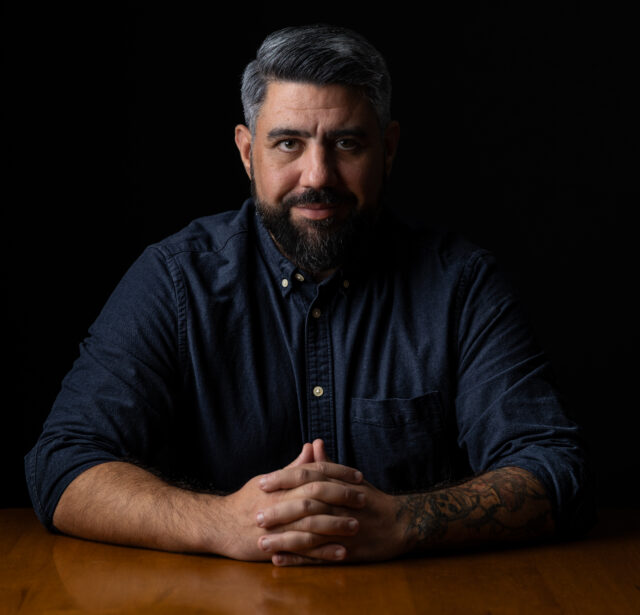 J. Stillwell Powers was born and raised in rural New England. He is a graduate of Greenfield Community College and Amherst College, and holds an MFA in Fiction from the University of Oregon. His work has been supported by the Fine Arts Work Center and the Elizabeth George Foundation, and has appeared in Willow Springs, The Florida Review, the Southern Indiana Review, and other journals. He currently lives in South Texas with his two children and is pursuing a master’s degree in clinical mental health.