

When I called, you said you were in a bar near your office with Julius. You were waiting for him to finish up, then you would either go to another bar and give me the address or you would come home. When I asked how long it would take, you said you didn’t know. “Then give me the address of the bar you are in now, and I’ll join you.”
“You might come for nothing,” you said. “You might come only for the two of us to return together.”
“That’s good enough for me,” I said.
I was sick of being in the house or in the small courtyard surrounded by tall walls, plastered with orange dirt and crowned by a roll of barbed wire. Unlike the other places you had lived in, this was in a central area. It was enough to take two steps outside the gate and I was in one of the busiest junctions in Kampala. Hundreds of motorcycles whooshed past me, a constant stream of students flowed from the university campus down to Wandegeya market, mixing with people coming from the city in search of the minibuses waiting at the end of the line, in the huge unpaved parking lot. On both sides of the boulevard, at the ground floor of buildings, there were shops with clothes, domestic appliances, graduation gowns, restaurants offered cheap meals out of big cauldrons, while on the edge of the sidewalk, women sold fruits and vegetables, among children and beggars.
In the past you had lived in residential areas with quiet streets and two or three story houses, where after a while people got used to me: the neighbors sharing our courtyard, the shopkeepers, the waiters at the terraces where I could have a coffee and read while I waited for the day to pass and for you to finish work. Here we didn’t even have neighbors. The flat was located at the back of the owner’s house, with a separate entrance and courtyard, and the gatekeeper wore a black and blue camouflage uniform and a gun. He didn’t speak English and spent his day slouching on a chair, with his gun leaning on the wall, watching loud videos on his phone. Every time I came out onto the terrace, I felt like we were locked up together. From the street came the noise of motorcycles, occasional quarrels in Luganda, ibis cries that sounded like lambs bleating, and hours of rhythmic music from the nearby church that became increasingly urgent as the day advanced, accompanied by the thundering voice of a pastor who seemed to announce the apocalypse. Although the inside of the house had a modern design, with a bar, a spacious living room and art on the walls that you had chosen yourself, you seemed not to enjoy being there either, as you only came home to sleep.
You gave me the address of the bar and told me to take an Uber, which meant a car, not a boda-boda motorcycle. It was after seven; it was dark and after nightfall the chances of having an accident on the unlit street increased. Then you called back and said Francis would come get me. “What should I wear?” I asked before hanging up.
“Whatever you want,” you replied, but not in the voice meant to reassure me that whatever I wore was all right, but in the irritated tone you used lately, although I had explained to you that it was enough that I was white, I didn’t want to stand out even more for being inappropriately dressed.
I put on some tight jeans (like I had seen other women wear) and a white T-shirt with a golden-green inscription that I styled with glittering jewelry and high-heeled sandals, and I tucked an additional sparkling necklace in my bag, in case it turned out I was underdressed.
Francis arrived on foot. He lived in the area. I insisted on calling the Uber myself. I needed to prove that I could do things on my own. I put the pin on the map and waited for the driver to call me so I could explain to him exactly where I was. It wasn’t clear to me whether GPS wasn’t accurate in Uganda or if this was a leftover habit from the time when there were no digital maps and people found their way using physical references—a junction, a supermarket, a gas station—the way it was during my first visits.
“Gebaleko, sebo. Django oncime Bativa Road, behind Ham Shopping Centre,” I said mixing Luganda and English. “Ntegerize.” I am waiting. I knew the word because it was the title of your first hit single, a love song.
The gatekeeper opened the two locks and let us out. The street was dark, but the headlights of a car parked in front of the gate let us know that the Uber had arrived. We got in the car and Francis said there was someone else we needed to pick up, a friend of Julius, Moses. I wondered if it was the same Moses you had told me about the previous night, how he had gotten drunk and grabbed a girl by the arm and pulled her towards a boda-boda, insisting that she come back with him to the student hall, until you had had to step in and free her.
The car passed the check at the entrance of Makerere campus and stopped by the boys’ student hall, a massive brutalist building that I had seen when I walked around the campus with Francis, and you said you would join us, but didn’t. Now, in the dark, all that was left of the building were the lit-up rectangles of the windows. Moses opened the door and took the seat next to the driver. Francis shook hands with him, I asked him if he was a student, what year and which major, but he replied curtly, so I let him be and Francis started asking questions about me.
Your mom had finally invited me to dinner. Francis laughed. “So Mommy Namukasa is coming around”.
I laughed back. “Yes, and it only took six years.”.
Francis said what he always said when we talked about your mother. That she was difficult, and she intimidated him as well, but once she knew me, there was no reason for her not to like me. It turned out he had been right. While you retreated to reply to some urgent emails, under the pretense that she was taking me outside to show me the damage monkeys had done to her garden, your mom sat me down on the terrace and subjected me to a long questioning about me and my family in Romania. She wanted to know how I saw marriage, what I planned to do in Uganda, if I wanted children and at what age. She told me I had to understand I was going to marry not a man, but a culture, and African culture is very different from European one, and I said that what she calls European is actually Western culture, while the world I come from has more in common with Africa than she imagines. My parents had also opposed our relationship and refused to meet you—but I didn’t tell her that. In the end, she got up and hugged me, and we came back into the house where you hadn’t moved from your laptop. It had been an important moment, the last obstacle in the way of our life together, and I was so immersed in the telling of the story, that it was only when the car stopped and three people exited that I remembered Moses was with us.
The Uber drove off and we were left in total darkness. I called you and you told us to enter what looked like the courtyard of an industrial building. In the distance we could see the light from an open door. You came to meet us, took my hand and gave me a brief kiss on the lips, even though you didn’t like public displays of affection, which were not customary in Uganda, but a remnant of our life in Europe.
The bar was a repurposed industrial hall and I asked you if it was the one in the pictures. In London we had seen many spaces like this one; then they had started appearing in Bucharest, then you had found one in Kampala. You sent me pictures of it with the caption: I found the hipster headquarters. You said it was the hall in the pictures, your office was right across the street, you came here almost daily, there was a bar, a food court, an art gallery, a shop with clothes made by local designers and a space meant for parties. Beyond the wall of galvanized steel, decorated with stencils of palm tree leaves and wild animals, I could hear drums, guitars, a choir led by a resounding male voice. You said that was Julius; he was responsible for the music at a church meeting.
You led me to a chair and told the bartender to take care of me, but instead of a stranger, Isaac emerged from behind the bar. He hugged me over the counter, asked me when I had arrived. You hadn’t told him I was in town. “I know,” I said. “He likes to surprise people.” A few months prior, when Crested Crane Records had offered you the position of Creative Director, you had called to ask my opinion. You weren’t sure how Isaac was going to take it and wondered if accepting would mean selling out. But wasn’t that the dream? To work in the underground music industry until you were good enough for the mainstream to want you? The fact that Isaac was there, in the bar you frequented, seemed a good sign. He said he was still making music; this job was only to make some extra money. You said you were leaving Isaac and me to catch up and sat down at a table with two women I didn’t know.
When we lived in London, we had discussed how in patriarchal societies like the ones we both came from, a woman risks being seen not for who she is, but for who she is in relation to a man, and neither of us wanted that. I appreciated that you introduced me with my name and profession, “Diana, writer.” It was a different starting point for a conversation than if you had introduced me as “Diana, my girlfriend.” I knew this and I knew I had to be able to stand on my own two feet when it came to socializing.
Next to me at the bar was Karim, a young hip hop artist that you had just finished recording. He watched me inquisitively, probably wondering about the white girl acting so friendly towards Isaac. I told him I liked his music. I had seen him perform at Sofar the previous Sunday with you and Julius. He said he had noticed me too. “There was little chance I would have passed unnoticed,” I laughed. I was sitting between Francis and him, on the other side of the bar Isaac was making me a drink, and I could feel the three men focused on me, asking me questions about my stay in Uganda, but instead of their interest in a foreign being I would have preferred your interest in me.
I excused myself, got my drink and walked over to you. I placed a hand on your shoulder. You invited me to sit down and introduced me to the two women. They greeted me coldly, especially one of them, who was tall and robust. She pursed her lips and looked at me with her eyes half-closed. You told me that they were working at the art gallery and you said that they should give me a tour, that I was a fan of contemporary art. The smaller girl said sure and it seemed to me like she wanted to get up, but she stopped when she met her friend’s gaze. The other one gave me a look that was either bored or pained, I couldn’t tell, and asked me to forgive her, it had been a long day, and she had a headache. “Sure, no problem.” We stayed in our seats. It got quiet. The smaller girl cleared her throat and asked me where I was from and what I was doing in Uganda, but as I was talking, I could see the other girl with her head thrown back, looking left, then right. I had never come across such animosity, at least not in your circles, and I wondered if it was because I was white or because I was your girlfriend.
Julius came out from behind the stenciled wall, and everyone stood to greet him. He was dressed in black boots, white jeans and a khaki silk tunic that was only buttoned at the neck, revealing a white vest underneath. A gilded peacock shone on his chest, hanging from a thin chain attached to the collar of his tunic, and round, gilded-frame glasses gleamed on his nose. We hugged. He took my hand and raised it, forcing me to do a pirouette. “Such understated elegance, I love it.” I laughed, delighted.
Julius was hyped after the gig and talked animatedly, about the show, about the people in the choir, about the things he still needed to do: packing up the equipment, getting his money. A small crowd gathered around him: Francis, Karim, Moses, and others I didn’t know. I sat down and finished my drink, exchanging smiles of genuine sympathy with the smaller girl seated across the table from me. She had her legs crossed and lightly swung a golden-braceleted ankle and every so often threw her long red braids over her shoulder. The other girl had stood up and was listening to you and Julius.
Eventually, we visited the art gallery. Francis hadn’t seen it either, nor Karim, nor Moses. Behind the stenciled wall lay an ample hall lined with containers that housed commercial spaces with their shutters pulled down. The tall girl pulled up one of the shutters, revealing the window of the small gallery. “She not only works here, but she is also a painter,” you said, and I wondered if she had made the painting at your house, which you had told me that you had had to buy from the owner of the gallery without the knowledge of the artist, who hadn’t wanted to give it to you because you didn’t want it enough. While the tall girl explained the paintings to Julius and Moses, I walked along the walls and tried to remember the signature on that painting at your house, whether it was anything like Winnie, what I thought was the girl’s name. You were sitting on the chair behind the desk, with your legs stretched out and your hands on your stomach and a familiarity that made me want to gasp for air. “What do you think?” Francis asked me. I couldn’t tell him the truth.
I was glad the group decided to go to Other, one of the hot stops in Kampala that attracted both Blacks and whites.
“Is Winnie coming?” I asked you.
“Vinnie,” you corrected me a bit too sharply.
“Is Vinnie coming?”
“Yes.”
We stood in the parking lot discussing how to distribute ourselves in the cars. Isaac couldn’t come; he was working. Moses didn’t want to come, but Julius said it was out of the question and assigned Moses a spot in his car. Francis and I were riding with you. Vinnie and her friend said they were coming with you too. Karim had to ride with Julius.
Vinnie opened the door of your car in my face, blocking my access, and climbed into the passenger seat. I crammed in the back with Francis and the other girl, wondering if I was going crazy or if there really was something wrong with the way you were both chattering in front, enveloped in an almost tactile intimacy, and only once in a while you remembered to throw a joke to us at the back, to which only the small girl replied, while Francis and I sat in an embarrassed silence.
Or maybe it was the fact that we had a long-distance relationship, and I was aware that I was missing out on the small victories and annoyances that made up your everyday life, but which at the end of the day didn’t seem important enough to be communicated in intercontinental conversations. It was normal for you to have friends, including women, with whom to unwind and vent at the end of the program. After all, it was my friends in Bucharest I called when I wanted to complain about an email from my publishers, or moan that I had put in a red T-shirt with the whites. Maybe it was only my insecurity and frustration at the fact that we were living our lives separately that made me jealous of your relationship with Vinnie.
“This is where I got robbed,” Francis said, pointing to a spot in the dark. “About two weeks ago, I was going home and the boda driver suddenly swerved left on a path and two guys jumped me. They took my wallet and my phone and hit me with a metal bar.” He rubbed the back of his head.
You didn’t say anything. You had probably heard the story already.
“What kind of boda was it? Had you ordered it through Safe Boda?” I asked.
“No, I picked it up by the side of the road.”
In front of the club, the parking was packed. You found a spot at the far end and everybody got out. I said I wanted to leave something in the trunk and you stayed behind with me.
“What do you need to leave?”
“Nothing. I just wanted to be alone with you for a minute.”
You laughed, pulled me close. You kissed me.
“You only kiss me in the dark.”
“I kiss you when I feel like it.”
“You kiss me when no one sees us.”
You loosened the grip of your arms enough for me to pull away a little, but you didn’t let go of me.
“What’s going on?”
“Does Vinnie know we are together?”
“Of course. Why do you ask?”
“She doesn’t like me.”
“Why do you say that?”
“Have you seen the way she acts with me?”
“No.”
“You should pay more attention.”
You put your arm around my shoulders, and we walked into the light. Vinnie and the small girl were waiting for us on the path to the club. Before reaching them, you stopped and kissed me one more time. Your hand continued to rest on my shoulder, and I entwined my fingers with yours.
“Have you been here before?” I asked Vinnie and her friend.
“No.”
“How about you?” the smaller girl asked.
“I have.”
I had been there once before, a few days prior. Your habit of going out to clubs was a new development, something that had appeared in the half year since we had last seen each other. You weren’t crazy about dancing. You usually liked bars with live music, but you had started frequenting Other for the EDM nights and the eclectic playlist, with music from Europe, Africa, Asia, and the Middle East, and because you liked to observe people. When you agreed to take me with you, you said you were nervous, that you didn’t know whether I was going to enjoy it because Julius and Francis didn’t. You usually went there on your own. We had sat at the bar, while you explained to me the groups. Expats that worked for embassies and international NGOs, young people that were there volunteering at charities or churches, backpackers with a brazen carefree air, businessmen with gold watches and undone ties, shady uncategorizable individuals. Next to us at the bar sat Black women with short tight dresses and sparkling jewelry running down into their cleavage, who were thinner and less shapely than the full-bodied women who usually acted like divas in other the places we went to. You told me those women were there to pick up white men. Some asked for money up front—“You mean prostitutes?” I asked, and you shrugged. “If that’s what you want to call them,”—others were more discreet, expecting presents and the payment of certain expenses. “But don’t worry, there are just as many men here to pick up white women. On this issue, there’s gender equality,” you laughed.
I looked around. “How can you tell who they are?”
“They have dreadlocks.”
Indeed, Ugandan society sanctioned long hair in men, but around the bar were a lot of guys with dreadlocks, cornrows and braids, bright shirts and beaded bracelets that came closer to white people’s idea of African people than everyday Ugandans. “Aren’t there normal people too?” I asked. A white woman with blonde hair caught in a loose bun, dressed in jeans and T-shirt, sat next to a Black man with a crewcut, in jeans and a shirt—an outfit not dissimilar to yours; he kept his arm on the back of her chair in a gesture of casual intimacy, while they both conversed with a Black woman with an afro. I wondered what we looked like, whispering at the bar with our heads close together.
“Of course there are normal people,” you said. “They’re just not as interesting to watch.”
We had such a good time that at one point you even agreed to dance, and the blonde woman with her partner and their friend came and formed a circle with us.
When we arrived at the club, you removed your arm from my shoulder to look for your wallet. Vinnie and the smaller girl waited behind us. You were greeted by the bouncer and the woman collecting the entrance fee, who said something in Luganda that made you laugh uneasy. You paid for all four of us, then I saw you slip the bouncer and the woman an additional banknote, another new development.
Francis, Julius, Moses, and Karim were waiting for us inside. They had found a table with couches next to the DJ podium. You said you were going to the bar. You asked me what I wanted to drink, then asked the other girls, too. It seemed like they were on your bill that night, as Ugandan social norms demanded, it was the men who paid for the women—I just didn’t get why it was you who had to pay for all of us.
I grabbed you by the hand and whispered in your ear: “Will you let me buy you a drink? You’ve paid for my entrance.”
You smiled. “Okay.”
We headed for the bar, making our way through the crowd on the dance floor, then among the tall tables where the women with modelling bodies and the men with expensive whiskey bottles were seated. Two waiters in black and white uniforms passed us pushing a cake on a cart. They stopped in the middle of a group of white people and the music changed to Happy Birthday. The birthday girl screamed and hugged her girlfriends. The waiters lit the candles. Somewhere a champagne bottle popped. The people around were singing and clapping. At the end of the bar there was a pool table that attracted all the backpackers and suspicious characters, and beyond it, the terrace with rows of plastic tables waiting under colorful paper lamps. Other was designed according to Western standards, but without falling into any of the cliches about African bars: no animal prints, no tribal patterns, no mural paintings of sunsets in the savannah. The area with the bar, the fancy tables and the dancing floor was covered with a wooden structure pierced by the trunks of jacaranda trees and decorated with lamps of perforated metal, while the floor was made of stone slabs and strewn with violet jacaranda flowers.
You ordered two beers for Vinnie and her friend, while I ordered a beer for you and a cocktail. You knew the bartender. He watched me inquisitively, but you didn’t introduce us. When we got back to the table, you squeezed yourself in between Julius and Francis, leaving me to take the only remaining seat, next to the small girl, on the same couch as her and Vinnie.
“Sorry, can you tell me your name again? I didn’t catch it.”
“Michelle.”
“Diana.”
We shook hands.
The couches were arranged in a semicircle facing the dance floor and I was sitting at one end. Michelle was the only person I could talk to, but she was leaning back and away from me, plastered to Vinnie, who was frowning at the dance floor. She took a swig from the beer and said to Michelle:
“Black men are stupid.” She spoke loud enough for me to hear it. “They drool over white women not realizing it was colonialism that taught them white is beautiful. They are brainwashed.”
She glanced at me, then returned to surveying the dance floor.
I didn’t know how to react. Usually, the women around you were your friends or the girlfriends of your friends who extended a premise of sympathy towards me based on your feelings for me. What was I supposed to do now? Come to you and tell on her? Inform her that Romania hadn’t had colonies? That I was a different kind of white? That what the two of us had wasn’t about any of that, but about mutual understanding and human affinity? Normally I would have agreed with her, I was a fan of the Black is Beautiful movement, but this wasn’t a debate, this was an attack.
I got up and said I was going to the bathroom. I crossed the pool table area, then the terrace with its empty plastic tables, all the while trying to calm down. My cheeks were burning, my heart pounding against my chest, and for the first time, I felt like I didn’t belong there. The queue for the women’s toilet extended all the way out. In front of me, two women were laughing loudly and joking with the men coming out of the men’s toilet and washing their hands at the outdoor lavatories. One of the women had her hair gathered at the top of her head, where it exploded into a bouquet of tight blonde curls, and a long red dress that hugged her curvy body. The other one had short hair, a thin curl stuck to her cheek and a low-cut silver onesie. They both seemed in the grip of an alcohol-induced frenzy. I went into a cabin, lowered the toilet lid and sat down. I needed a place to fall apart without anybody watching, but it wasn’t long before someone knocked on the door. I flushed and left the cabin. I washed my hands and looked in the mirror. My cheeks were bright red, the whites of my eyes were made pink by a filigree of red veins.
“I love your hair,” said the woman in the red dress, smiling at me from the other lavatory.
I couldn’t help smiling.
“Thank you. I love your hair too.”
“Is this your natural color?”
“No. I dye it. Are those your natural curls?”
She laughed.
“No. I have to use shitloads of products to get them to look like this.”
“Well, I’ve always wanted curly hair.”
“Well, I’ve always wanted straight hair.”
We laughed.
“That’s life for you, isn’t it?” she said, fluttering her hands to shake off the water, and then she walked to her friend who was waiting for her on the path.
Francis watched me on my way back to the table. It seemed he had been expecting me. You continued to talk to Julius, not letting on that you had noticed my return or my absence. Moses was listlessly eating a pizza—and I struggled to imagine him grabbing a woman by the arm and pulling her towards a boda-boda. Vinnie was still frowning, Michelle still small next to her. I said I was going to the dance floor, and Karim jumped to his feet. Michelle said she was coming with us. I would have liked you to come as well, or at least show that you had heard me.
The music was Bon Jovi, Psy’s “Gangnam Style,” Radio & Weasel, Backstreet Boys, Bjork mixed by Omar Souleyman. White people cheered for some songs, Black people for others, Asians for others. Some songs got everyone cheering, others got no reaction. Karim was a born entertainer: He danced with Michelle and myself, without coming too close to either and paying equal attention to both. He even had enthusiasm and energy left to interact with other dancers, men and women, who rallied in a big circle around us. At one point I saw you, Francis, and Vinnie advancing towards us through the crowd. You joined us and Karim started dancing in a self-mocking way that you and Francis immediately picked up, then Francis came to dance with me, and Karim was dancing with you, and Vinnie had her arms around a stranger’s shoulders and the woman in the red dress and her friend in the silver onesie came over and put me in the middle. They were dancing provocatively in a way that reminded me of my nights of showing off with my girlfriends in Bucharest. Then the woman in the red dress whispered in my ear: “We have a friend who wants to meet you.” She moved aside and a man took her place. He had dreadlocks, a wifebeater and an unbuttoned shirt with tropical flowers.
“I have a boyfriend,” I said quickly.
“Where is he?”
I looked around and saw you talking to Vinnie.
“Why isn’t he dancing with you?”
I didn’t reply. I came over to you. Vinnie continued to say something in your ear. You laughed, then said something back. I stood next to you rummaging my brain for something to say, something funny. Eventually you noticed me.
“What’s going on?”
“Some guy hit on me.”
“So?”
“I told him I have a boyfriend.”
“And if you didn’t have a boyfriend, would you have accepted? You should have told him you aren’t interested.”
I went to the bathroom again, but this time I didn’t go into the cabin. I went straight to the lavatory, soaked my hands in cold water and passed them over my neck and forehead. I looked in the mirror. What was happening to me? I had been to Uganda countless times before and I had never felt so uncomfortable, so confused, so unwanted. Was it your new job, the new social life, the new friends? Was it my fear of moving to Uganda?
I came over to you again.
“I need to talk to you.”
You followed me to the terrace. We sat at a table. I wanted to take your hands into mine, like we did when we had difficult conversations, but from your position, leaning back on the chair, holding the beer with a hand, you didn’t seem open to the gesture.
“Look, I don’t know what’s happening with me tonight. I am not okay. I need you. Can you stay with me? Can you not leave me alone anymore? I feel like you keep leaving me alone.”
You said okay. We came back to the dance floor, and you started dancing with me, but you didn’t look like you were enjoying yourself. I had proven that I couldn’t handle myself. This was your biggest fear when it came to our relationship: that moving to Uganda, I would feel alone and lost and all my unhappiness would be on your shoulders.
The intro to Tupac’s “California Love” started playing and I moved away from you. I went to dance with Karim who was standing in the middle of a circle of people, and rapping to an invisible microphone. I knew the lyrics, I had listened to hip-hop when I was a teenager, Tupac had been my idol. I started rapping too. Around us, people were cheering and bouncing their palms in the air.
When it got to the chorus, I went over to Vinnie and said in her ear: “I used to listen to a lot of hip-hop growing up. In the country I come from, we didn’t have Black communities, and I didn’t understand half the things Tupac was talking about, but somehow his music spoke to me.”
She looked at me opaquely.
“I think art has this ability,” I went on, “to touch something in us even when we don’t understand the context, because it appeals to what is human in all of us, beyond skin color or the culture we come from. But you are an artist too. I think you understand this.”
I thought I could almost see sympathy in her eyes. She nodded:
“I do.”
I felt myself regaining balance.
When we went back to the table, you sat down next to me. Moses was where we had left him, with the barely touched pizza in front, and Julius was by his side bearing an exasperated expression. You leaned over the table and said something to Julius, who straddled Moses and moved closer to you. You leaned over the legs of Michelle and Vinnie to hear him better, while on the other side of the couches, Moses, Karim, and Francis looked bored and ready to go home.
Over your back, I tried to catch Michelle’s eyes. I wanted to ask her if she did other things apart from working at the art gallery, but she was immersed in her phone. In the meantime, you kept your elbows on her thighs, and your forearms on Vinnie’s, and I felt something swelling up in me. How could you touch them so casually when you couldn’t even hold my hand in public? Michelle got up and left, and you moved closer to Vinnie and continued talking to Julius. I was again at the end of the couch, by myself. On the other side of the table, Francis waved me to come sit next to him. I smiled and shook my head, I was fine. Now you were talking to Vinnie and her face was completely lit up. There was nothing wrong; it was normal for you to be talking to other people. I did not want to be the paranoid girlfriend. Then you took Vinnie’s hand, removed her bracelet, put it on. A simple black beaded bracelet. Why couldn’t you have just asked for it? Why did you have to take her hand? And then I caught sight of Julius looking at me and what I recognized in his eyes was, without a trace of doubt, pity.
I got up and didn’t know where to go, to the pool table, to the terrace, to the bathroom. I needed to do something, to walk, to run. I headed towards the exit and out onto the path to the parking lot. The street in front of the club was empty, no boda boda in sight. I opened Safe Boda and searched for a bike. The app scanned the area on a radius of five minutes away, ten minutes, fifteen, twenty, thirty. Nothing. Across the streets the silhouettes of some giant trees were black against the sky, and from their crowns I could hear the flapping of wings from the kalolis. Beyond them, only darkness. Anywhere else in the world—in Bucharest, in London, in Valencia—I could have left. I could have wondered the streets alone, I could have taken a cab, the image of the city, of life carrying on beyond my problems would have helped me. But here I was completely reliant on you and that was my biggest fear about our relationship.
I know that you are not actually here. That this direct address is just a literary device. That you will probably never read this because the two of us have agreed not to send each other messages through our art. If we have something to say, we will say it directly. But you have left me no choice.
I came back to find you still immersed in conversation with Vinnie. And what did you still have to say to each other when you saw each other daily, and how come you had nothing to say to me when we hadn’t seen each other in months? Vinnie was beaming a self-assured satisfaction, with half-lowered eyelids and a smile in the corner of her mouth. She was undeniably beautiful, with her statuesque figure, her hair braided and gathered in three tight buns aligned from her forehead to the back of her head, her shiny dark skin, her long legs sticking out from under her business skirt and her long fingers linked on the table.
I told you again that I needed to talk to you. You looked at me with a surprised expression but said sure. I went ahead to the terrace, but you stopped by the bar to get yourself another beer. When you finally sat down at the table, you tried to seem calm and open, but I could feel your underlying irritation.
“What’s going on?”
“Do you like Vinnie?”
“Where is this coming from?”
“You didn’t answer my question. Do you like Vinnie?”
“No.”
“Would you tell me if you did?”
“If you don’t believe me, why do you ask in the first place?”
“You act like you like her. She is cool, I can see why you’d like her. But I need to know.”
“You’re being irrational.”
We looked at each other. You seemed honest and genuinely concerned for me. I knew I was falling apart, my cheeks were burning, I felt like crying, I hated feeling like that.
“I’m sorry, but this is what I’m feeling. I don’t know what’s wrong. It seems to me like you’re not paying any attention to me tonight and that you like Vinnie. If there is something wrong with our relationship, I prefer to know. Please.”
You seemed to be thinking, reaching a decision.
“Look, I don’t want you to feel like I’m gaslighting you. I don’t think I’m being any different from how I usually am. Vinnie is my friend and I like her, but not in the way you think. I’m sorry you feel this way. I don’t know what to do. Let’s get a third opinion.”
I looked at you, confused.
“When you move here, we’re not going to make it on our own. We need a support network, friends. You need other people to talk to apart from me.”
“Okay.”
“Who would you like me to call?”
“Julius.”
I stayed at the table while you went to fetch him. Your offer was almost generous, giving me one of your friends.
When Julius appeared from the dance floor with his silk tunic flowing behind him, his gilded peacock and runway walk, I couldn’t help smiling. He was smiling too, intrigued by the situation. But when he got close to me, I burst into tears. He took me in his arms—and I wondered how come you couldn’t take me in your arms—and I told him about the evening.
“I feel like I’m going crazy. Please help me. How do you think he’s been acting?”
“Yes, he hasn’t really been paying attention to you,” confirmed Julius.
I felt the ground return under my feet. I sighed in relief. I preferred to know what I was dealing with.
“Do you think he’s in love with Vinnie?”
Julius proved himself to be a good friend to you and to us.
He said he didn’t think you were in love with Vinnie, but that your new job was exceptionally stressful and in moments such as these it was easier to have superficial interactions rather than open up and connect to loved ones. He had been through something similar the previous year, when he had released his album. He had had the tour and weekly gigs in bars in Kampala and had had fights with all his friends, including you. Plus it was normal to take us a while to get used to being together after not having seen each other for months. It was just a difficult period. We had to be kind and understanding with each other, and we would overcome it.
I hugged him again to thank him. I asked him how he was faring after his difficult year.
“I’m okay. But you know life, there’s always new shit.”
“What new shit are you dealing with now?”
“Moses has cancer. Stage four. The doctors gave him zero chances. That’s why I try to take him out of the house, convince him to eat. I don’t want him to be alone.”
I wish I could say that Moses’s problems made mine seem insignificant. Of course I reevaluated my interactions with him, the moment he had listened to me talk about our future in the car, the way we had shown off on the dance floor, my teary self-absorbed back and forth. The situations did not cancel each other out, they added up: two obstacles in the middle of the road, impossible to ignore or overcome.
Julius went to get you. I asked him to communicate the verdict and as I listened to him telling you that you had been indeed ignoring me, I felt calm, even triumphant.
But you looked at me and said: “I just don’t think I did.”
* * *
Julius asked us to take Moses home. Karim got a ride from a friend and you went to help Vinnie find a boda boda. We waited for you for twenty minutes on the terrace, Moses, Michelle, Francis, and I. With my last forces, I tried to make conversation, while Francis tried to reply without letting on that he knew everything he knew.
In the car I reclaimed the seat next to the driver, but you were only looking ahead and joking with the people in the backseat. You seemed so likeable and funny. I wished you were like that with me.
Julius had instructed us to get Moses fruits and water. You stopped at a gas station and Michelle and Moses went in. Francis said he needed some fresh air and got out. I waited for you to turn to me. You were resting your arm on the open window and watching the gas station entrance. I touched your shoulder.
“Are we okay?”
“Yeah. Why wouldn’t be?”
You stopped a late peddler with a woven basket on her head and bought a bunch of apple-bananas. You threw them in the backseat. When Moses and Michelle returned to the car, he said something in her ear, and she giggled. When you asked her about her address, she said she was getting off with Moses.
For the rest of the drive the three of you joked and laughed. There was so much good humor in the car, but I couldn’t connect to any of it. You had cut off all connection.
* * *
Sometimes, in random moments, when I come out of the shower or I am cooking or I am walking the streets of Bucharest on my way to meet a friend, I still think about Moses, I wonder what happened to him. I know I could write to Julius or Francis, but it would be weird to ask about him, of all the people. And anyway, knowing wouldn’t make any difference, would it?
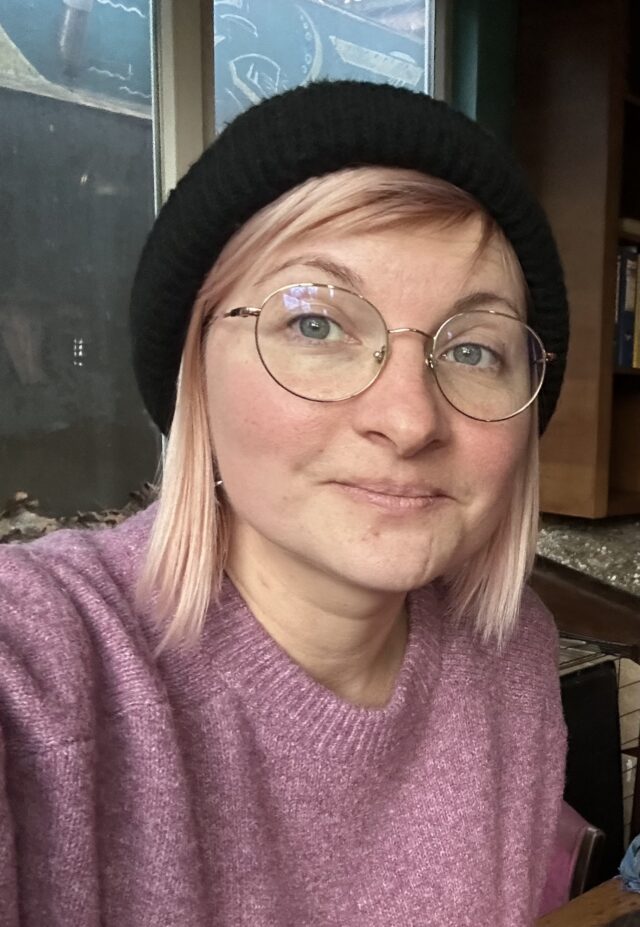 Cristina Chira is a writer based in Romania who writes in Romanian and English. She holds an MA in creative writing from Birkbeck, University of London. She has published short stories in numerous Romanian magazines and anthologies, and her debut volume Raluca nu s-a culcat niciodată cu Tudor (Raluca Never Slept with Tudor) was awarded Best Prose Book of 2023 by the Romanian publication Agenția de carte. “Each Other” is her first story published in English. It is part of her upcoming collection of short stories Return Trip Bucharest–Kampala. Cristina has lived in Romania, UK, Spain and, for short bursts of time, Uganda.