
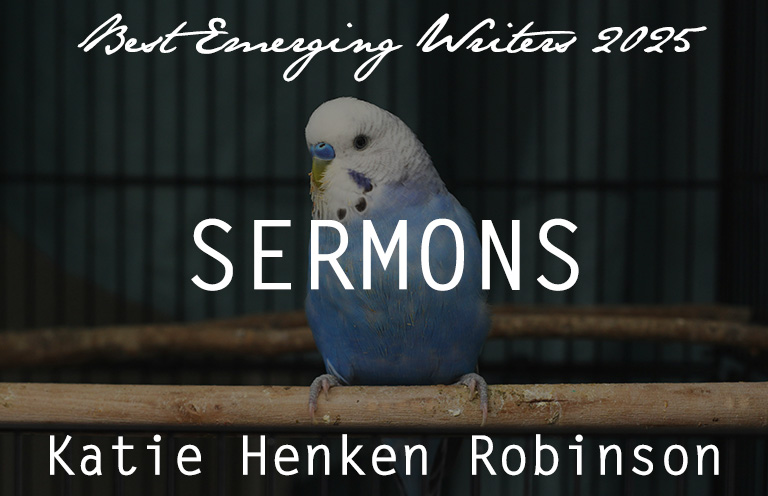
Pixie showed up on our doorstep one morning in June, looking more like a carnival sideshow act than our new renter. She was tiny and frail, holding a caged parakeet in one hand and a purse as big as her body in the other. Her hair was dyed purple with grey at the roots, and she wore a tie-dye dress plastered with emojis. When she smiled, I counted three missing teeth.
Dad had told me the night before that a new renter was coming, our third in the span of four months. We started renting out my bedroom after Mom and I got into a car accident last winter. I’d walked away unscathed while she was in a coma, hospital-bound for four months now. It became clear once the medical bills started rolling in that if we wanted to keep the house, we were going to have to share it. We’d stripped my bedroom of the accumulated detritus of my youth—tee-ball participation trophies, a blue ribbon from freshman-year spelling bee, movie posters I copped from the local Blockbuster when it finally closed down—and brought it all down to the basement. Free of my personal junk, the room became the sort of place someone might actually want to live.
When I found Pixie at the door, I was convinced she wasn’t the new tenant. She didn’t exactly fit our usual renter profile. I hoped she was a Jehovah’s Witness or confused grandma on the lam. “Can I help you?” I asked.
“Pixie?” My dad came up behind me, reaching his arm past my shoulder to shake her hand. “Come on in! I’m Ray. This is my son, Charlie. So nice to meet you in person.”
Pixie hobbled into the living room, the cage jangling. She set the bird on the coffee table and turned on the TV. “Do you have CNN? That’s his favorite.”
It took me a moment to realize that by his, she meant the bird. I glanced at my dad like, What the hell were you thinking?
He refused to meet my eyes and said, “Sure, it’s channel 100.”
The parakeet seemed genuinely riveted by the TV. He was the color and scent of dehydrated piss and had a strangely judgmental facial expression for a bird. It felt like he was waiting to peck our eyes out.
Pixie wandered into the kitchen and flopped down on a chair. “Sorry, he’s just so particular. We preach at a local church on weekends, so on Mondays he’s always tired and grouchy.”
“You preach?” my dad asked.
“Oh, it’s mostly Father Skeeter. I fill in the things he can’t say.” She laughed. “He’s a minister. Real popular around here.” Pixie nodded her head toward the cage, and my dad and I simultaneously realized that Father Skeeter, the minister, was indeed the bird. I shot my dad a glance again, and this time he met my gaze with a warning glare.
“Well, it’s not a church church,” Pixie explained, as if that cleared anything up at all. “You two can come sometime! Anyone’s welcome. He gives a lovely service.”
“I gotta get to work,” I said.
“Why don’t you bring Pixie’s bag to the room first?” my dad said.
I remembered then that I hadn’t gotten the room ready like I was supposed to. I’d stolen some beers from the fridge the night before and gotten drunk by myself. In the morning, I was too hungover to run through the renter protocol of cleaning the room, changing the sheets, and removing all traces of my existence. I’d told myself I’d do it later, but by the time Pixie arrived, I still hadn’t done shit.
Dad handed me Pixie’s bag. “Here, take this.”
“Take this. Drink from it,” Father Skeeter squawked from his cage.
“Jesus Christ,” I said, jumping at his voice, a strange combination between screech and whisper.
“Praise to you Lord Jesus Christ,” Father Skeeter intoned.
“I didn’t know parakeets could talk,” my dad said. He looked more amused than disturbed.
“Oh, they can, but most aren’t very good at it. Father Skeeter is special. He was chosen by God.” Pixie put her face against the cage and cooed.
I carried Pixie’s bag down the hallway to what was once my bedroom, and she followed behind.
“Your dad mentioned that your mom is in the hospital,” she said. “I asked Father Skeeter to say a prayer for her at this Friday’s mass. He’s known to be a real miracle worker, you know.”
She stepped into the room. I felt my cheeks grow hot when I noticed the crumpled bed sheets, twisted and smelling of beer. I decided I hated her. For being here, for talking about my mom, for believing her bird’s prayers meant anything.
“Room’s kinda smelly,” she said, glancing around with her nose crinkled. “A bit small for four hundred bucks.”
I stared at her, unblinking, a game of uncle. Eventually, she turned away.
“That will be all then,” she said dismissively. Even though she’d looked away first, I had the sense she’d won.
“Pixie all set up?” Dad asked when I came back to the kitchen.
“Dad,” I said, my voice low. “What the fuck.”
He shrugged. “She seems nice enough.”
“She seems like a lunatic. She thinks her bird is a minister, for Christ’s sake!”
“Christ has come, Christ has risen,” chanted Father Skeeter.
Dad met my eye. For a moment, I glared at him. But then we were laughing so hard tears came out of our eyes. I grabbed my keys off the table, wiping my eyes with the back of my palm.
“Peace be with you,” I said on my way out the door, closing it just as Father Skeeter echoed the refrain.
* * *
A month back, I’d taken a shit job for shit pay at Beer World, a drive-through liquor store down the street. I’d been planning to go to college, but after the accident, I threw my future plans out the window. When my acceptance letters rolled in, I put them in the trash. Dad told me I was being stupid, that I had to go. But he couldn’t hide the bills piling up on the table, the late notices, the hushed phone calls begging the electric company to give him a few more days. Whatever excitement I’d had about college was gone after the accident anyway. I told Dad there was always next year, that I’d work in the meantime, but really, I had no plans of going, now or ever. When I saw a help wanted sign at Beer World, I applied. I liked the idea of hauling boxes around, breaking my body just to feel like I could.
It started getting hot early this year, and Beer World was sweltering, the air heavy and humid. There were two standing fans covered in grease and dust, spitting grime into the air that swirled about when sun streamed through the entryway.
“Fuck this place, man. I would straight-up murder to work somewhere air conditioned.” This was Joey-Jim, who worked the Monday shift with me. He stood in front of a fan, sneezing from the dust. He got his name because there was already another Joey. We would’ve used his last name, but there was another Hernandez, too. So he got stuck with first and middle.
I nodded lethargically. I kept thinking about Pixie, her bird, how much longer my life would be this way. For a while, I’d thought it would all be temporary. That Mom would recover fast, and things would return to normal. I’d had visions of her coming home in time to drop me off at college, and I’d miss her, but it would be the regular sort of missing. Instead, she’d been in a coma for long enough that it was becoming hard to believe she’d come out of it. Two months of finger twitching might be enough for Dad to hang onto, but I’d done enough research to know there were no guarantees it would ever amount to her waking up. We were staring down a lifetime of drowning in bills if we wanted a chance for her to get better. Dad said the money would work itself out. I hadn’t inherited his optimism.
“What’s up with you today?” Joey-Jim called over to me. “You seem out of it.”
“Who knows. Just thinking about how I was supposed to be at college but instead I’m here, fighting off heat stroke for minimum wage.”
“Shit. I’m sorry man.” He came closer and cupped my elbow with the palm of his hand, a gesture that felt awkward and too intimate. He’d stripped his shirt off and tucked it into his pocket so it stuck out like a dish towel, his chest glistening with sweat. He looked good. We’d hooked up a week ago—when things were real slow and we stole a six pack to drink in the register booth. In the bathroom in the back, he got on his knees while I leaned against the molded sink. Afterward, I went to count the money at the register.
He hoisted himself up onto the counter beside me, his legs swinging by my side, grazing against me. “You ever done that before?”
I glanced at him briefly, trying not to lose my count. “Do what? Get a blowjob?”
“You know what I mean.”
I scoffed. It came out meaner than I meant it. “Yeah, I have. Guys, girls. Whatever.”
“You just don’t strike me as the type.”
“I don’t consider myself to be any type.”
He looked a little forlorn, like he was waiting for something more. I continued to count, refusing to meet his eyes, until eventually he hopped down from the counter and walked away.
We never talked about it after that. I was too freaked about someone at work finding out. Our boss didn’t exactly strike me as the tolerant type. I wrote it off as a stupid thing I did because I could, maybe because I’d broken up with my girlfriend a couple days before and just wanted to forget all that. But whenever he acted all gentle and kind, I didn’t know how to react. I was too worried that tenderness was a trick, the lead-up to a demand of some kind. It seemed easier to keep my distance.
I moved my elbow out of his grasp. “I should go do inventory,” I said. An easy excuse to cross the room entirely.
* * *
On Mondays after work, I was supposed to go see Mom at the hospital, but today, like usual, I kicked around Beer World for a couple hours instead. I sat on a bench in the alley next to the shop. It had cooled off, and a breeze rolled across my face. Like always, I stared at my phone and drank can after can of Coke from the vending machine, and then I’d go home and tell Dad I’d been at the hospital. He knew I was lying, but he never called me out on it. I couldn’t explain why this made me mad, but it did.
I knew I should go see her. The doctors said talking could help, but it seemed fake to me, the kind of thing they say to make you feel useful when really all you can do is sit and wait. I’d gone in the early days, but it had felt like sleepwalking, my body going into autopilot the moment I walked through the hospital doors. And then one day I went with Dad, and while he held her hand and spoke softly to her, I somehow snapped into it, too aware, too awake. It was like I only just realized the woman in that hospital bed was Mom, and she would maybe never wake up. I ran to the bathroom and threw up, then sat on the floor, raking my hands through my hair and trying not to puke again. I hadn’t been back since.
The accident had happened in late February, during that stretch when the days were too warm for snow and so it rained instead, and then at night the roads became slick with black ice. Mom and I were driving home from dinner—we’d gone out, the two of us. That night, it was pitch black and beautiful and the tree branches were encircled in ice. One minute we were laughing and the next a deer jumps out into the road and Mom swerves, and there’s a truck coming the other way—boom. The car on its side, windshield smashed, air bags out—useless. I was standing there, somehow out on the pavement, useless as the air bags. I don’t even remember if I was trying to get her out of the car, or if I was just standing there, saving myself. The truck driver got out, and I could hear him shouting at me, but I couldn’t answer. I couldn’t do anything. In the end, he was the one who pulled her out. I couldn’t look him in the face while we waited for the ambulance. I was too ashamed he’d had to do what I should’ve done.
Somehow, I walked away with barely a scratch. I had an ugly gash on my forehead from a piece of glass, a bruise across my chest where the seatbelt had been. Everything that escaped me had happened to Mom instead. Broken ribs, punctured lung, the head injury she might never recover from.
The renting had been my idea. I wasn’t sleeping half the time anyway, and when I did, it was fitful, punctuated with bad dreams. It felt like a waste of a bedroom. I hated to admit it, but I thought maybe sleeping on the floor of Dad’s room would help, just to have someone else there. But it turned out I still couldn’t sleep.
“Want one?”
I jumped at the sound of Joey-Jim’s voice. I hadn’t even noticed he’d walked over.
He had a cigarette hanging from his mouth and another between his fingers, held out to me. “Sorry. Didn’t mean to scare you.”
“I was just zoning out. Didn’t hear you coming over.”
He handed me the cigarette and a lighter. I stared at the building next door, a Mexican grocer that was tagged with bubble graffiti that read “Uglee Boy.”
“I’m not going to college either,” Joey-Jim said.
“Huh?”
“You were talking earlier about not being able to go. I just wanted you to know I get it.”
“Oh. Thanks.”
“I’m saving up money to apply in a couple years, taking classes at community college in the meantime. What about you?”
“Can we just stop talking about it?”
A look of hurt passed across his face, but then it was gone. He dropped his cigarette and ground it into the asphalt with the toe of his shoe. “All right,” he said.
“Sorry. I’m just—”
“No, it’s cool. I get it.” He stood and brushed off his pants, gave me a soft smile. “I’ll see you later.”
Somewhere nearby, I could hear kids laughing in the park. A hazy summer glow rippled over everything. I finished my cigarette, then sat there for another hour, watching the sun dip lower in the sky. I promised myself that next week I would get on the train to go see Mom, but I made that promise every week, and by now I knew I was full of shit.
* * *
When I got home, a thin layer of smoke and the overwhelming scent of tuna drifted through the house. Pixie stood in front of the open oven, pulling out the source of both. Dad was at the kitchen table, fanning the air with his newspaper.
I took in the scene from the doorway, some strange dream in which an alien had come to replace my mother.
“Pixie made tuna casserole,” Dad said. There was a hint of an apology in his voice. “How was Mom today?”
“She’s—you know. The same.”
Dad smiled, but the corners of his mouth were downturned.
Pixie put the casserole on the counter. “Have a seat! We’re just about ready for dinner.”
I sat at the table and noticed the fourth chair was filled too. Father Skeeter was perched on the seat back, picking at a talon with his beak.
Pixie passed us each a plate. The mess of tuna and butter noodles was a murky shade of gray, burnt around the edges. Dad and I had mostly been eating canned tuna on crackers for dinner since Mom had been in the hospital. I was tired of tuna generally, and this version was somehow even less appealing than scooping it straight from the can. When Pixie sat, I noticed she was wearing Mom’s apron: white canvas with a bumble bee emblazoned on the breast pocket.
My body tensed up. I turned to my dad. “Why is she wearing that?”
Dad looked at Pixie, then at me. His mouth opened but nothing came out.
Pixie widened her eyes. “I found this in the closet and assumed it was for anyone.”
“Well it isn’t,” I said. “Take it off.”
“Charlie—” my dad started.
“Take it off. Now.”
Pixie untied the apron and slid it over her head. She folded it into a tight square. My hands shook as I took it from her.
“I’d like to lead us in grace now, if you don’t mind,” Pixie said.
I pushed my chair back and stood up, throwing the apron onto my chair. The movement startled Father Skeeter, who began flying circles overhead.
“Bless us, O Lord,” he said.
“I’m not fucking doing this,” I said.
“Language,” Dad said.
“No, don’t fucking language me. I’m not sitting here playing house with this freak and her deranged bird.”
“Charles, sit.” Pixie spoke with the stern voice of a priest in the confession booth, like she was ready to tell me how many Hail Marys to do for absolution.
“I’m not hungry.”
I left them at the table and went outside. I didn’t have anywhere to go, so I walked back to Beer World and sat on the bench, exactly where I’d been twenty minutes before. I felt like if I didn’t get out of there, I was going to do something terrible. I had flash images of wringing the bird’s neck, smashing all the shit in Pixie’s bag. I wanted to swing a baseball bat at something, beat something with my hands until it softened to dust.
I opened my phone and texted the only person who came to mind. Wanna grab pizza tonight? I typed, then sent it off to Joey-Jim.
We hadn’t hung out outside of work before. I wasn’t sure why he was the person I reached out to. Maybe I felt bad because of how I’d acted earlier. Maybe I just wanted to be around someone who barely knew me, who I didn’t have to act any type of way around.
Ten minutes passed, then: Sure. When?
Now? I’m still at beer world
He texted back right away. Ok. Be there in a few.
* * *
Joey-Jim’s car was small, with cloth seats and an aux cord hanging out of the tape deck, instantly dating it as something nearly as old as us. He danced his fingers nervously across the steering wheel.
“Thanks for picking me up,” I said. Now that I was actually in his car, I wasn’t sure why I’d decided to do this. Joey-Jim looked so kind. I felt like a stray shard of glass on a tile floor, waiting to wedge itself unexpectedly into the soft meat of someone’s heel.
“Why were you still at work?” he asked.
I shrugged. “Nowhere else to go.”
“You usually go to Philly on Mondays, right? I feel like I heard you say that before.”
I didn’t remember telling him that. For whatever reason, I seemed to tell this lie a lot, as if saying it to everyone would make it true. “Oh, yeah. I didn’t go today.”
“What’s in Philly?”
I stared out the front windshield at the stretch ahead: a Burger King with a sign announcing that chicken fri s are b ck!, a not-yet-finished bank, two rival gas stations that had beaten out a third. I did everything but look at Joey-Jim. “My mom,” I said finally.
Joey-Jim nodded like he understood. “Ah, divorced parents. Me too.”
“Actually no. Mine are still together.”
“So, what’s your mom doing in Philly then?”
I let out an uncomfortable laugh. “I was sort of hoping you wouldn’t ask.”
“We don’t have to talk about it if you don’t want.”
“No, it’s okay. She’s at Penn. The hospital. She had a bad accident and has been there since. Actually, we both did. I’m all right but she’s… Anyway, I try to go see her, but I don’t get out there as much as I should.”
“Shit.”
We were both quiet for a minute.
“The pizza spot is up here on the left,” I said.
“I’m really sorry.”
“Don’t be sorry. Just don’t miss the turn. I’m hungry.”
We pulled into the pizza joint. Joey-Jim ordered and when the pizza guy asked for a name, I felt surprised to hear him say Joey. I laughed.
“What?” he asked.
“Nothing. I’m just realizing if we’re hanging outside of work, I can probably just call you Joey.”
“Jesus, yes, please do. Joey-Jim is such a stupid fucking name. And you know Jim isn’t even my middle name?”
We were both laughing, and I felt a loosening up inside me, a fist unclenching.
The pizza guy brought the box to the car, and Joey pulled it through the window, placing it on my lap before driving away. We drove around aimlessly, eating pizza and talking about whatever. I watched him laugh with grease dripping down his chin and felt more at ease than I had in a while. We finished half the pizza by the time we pulled back up outside of Beer World.
“You know, I was kind of surprised you asked me to hang out. You’ve been kind of a dick since…” he trailed off, let me fill in the gap.
“Have I?”
“Oh, come on.”
I chewed my lip. “I’m not sure I’m up for anything more than hooking up, is all. I didn’t want to give you the wrong idea.”
“Don’t do that. I never asked you for shit. Maybe I just want to hook up too.”
“Do you?”
“I don’t know. I’m still figuring that out.”
“Why’d you agree to come then? If you think I’m a dick?”
“I never said I thought you were a dick. Just that you were acting like one.”
I smiled in spite of myself.
“Well, I’m glad you did, anyway. Ask me to hang.” He put his hands in the air. “Don’t take it wrong. I’m not saying I think we’re dating now or anything.”
“All right, come on.” I swatted his hands down. “You don’t have to do all that.”
I opened the car door to get out, but then a thought came over me that I couldn’t shake. “Hey,” I said, “would you wanna do something really fucking stupid with me on Friday?”
He raised an eyebrow. “What exactly did you have in mind?”
“I don’t know how to put this, but have you ever heard about the parakeet minister around here?”
“What the hell are you talking about?”
“All right,” I said, closing the car door. “You’re not gonna believe this shit.”
* * *
The week passed too slow. I avoided Pixie and Father Skeeter as best I could, though they didn’t make it easy. Pixie was cooking all the time, nearly burning the house down. For someone with such poor kitchen skills, she couldn’t seem to keep herself away from it. Every night from the foot of dad’s bed, I could hear them practicing sermons in my room. Or at least, I could hear Pixie prompting the bird. He was too quiet for me to hear his replies.
When Friday rolled around, I texted Joey to make sure we were still on. I’d explained everything to him—the renting, Pixie, Father Skeeter. We’d researched the when and where of Father Skeeter’s sermons. It wasn’t too hard to find the church—if you could call it that, given that it was just some guy’s basement. Turned out there weren’t a lot of bird ministers or priests name Skeeter. He had a Facebook page with forty-two likes that posted religious quotes, “candid” photos of Father Skeeter at the pulpit, and graphics featuring the time and location of his sermons, which were shockingly frequent—three times a week, Friday to Sunday. The most recent post said his next sermon would be on forgiveness, held on Friday at 6pm. Joey agreed to drive me there. I told him I just wanted to see what it was about, but it was more than that. Something had been bubbling up in me since I saw her in my mom’s apron, and maybe even before. Since she first mentioned my mom’s name, or arrived at my door, or before I even met her. Maybe I’d been simmering for months. I wanted to intrude on her like she’d intruded on me. To show up and disrupt her life. See how she liked it. I was still having violent thoughts, images of squeezing Father Skeeter till he popped in front of the congregation like a balloon full of guts. I didn’t want to do that. It was just something that passed through my mind, a building pressure I struggled to release.
Joey picked me up at five thirty. “Ready for church?” he said.
“As I’ll ever be.”
The house was a short drive away. It was an unassuming place: a rancher, gray with a blue door. We parked across the street. As we walked to the door, I grew simultaneously more uncertain about this decision and more stuck inside of it. I was glad Joey was with me. I thought having him there made me less likely to do anything that would land me in jail. Though I couldn’t be entirely sure.
The man who opened the door was tall and lank with thin-rimmed glasses and long, gray hair tied back in a ponytail. He looked like exactly the kind of guy who would host a bird church.
“You here for the service?” he asked. “I don’t think I’ve seen you before.”
“Yes,” I said. “Pixie is my, um. Roommate?”
“Oh, shit! You’re Charles?”
How this man already knew my name was beyond me. “It’s Charlie, actually.”
“Nice to meet you, Charlie. I’m Rand. Pixie’s doing a special service for your mom today. She’ll be so glad you’re here.”
He ushered us inside, down a hallway with peeling wallpaper and water stains dotting the ceiling. Rand led us down the stairs into a basement with mismatched benches set up like pews. Father Skeeter was preening in his cage, displayed on a small table beside a music stand at the front of the room. A clip-on microphone was attached to his cage wiring, the transmitter resting on the table. Fifteen or so people milled about. I didn’t see Pixie among them.
Rand placed a hand on each of our backs. “Have a seat.” He walked to the front and addressed the small crowd. “Thanks for coming, everyone. Please take your seats so we can get started. We have a really special sermon for you today.”
People shuffled about, moving toward the benches. Joey pointed to the bird cage. “Is that Father Skeeter?”
“The very same,” I said.
Rand placed a hand on the bird cage. “Father, could you get us started, please?”
The bird rocked back and forth, making strange, long chirps. Everyone leaned forward in their seats, craning to hear. Rand knelt in front of the cage and adjusted the microphone, which crackled to life and sent the chirps projecting through the room. Joey grimaced at the sound.
From behind me, I heard footsteps and turned to see Pixie walking down the aisle. When she got to the front of the room, she caught my eye in the crowd. If she was surprised to see me there, she didn’t let on. She nodded, almost as if she’d expected me, and stepped up to the mic.
“Today,” she said, “Father Skeeter is going to speak about guilt. But first I want to tell you a story about a woman I know. She’s not well. A car accident left her in a coma.”
The congregation let out a sympathetic hmm. I could feel Joey looking at me, but I didn’t look back.
“I recently moved in with her husband and son. As many of you know, Father Skeeter and I consider ourselves nomads. But something called me to this home. When I saw their room for rent, Father Skeeter began chirping nonstop. I knew that God had spoken to him, and that we were meant to go.”
I felt myself growing hot, furious. My jaw clenched. I was worried that if she kept going, I would do something I’d regret.
“I prayed over her photograph. That night, she appeared to me in a dream in which we met in her hospital room. She said she’d heard my prayers and thanked me. She said no one had prayed for her in some time, and asked me why I had. The reason, I said, was because I felt she needed it. At this she started to cry.”
I became lightheaded, my stomach sick.
Joey leaned over to me. “Are you okay?”
I nodded, unable to get out any words.
“She told me her son hadn’t come to see her in some time. She wasn’t mad, but concerned. She knew it was hard on him and wanted to know how he was doing. I answered her honestly. I told her he was angry. Not at her, but at the world, and at himself. That he is punishing himself over something he can’t change.”
I stood up. Joey touched my arm, but I brushed him off.
“Charlie,” Pixie said. The congregation turned to me. Out of tune with what was going on, Father Skeeter started chirping his hymnal again.
I stepped forward, struggling to breathe.
“She isn’t mad at you. Your guilt is a trap.”
“Guilt is a trap,” Father Skeeter echoed. He did a little flutter and began to sing “guilt” with enthusiasm. A few people in the congregation started clapping along uncertainly, unsure if this was part of the show.
I stepped toward the stage in a way that must have appeared menacing, because an emaciated man in the front row threw his arm out and said, “Step away from the priest.” But when he saw the look on my face, one that must have told him I would plow down anyone in my way, he dropped his arm and muttered an apology.
“She doesn’t want you to blame yourself, Charlie,” Pixie said.
“Blame, blame!” Father Skeeter chirped.
“Shut up!” I said.
A few congregation members gasped. I leaned over to look Father Skeeter in the eyes. I was feverish, my pulse throbbing in my chest, my neck, the tips of my fingers.
“Blame!” Father Skeeter said. His head bobbled from side to side. “Guilt, guilt, guilt.”
I narrowed my eyes at him. Who the fuck was he to tell me what I felt? He was a goddamn bird. A bird couldn’t know what guilt was or wasn’t.
Pixie reached out and grasped my wrist. “You should go see her.”
It was too hot, too loud. Father Skeeter was so close to my face. His ammonia scent made my stomach churn.
“She doesn’t want you to keep punishing yourself.”
I heard Joey call my name. He walked up the aisle and placed his hand on my shoulder. “I think we should go,” he said.
I stared at the bird, almost believing he might tell me something transcendent.
“Forgive,” Father Skeeter said. “Forgive.”
Vomit shot up my throat and out, too suddenly to stop it. It splattered across Father Skeeter, who started flapping wildly around his cage, squawking. The congregation gasped. Someone shouted to get water and a towel for Father Skeeter. My brain flickered. I felt Joey lift me up by the armpits as everything went black.
* * *
I came to in Joey’s car, stretched across the backseat. It was dark out. The congregation was filing out of the house and into their cars, though I didn’t spot Pixie.
“You’re up.” Joey turned around from the front seat. “That was… intense.”
“I shouldn’t have done that. I don’t know what came over me.”
“I don’t know. I think the bird had a point.” The smile on his face told me he was both joking and not.
“Forgive, forgive,” I said. We both laughed. But in my head, I saw myself standing at the edge of the burning car, not moving. Sitting outside Beer World instead of at the hospital. Throwing out my college acceptances, offering up my room, walling out Joey. I felt insane for thinking it, but it had seemed, for a moment, like the bird was seeing something inside of me and asking me to pull it out.
I pushed myself upright. “Hey, are you working tomorrow?”
“No. Why?”
“I know you probably don’t want to go on any more errands with me after this one,” I started.
He laughed. The sound was starting to feel familiar, a comfort.
“Would you drive me to the hospital when I get off work? To Penn? I haven’t… it’s been a while since I’ve gotten out there to see my mom. And I—” I felt a knot tangling in my throat. I tried to cough it out.
“Of course,” he said. I met his eyes and could see he didn’t need me to explain. We sat for a moment in silence, nothing but the hum of the car engine. I thought of Father Skeeter. Forgive, forgive. I wasn’t sure who I was forgiving or for what. Everything had gone off the rails, and I’d been so busy being angry at the world that I kept spinning the tires deeper into the mud. I was glad I puked on the bird. It might have been the first real thing I’d done in a long time.
When we drove away, I stared out the window and watched the roof of the bird church pass swiftly by, then disappear.
* * *
I went straight to the shower when I got home, dodging Dad’s questions about why I took my shirt off the second I walked through the door. Once I was clean again, I found Dad watching Wheel of Fortune in the living room, two bowls of stovetop mac and cheese on the coffee table in front of him.
He looked up at me. “What was that all about?”
“Puke. I’ll explain later.”
He nodded toward the mac and cheese. “Need some food?”
“Sure, thanks.” I could feel him staring at me as I sat. “Why are you looking at me like that?”
“I want to talk to you about something.” He pressed his lips together and took a deep breath. “I know you haven’t been going to see Mom when you say you are.” He said it very matter-of-fact, like he wasn’t angry but had decided it was time to clear the air. Still, I felt like he’d stuck a pin in my lung.
“How did you know?”
“Because I was worried about you, so I asked one of the nurses if you seemed okay when you were there. And she said they hadn’t seen you in over a month.”
My apology came out in a whisper, a knot forming in my throat.
“You don’t need to apologize. I just want to know what’s going on with you. You haven’t been yourself.”
My eyes felt hot. I rested my face in my hands, trying to obscure that I was crying, but of course he knew. He put an arm around my shoulder.
“I keep wanting to help, but instead I’m just making everything worse,” I said. “And nothing I’m doing is helping Mom get better.”
He ran his hand over my hair. “Charlie, you can’t think like that. There’s nothing you could’ve done. I’m sorry I—I haven’t been paying enough attention.”
I sat up, wiping my eyes on my arm. “I’m going to see her this week. A friend is driving me into the city.”
“Okay.” He rubbed my head again. “Only if you feel up for it.”
“I do. And maybe next time you go, if you want, I could go with you.”
“Okay. I’d love that.”
“And there’s something else. I think I messed up with Pixie. Like, she might be really mad.”
He gave me a concerned look, the kind of face that’s asking a question.
“I might’ve maybe gone to her church and caused a bit of a scene. And puked on Father Skeeter. But that part was an accident!”
Dad rubbed his face, shook his head. “All right. That’s all right. You should just apologize. I’m sure it’ll be fine.”
“Is she home?”
“I didn’t see her come in, but you can go check.”
I headed down the hall. The door to my old bedroom was closed, but light crept out around the frame. I knocked and waited. When she didn’t answer, I pushed the door open slowly. Inside, the room was completely empty. The light was on, but there was no Pixie, and none of her stuff either. Her bag and the bird cage were gone. The bed was made, the dresser drawers half-opened and cleared out. I stood there for a moment, then called for my dad.
He came quickly, concerned by the sound of my voice, then stopped when he saw the empty room. “What the hell?” He stepped inside, pulling the drawers all the way open, as if her things might reappear if he only looked harder. “When did she even… I was here all night!”
“Did you fall asleep or something? Maybe she snuck in and out?”
He stood in the middle of the room, his hands on his hips, shaking his head. “I mean, maybe, yeah. I must’ve.”
“I’m sorry. This is probably my fault.”
Dad looked at me, pulling himself out of his confusion. He waved his hand in the air. “That lady was batshit anyway.”
On the bed, I noticed something sticking out from between the pillows. It looked like a sliver of paper, maybe a note. I pointed to it. “Looks like she left something.”
Dad reached out and grabbed it, holding it up. It was a piss-yellow feather.
“Nope,” he said. “Just a little parting gift from Father Skeeter.”
I plucked it from his hand and rolled it between my fingers, the colors rippling in the shifting light. I saw myself in front of the bird cage, Pixie’s hand on my arm. It felt as if it had been a dream. Tomorrow, I would see my mother, and it would hurt. I would tell her about the minister bird and hope that somewhere in there, she could hear me, and it would make her laugh. Or maybe tonight, after everyone was asleep, she’d visit Pixie, and by the time I told her the story, she’d already know. I didn’t believe in any of that shit, yet I couldn’t shake the feeling that something had happened to me I couldn’t explain. That years from now, I’d tell the story of the woman who appeared and dissipated like magic, and wonder if she’d even existed at all.
I placed the feather on my bedside table, deciding I would keep it. Proof, for my future self, I hadn’t dreamt it up.
 Katie Henken Robinson is a Boston-based writer and the Senior Editor at Electric Literature. Her writing has appeared in or is forthcoming from The Southwest Review, Split Lip Magazine, and Grist, among others. The winner of the 2025 Tennessee Williams Festival Fiction Contest and a Virginia Center for the Creative Arts Fellow, Henken Robinson’s short stories have been finalists for numerous prizes and awards, including The Perkoff Prize and The Stephen Dixon Fiction Prize. You can find her at katiehenkenrobinson.com.