
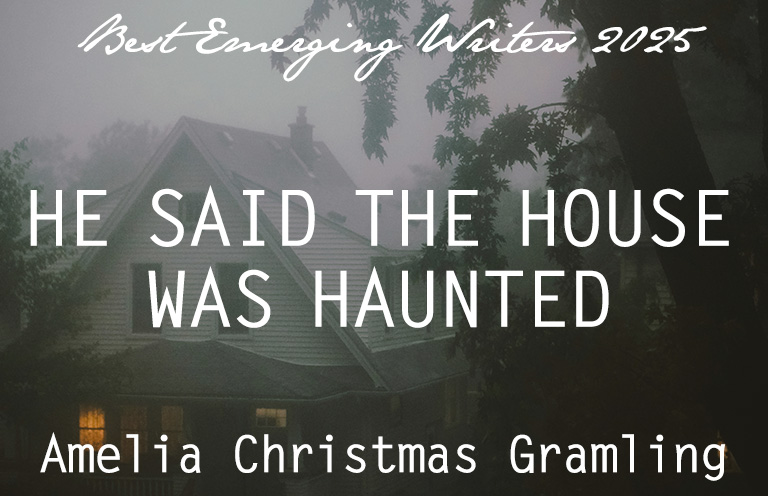
The first time he said the house was haunted, it was October. I laughed because it suited the season. But now it’s March, and the weather has shifted toward superstition, winds high enough to level trees. And the joke, like the house, is no longer sturdy; I catch it bending towards belief.
The house is not old, but it was built to house the aging—what they call a “mother-in-law suite.” An odd little half-house at the top of a hill on the edge of a horse farm. Haunted by a woman, or so we joke, who lived beyond the lifespan of her reason, who moved here when age reduced her to the sum of her needs.
Or that’s the story we like to tell, because when we moved here, we were also enfeebled—not much more than need ourselves. And if the house is haunted, it’s only because the history we thought we were uncovering behind the siding was not a stranger’s but our own.
This house returns us to the one we came here to forget.
* * *
I loved him, first, in an attic apartment in Eastern Iowa: wood paneled, pitched ceiling, carpeted even in the bathroom. The apartment was an afterthought, a strange addendum to an old house, but it alone rose above the tree line. In the mornings, it was awash in light.
I think he would agree that in that period we felt like we were living outside the bounds of polite society. When we walked hand in hand through the college town, built within flooding distance of the Iowa River, streets wide enough for horse-drawn carriages and little else, we felt spotlit. If ever he kissed me in public, he’d murmur,
“We should be killed.”
And then he’d kiss me while I laughed.
We moved fast. In retrospect, it was as if we knew what was coming.
* * *
We met in late summer of 2021 and were living together by Halloween.
In the early days, I couldn’t distinguish my love for him from love of his attic. The tapered walls were covered with movie posters, signed photographs, and prints, like a sheet of one-way windows or a panel of trick mirrors. Every framed picture he’d hung up, a truer portrait of himself: movie monsters and monster movies; Boris Karloff and Bela Lugosi; Dario Argento and George Romero. The course he taught that fall and reprised in the spring was yet another autobiography, Making Night Hideous: Drama as Haunting. In it he taught Hamlet and Ibsen’s Ghosts; Angela Carter’s “The Bloody Chamber” and Shirley Jackson’s The Haunting of Hill House. He lent me the latter early on, furred with sticky notes. I noticed that where the cover had once proclaimed Now a Netflix Original Series, S had Sharpied a still, black moon. S was like that: when the times didn’t live up to his tastes, he scrubbed them from view.
If I asked him questions about himself, he was often evasive—he’d change the subject, make a joke. On more than one occasion, I asked him what he was thinking, and he answered, contemplatively, “Poo.” But if I turned his head, instead, toward his collection, he’d begin—slowly—to reveal himself. So, naturally, we were talking Hamlet’s ghost when I learned that for S, our love was an interruption to grief. S’s father had died the year before we met.
We were out on the fire escape of the attic apartment, sharing a cigarette, and watching the street. It was late. A man I’d seen before, a local character who was famous in town for wearing a duct-tape toga and little else, appeared under a streetlight. The man gestured dimly to something out of view. I said, under my breath, “He beckons you go away with him.” S laughed before he corrected: “It. It beckons you go away with it.” I rolled my eyes, but S was already full tilt: “No, no, hear me out. At first, it’s just a mute shape in the armor of Hamlet’s father. Horatio’s not sure what it is, and neither is Hamlet. In fact, later, Hamlet tries to back off, deny the resemblance:
…The spirit that I have seen
May be a devil, and the devil hath power
T’ assume a pleasing shape; yea, and perhaps,
Out of my weakness and my melancholy,
As he is very potent with such spirits,
Abuses me to damn me.”
(He really did quote these lines from memory. I know.)
“But when it walks, it beckons to Hamlet, talks to Hamlet alone—says remember and revenge.
“What’s fucked up about the gesture,” and here S stopped to beckon, “isn’t just that it’s Hamlet’s father returned from the grave, but that it indebts him to a past he wasn’t there to witness—a past about which he can never be sure, one that he can’t confront, as you could confront a living father. The ghost, you know, is covered in armor. Hamlet can’t even see its face.”
S’s estranged father had died suddenly, in the summer of 2020, during the height of quarantine. S had been living in the attic apartment when he heard the news. S watched the funeral over Zoom.
* * *
After he told me, we made love. I woke early to snoop. But in the blue/yellow half-light of morning, I saw the flimsiness of the posters that covered his walls, the places where the tape was peeling, taking with it drags of drywall. Maybe it was decoration after all. He ornamented his home in the trappings and the suits of hauntings, as a way of warding off his ghost.
* * *
For my part, I was looking to escape. I, too, was a collector but had little of my collection with me. A box of my things in my sister’s attic in Kentucky. A box of my things in my ex’s basement in Ohio. A box of my things in his mother’s attic. And so on. I met S with all his objects apparently gathered in one place and felt the special pull, in early love, to anchor myself in someone else’s things. And in the beginning, I succeeded. I disappeared into the furnishings, and tchotchkes, the collection of California Raisins, the tub with the detachable showerhead in the carpeted bathroom whose ceiling tapered to such an alarming degree that to take a shower meant squatting on your knees.
The kitchen was so small, it couldn’t endure a fridge, so the fridge stood—not sane—in the hallway. In the morning, he made omelets, and his concentration was so intense that simply by walking into his periphery, or by saying his name ever so gently, I could make him jump out of his skin.
* * *
It was Christmas break when he fell ill. The days broke late and drifted wearily for a few hours in the winter half-light of the attic until they settled, like dregs, on the other side of the world. He had a persistent headache that lasted half a week. By the new year, he couldn’t get out of bed.
II.
Love, like sickness, lives in that hazy half-light between choice and fate. Seduction is a spell, but who can be said to have cast it? S did a perfect impression of “The Monster Mash.” I did a passable Groucho Marx, and in both cases we were really impersonating our mothers, who were impersonating the color TV.
When it comes to health, choice is also illusory. I was with S when CNN informed us that Johnson & Johnson baby powder was, well into the nineties, tainted with lead. When we heard— both of us inadvertently poisoned by our mothers—we shrugged.
So, with love. We think we say yes to a lover, make a choice about who we are and what we want, and in fact, we say yes to a stranger—not only the child he used to be, but the unfathomable other that love will become; it is all in the asking, all in the warning.
“You won’t like it,” says Dudley the caretaker of Hill House—which I read hungrily that January while S convalesced. “You’ll be sorry I ever opened that gate.”
* * *
He got sick a year into the pandemic. It wasn’t just that those left in the medical profession had, by 2021, less patience for the illegibly ill, it’s that the specter of COVID had made us—the public—jumpy, spooked, strangers to our own bodies. S was sick with something both invisible and vague. He was weak, exhausted, easily confused. He complained of a racing heart, migraines, of roving and unpredictable pain.
S did his credibility no favors by fashioning himself after Bryan Ferry. The first doctor I took S to in February wasn’t charmed by S’s fuchsia-colored high-waisted pants. In fact, the doctor was the picture of skeptical rationality in a military-style haircut. S told his story, and left the clinic, thirty minutes after arriving, with a diagnosis of Generalized Anxiety.
I recognized the category of (non)illness into which S had been shuffled from a show we’d started watching religiously that winter, after S got sick: The Dead Files.
When we first met, S and I watched films. In the Halloween season of 2021, we sampled the greatest hits of his DVD collection, which fulfilled the promise made by the posters covering his walls. After he fell ill, time elasticized, and we longed for a void into which we could mindlessly dissolve—i.e. reality TV. The Dead Files came on the Travel Channel and its subjects—haunted Americans—were selected based on letters they wrote in to self-proclaimed “physical medium” Amy Allan and her partner, former NYPD detective, Steve DiSchiavi. Often the families featured on The Dead Files were witness to strange phenomena, but also chronically “ill” with insomnia, fibromyalgia, cystic fibrosis, anxiety, depression, loneliness, and displaced rage. They were poor, white, and lived in places like Youngstown, Ohio, and Gary, Indiana—the postindustrial wastelands of middle America, the suburbs God forgot.
We watched The Dead Files for the same reason one might be tempted to email www.helpmedeadfiles.com: Our lives were disrupted by something mysterious, and we sought a common enemy, a place to put our own displaced rage. For those featured on The Dead Files, the enemies were “shadow people,” hordes of “restless dead” that sent tendrils into the open mouths of sleeping children. For us watching, the enemy was con artist Amy Allan, and guilty-by-association sidekick Steve DiScihavi.
Though we hate-watched Allan passionately because she deceived fretful widows into believing their moody adolescent daughters were possessed by demons, her methods were also intoxicating—because sometimes they worked. The families that wrote into The Dead Files were indeed cursed, because of the perfectly ordinary conditions of life where they lived: poisoned water, polluted air. For these people, Allan offered the sheer power of her belief. It wasn’t a cure, but for those who suffered, she offered catharsis, absolution, and freedom from personal responsibility. “There’s something wrong with me” was reconfigured on The Dead Files as “There’s something wrong with the house,” and so Allan left the haunted with hope: the possibility—if not the means—of getting out.
* * *
Of course, I believed S was sick. And yet.
I was—as weeks hardened into months—more and more seduced by the doctor’s suggestion that what was wrong with S’s body originated in his head. The prospect, once raised at the clinic, followed me back up the attic steps. Was there a history of mental illness in his family? Had S ever struggled with bouts of prolonged sadness? Hopelessness? Loss of appetite?
S wasn’t insulted by the implication. He was incensed.
When we left the clinic, before I could ask a timid, “So how are you feeling?” S snorted derisively. “I could have been bleeding from the fucking eyeballs, and that hick would’ve given me a referral to a shrink. Anxiety my ass.”
But in listening to the “hick’s” questions, I realized how little I knew myself. What was the state, now that he mentioned it, of S’s mental health? By the time we were walking up the attic steps, the rage had gusted through S. He made it to the blue couch, weakly loosened his tie, and collapsed.
Neither S nor I came from households which acknowledged the legitimacy of what is, today, commonplace pathology. When I was a girl and my mother didn’t get out of bed for days at a time, no one said “depression.” My dad said she was in a “black mood,” “possessed” by something unnameable. We maneuvered through her moods as one maneuvers through the weather. I learned to batten down the hatches and wait.
I shared this fundamental skepticism with the participants on the Dead Files. Mental illness was, for them, a much less likely culprit than one of Amy Allan’s so-called “gobliny goblins.” Don’t get me wrong, the participants on The Dead Files racked up both diagnoses and prescription drugs—but they, in almost every case, had little faith in doctors to pinpoint the real source. In Allan’s universe, the source wasn’t physical or emotional, but something altogether other: a foreign intruder, an evil force (sometimes extraterrestrial) which migrated to the family from a bad somewhere else. Narratively speaking, Allan and DiSchiavi would have preferred to locate the badness inside the home, to uncover a nineteenth century newspaper clipping from a local library which revealed a brutal killing had occurred in the basement, the bones of the victims buried under the cornerstone, but those histories were hard to come by in flyover country. The archives are slim. And the houses aren’t that old.
S and I, marooned in our love, had no shared history. We were alone in that river town with the exception of the other. We had graduated from our MFA program and stayed behind an extra year while our friends moved away, moved on, moved out. In the attic apartment, history and reality rarely intruded. When it came to S’s mental health, there was no one with whom I could triangulate what was normal and what was aberrant, what was old and what was new, what was symptom and what was cause, how much of S’s personality was his illness, and how much was something closer to loss.
S was debilitated—and yet, as far as the clinician could tell—in perfect health. So I wondered with Amy Allan: Was something wrong inside the house?
* * *
At the beginning of March, I found him sitting in the dark, holding a worn red notebook filled with the previous semester’s lecture drafts. He was close to tears. I curled in his lap.
“What’s wrong?”
“I can remember writing this down, but reading it back is so strange. It’s like I can’t access that part of myself anymore. I feel like I’m reading someone else’s words.”
I looked down at the notes and realized that I remembered the lecture he was referencing.
In the fall, before S got sick, I sat in on one of his Hauntings sections.
He began that class with a question: “What’s the difference between grief and mourning?” And eventually the class arrived, through his coaxing, at the answer he liked: time.
Mourning was a period. It was dramatic, contained action, and might be structured as an arc. Grief wasn’t so easily moved, concluded, or exorcised. He wrote a word on the board and circled it: “Contretemps.” Counter-time.
“As Derrida reminds us, the ghost, at its first appearance, is already a repetition. It’s visited the ramparts before Hamlet arrives and before Hamlet begins. Hamlet can’t remember when his father died, can’t locate the loss in time—there’s no way to know or to measure mourning’s start or end. It’s always extending itself, backwards and forwards, muddling the dates, covering its tracks. The time is out of joint. Hamlet believes that by letting the ghost take possession, by giving himself over to the demands of the past at the expense of the future, he can go back and impose order on the disorder, serve as a corrective, set it right.”
A pause, then quietly, S, from the present, said, “I’m just so afraid it will never come back.”
I shushed him and lied.
III.
S got sick in January. By May, I had gone a bit mad.
After the first doctor had diagnosed S with anxiety, we sought a second opinion. Now, the going theory was that S was one of those poor souls who had developed Long COVID, which seemed, as far as I could tell, as nonspecific and ephemeral a diagnosis as nineteenth century hysteria. I joined a chatroom and drank in horror stories. Out of work for six months, twelve months, two years. Brain fog. Heart palpitations. Loss of sex drive. Divorce. Depression. And—in rare cases—suicide. I bought a rolling subscription to Zinc, Niacin, and Vitamin B12. I sent someone in Sacramento sixty bucks for a twelve pack of FODMAP smoothies that never arrived.
I became manic about taking walks.
* * *
Amy Allan, when it comes to recovery, has only two modes, one of two prescriptions for dealing with ghosts: Stay or go. Most of the haunted who ask for her help don’t have the means to pick up and leave, but Allan, in almost every case, confesses it would be preferable, safest, most elegant, to abandon everything they know and flee. Bulldoze the house, salt the earth, start over somewhere else.
Indeed, it would have been simpler if S—once struck with illness—was always confined to the worn blue couch, but he had his good days. We got out. I managed to convince myself on these “good days” that he was on the mend, that he was well enough to be coaxed into considering the future, into making plans. His lease would be up at the end of June. It was May. We still hadn’t discussed what would happen to us when we reached that irremediable deadline, where we would go, and when we left, whether “we” would leave together.
Once, he gave in to my near constant solicitations that he join me for fresh air and exercise, and we went out for a walk above the Maquoketa Caves, north of town. We stooped and squatted through a dank passageway of hollowed earth and then emerged in the dripping spring sunshine, thawed. He grinned at me, from the other side of a shallow passageway and suddenly looked so very much like himself, I shivered with hope. But, by the time I’d reached him, the wind had shifted. He fashioned a cane out of a fallen tree branch and hobbled back to the car. It (or he) could turn like that, that fast, and when it did, as it always did, I was so wracked with fury, I had to hang back, duck out of view, bite my fist.
The youngest child of five, I was not used to mothering, to nursing the sick, to taking better than even cursory care of anyone—including myself. In truth, my mother had given me no fewer than four plants since I left home at eighteen, and I had neglected all four to premature death. Before I met S, I think I believed in the you-can’t-find-me-if-I-shut-my-eyes logic of the child, that if I didn’t learn (much less memorize) the domestic book of spells, if I couldn’t cook or keep house, hold a baby in my lap, I could escape being needed at the expense of myself.
But then illness made S into a child, in the way that someday time will make children of us all. He sometimes reminded me of my grandmother—though I kept this to myself—diagnosed with dementia five hundred miles southwest. He repeated himself. He lost his keys, lost the thread. He thought in circles and walked in loops. I vacuumed the carpeted bathroom. I emptied the trash. I made the soup. I asked him, “How are you feeling?” I laid a hand on his forehead. He didn’t ask and I didn’t offer, and yet by May we were both more and less than friends and lovers.
I was his caretaker, and he was my charge.
One night, something (who can say what?) possessed him to rent Burnt Offerings. I watched Bette Davis—made prematurely old by a life-sucking Victorian summer home—grow forgetful, lose her marbles, stop trusting her own mind. I bit my nail beds through her swift deterioration. By Davis’s penultimate scene, I was bleeding. I stood up, left the room, pretended to pee. When I returned, the screen was frozen on Davis’s contorted face.
I wouldn’t sit down until S agreed to tell me the ending. He refused.
Suddenly, I found myself shouting.
“You’re not my father, you can’t make me watch it.”
“Are you serious?
“JUST TELL. ME. WHAT. HAPPENS.”
“Fine—you really want to know? Everybody dies. They all die. The house eats the whole fucking family alive.”
Just as suddenly, we were no longer discussing the movie. Subtext became text. I said more than I meant: “I’m just so afraid. Aren’t you afraid? What if this”—I gestured to him on the blue couch—“is just how it is now?”
He heard in my elision the threat I both did and didn’t mean and so threatened, himself: “Do you want to leave? Is that what you want? Well, no one is keeping you here. Be my guest.”
And so, I left.
* * *
Hauntings remind us of the instability of binaries, the mutability of flimsy categories that separate self and other, here from there, this time from that time. Amy Allan’s methods were seductive—get the fuck out—but they were also naive. Our ghosts won’t remain where we left them. Between S and I—in that fight—were others. My mother, for one, who had come close to dying of breast cancer when I was a kid. S’s father, for another, who had stormed out in rages throughout S’s life, and then had gone and never come back. We were threatened by forces and figures invisible to the other, that took over in the heat of the moment.
I think we all know this to be true, in love, but I met S at a strange time both for love and for grief, when it seemed that, in the aftermath of the pandemic, there was no limit to that which, as far as the fearful public was concerned, could and should be quarantined.
I called a friend after I walked out of S’s apartment, and she said, in my defense, that I didn’t have to go back, that no one would blame me if I “chose myself.”
She said, “Well, you know, you didn’t sign up for this.” And she was right.
But what do we sign up for when we choose to make a home with the other? Or, better question—for whom is love a choice, and how, once in love, does one impose such conditions?
S’s illness coincided with a cultural fixation on boundaries, on categorizing and policing modes of relation, but in practice, those linguistic and theoretical partitions collapse at first touch. If I left, he would move into a one-bedroom condo in Yonkers with his mother, a mother who was busy mothering her own 103-year-old mother on her own blue couch. Whose is the love that stays put, confined to one room of the house?
I wasn’t just wanted, I was needed. And I was, at times, infuriated by the imbalance between us. Not only for the reasons you might expect—because I felt unappreciated, taken advantage of, or because my love for him was coming at the expense of my work (I found myself nearing the end of a one-year teaching contract with no savings and no job prospects, and nowhere I could imagine moving toward). I was angry for those predictable reasons and in the predictable ways, but beneath that anger was something else: the knowledge that I had chosen him as an escape route, a way out of my own blank apartment. I had not been careful, in other words, about what I wished for. What if he got better? And what if, in getting better, he stopped loving me—his love no longer reinforced by the urgency of his need? Or—and this was a fear whose reality I could only very rarely brush up against—what if he didn’t get better at all?
The truth is, he wasn’t the only one of us pretending that June wouldn’t arrive, that time wasn’t operating by its usual rules, that by talking and walking in loops, we had created a stay we could live inside. I thought of my boxes, abandoned in other houses where I had played at other lives, and wondered what of myself would remain with me when I left the attic apartment behind.
I came back that night, and we held each other even more tightly, and I got the ice for his ice water, and I kissed his forehead. I promised myself I would—tomorrow—take control, force the both of us to face the future, but I knew, even then, that I was telling a lie.
* * *
We stopped watching The Dead Files after season seven, episode five, subtitled “The Consumed.” Amy and Steve were called in to help Laurie of Youngstown, Ohio—Laurie, who had stage four cancer and two months to live.
Allan begins each episode with a “Night Walk” of the haunted house in question—which has been scrubbed, in anticipation of her arrival, of all personal touches, any trace of a life that might call the authenticity of Amy’s psychic powers into question. Walking the darkened hallways at the start of “The Consumed,” Amy said, “The thing about this land is that the dead can’t die here. They’re trapped.” Concluding, in an accent that wanders the continental United
States and parts of Canada, “So, there’s something very wrong with this land.”
That wrongness, Amy claimed, affected the living—and was even the source of Laurie’s cancer. It had also, per Amy, engendered personality changes in the rest of the family. Laurie’s daughter suffered “anxiety attacks.” Laurie’s husband seemed “possessed” and was often afflicted by violent rages, punching walls, chasing the dog around the house. At one point, Steve DiSchiavi, in a moment of surprising lucidity, asked Laurie if her husband’s rage might be related to his grief. “You don’t tink it’s frustration,” Steve said in his old school New York accent, “about youse and your sickness?” Laurie agreed that her illness could make her husband “frustrated” but couldn’t, she said, cause him to become someone other than the man she married.
For Laurie, the possibility of haunting helped her to externalize her family’s demons: divorced her daughter’s anxiety and her husband’s rage from one origin—her impending death—in favor of a story that preceded their arrival, may even precede the construction of the house. Laurie didn’t, in emailing helpmedeadfiles.com, believe that Amy Allan or Steve DiSchiavi could save her (could cure her cancer or otherwise alter the doctor’s prognosis) but she hoped they could contain the illness, the wrongness, to her body alone. She wanted to die knowing her death wouldn’t disfigure her family for life. In other words, Laurie’s was the ghost she hoped Amy could exorcise. She was asking for a proleptic exorcism. In another age, she would ask to be buried with a stake of holly through her heart, pinning her to the coffin floor. What Laurie wanted, simply, was for her loved ones to return to a world unruptured by grief, made clean of her and of her loss.
When Amy Allan walked into the dining room during her “Night Walk,” she proclaimed that she had discovered the source of the haunting: “A big, like, blob? That’s moving like a pulse?” At first, it seemed she was describing a heart, but as is often the case, Amy’s metaphor soon got away from her. The blob was the “manifestation of all the negativity in the house.” It fed on the sick, on suffering, it was touching the ceiling, and soon, it would “mesh” with the walls: it would become the house.
“Oh my God,” S said, next to me, “She’s describing a tumor metastasizing.”
IV.
S dreamed of his father on the morning he started bleeding internally.
He hardly ever spoke his dreams aloud, and even more rarely spoke of his dad, but he told me this one, his hand cold in mine, after he woke from a fainting spell in the same small clinic—in the same small room—where, in February, he’d been first diagnosed with anxiety.
Now it was June.
I’d driven him through the midwestern soup, along the road that follows the river, after he called out from the attic’s carpeted bathroom: “So, I appear to be shitting blood,” and I agreed that sounded bad.
Military Haircut was nowhere to be found. Instead, a nurse practitioner with soft wrinkles around her eyes grabbed S by the shoulders, mid-swoon, to keep him from hitting the floor. I don’t remember what she said to convince us an ambulance was worth the price of admission, but I got the gist: He was losing blood—fast.
S, a lapsed Catholic who worshipped at the church of Halloween, was superstitious, and less spooked by the blood loss than he was by the dream—which was just his father talking, the words he couldn’t make out. S said that the dream wasn’t scary, it was weirdly comforting—familiar. But, after he woke up, it was the comfort which scared him the most.
I played the skeptic, told him not to be silly, and I let the throbbing blob inside me grow
a little fatter on his fear.
Later, after he’d been admitted to the hospital, and was awaiting a blood transfusion, I wandered into the cafeteria, contemplated the wisdom of the SunChips vs. the honey-spiced Fritos, and called my mom. I was calm as I briefed her on the “facts” of his condition, as far as I understood them—which was hardly at all—but my voice cracked when I told her about the dream. She became my skeptic, recited her lines with feeling: “It was just a dream.” Then she elaborated. She said that S’s body knew something he didn’t (knew the wrongness was reaching a fulcrum, building steam), and plotted while he slept. The dream of his late father was not really his father, but his unconscious rising to the surface of conscious thought, assuming a questionable shape, doing what was necessary to scare him awake.
I didn’t say but thought—that sure sounds like a ghost to me.
* * *
At the end of “The Consumed,” as at the end of every episode, Allan and DiSchiavi moved onto “The Reveal” of their findings to the family. Amy’s revelations were always terrifying, and usually they involved a detailed description of an army of dead people hovering around a baby’s crib. But the “Reveal” was usually calibrated to make the family come apart at the seams, so that Amy, in prescribing her cure, could build them back up again, restore sanity, inspire hope. When a family couldn’t afford to leave, her “cures” included the hanging of crystals, the sprinkling of expensive, exotic salts, and the solicitation of a hunky male medium or a generic “Holy Man”—sometimes both. Amy presided over an oddly, and inconsistently, secular metaphysical universe; the particulars weren’t important. What the most desperate wanted to know was that someone was coming, someone could be called, that while the infestation was real, it didn’t mean the house was condemned.
As was clear from the opening credits of season seven, episode five, The Dead Files, in responding to Laurie’s call, had crossed an uncrossable line. Laurie’s suffering was beyond the pale of “normal” hauntings, and as DiSchiavi repeated numerous times throughout the episode, her story was utterly “hawtbreaking.”
After “The Reveal,” of the all-devouring ghostly tumor, DiScihavi said aloud what we were all thinking:
“Amy, listen, I don’t want to put pressure on you, but I really hope you can come up wit something for Laurie, so she can live out her final days in peace.”
In Steve’s words, you could hear something like an admission to the hokum, to the scam, an indication that he was a conscience-stricken accessory to Amy’s unchecked villainy. You got the impression, finally, that this was a human being stepping out of a role he was paid to inhabit and genuinely asking for mercy.
Amy Allan blinked twice, shook her head.
She did not extend mercy and she did not relent.
She told Laurie and her husband that if they stayed in the house, they’d be “eaten alive.”
“What I’m honestly hoping,” she said, “is that the area will be leveled.”
Laurie, the postscript revealed, died a few weeks later, before the episode aired.
* * *
The new blood made him cold all over. I cracked a Dracula joke, and S indulged me, his smile cracking through his lips. He had finally been admitted to the ER after an interminable stint in the waiting room where we watched Beat Bobby Flay in between trips to the bathroom. I helped him from the wheelchair to the toilet and then stood outside and waited for him to signal that he was done—then wheeled him back to Bobby Flay grinning ghoulishly, spooning Fresno chili hot sauce into Guy Fieri’s open mouth.
Now, S was recovering from blood transfusion number two. He slept while the machines recorded him sleeping. I, unsleeping, glutted myself on basic cable, curled up in two metal chairs pushed together, my butt sagging through the ever-widening gap.
In the ER, between the hours of midnight and 4am, ghosts abounded—Betty White for instance. The Golden Girls marathon on CMT inspired in me many revelations, only one of which I’ll record here. It occurred to me that there is always a Golden Girls marathon playing on basic cable at 2am, and who is watching basic cable at 2am but the elderly and the infirm?
Golden Girls has taken the priest’s place in the preparation of man for his end.
The next day, S was taken for tests to confirm the doctor’s theory that the bleeding was coming from his stomach lining due to prolonged “ibuprofen abuse.”
Basically, the doctor believed S was ill from taking over-the-counter pain relievers for the chronic pain he suffered due to Long COVID—an illness that, as far as the ER doctor was concerned—wasn’t otherwise relevant to S’s current condition.
It’s easy to anticipate the story in which his illness turned out to be something metaphysical, that belief in his own illness, and its attendant anxiety, made him sick. Indeed, that is the story I anticipated, when S was wheeled away for his CT scan.
His mom, in the south of Yonkers, couldn’t make the trip because she was still caring for her mother, and I realized, as S rounded the corner on the stretcher, and I brushed the hair from his forehead, and pressed my lips to his palm, how it happens in the worst lighting—in front of the TV, in the blue-tinged dark—we were each other’s family now.
Death is the daily business of the hospital. So mortal fear, however acute, has little get-up-and-go; it eventually dulls and becomes boredom amid the ward-wide chorus of so many tiny beeps. After the test, we waited and watched Reba. We waited and listened to an old man in bed thirteen beg a nurse to play Al Jolson over the loudspeaker. We waited and listened to “Puttin’ On The Ritz.” We waited so long that waiting stopped being boring and became something else. At some point, it seemed clear to both of us that we wouldn’t hear anything until the next morning.
I hadn’t showered in forty-eight hours. S was on transfusion number three, and yet somehow, between the two of us, I looked the worse for it. I decided I would leave and come back first thing. I would indulge in much needed self-care. I would return to the attic. I would shower on my knees, spend the night in a real bed, and recover some of my lost sleep. I would celebrate my freedom by devouring a meal I knew S would hate. I had, in fact, just ordered from that Ethiopian place when S’s newest doctor walked in.
The doctor was young, and wearing a mask which covered her carefully composed attempt at neutrality. She had something to say that she did not want to say. She avoided meeting my gaze.
There was a mass in his small intestine.
Cancer?
The question, once voiced, remained, like static, in background of the room.
My phone buzzed. “We’ve confirmed your order from I HEART FUFU.”
“Well—” she said. She couldn’t yet say anything for certain. She didn’t dare say more.
Wait for surgery, the nurse cut in. Wait and see.
* * *
When the doctor bid us goodnight, I took myself to the bathroom. I bit the inner skin of my forearm to choke off my sobs. I told myself to stop. I told myself to lie. I washed the blood back into my face. When I returned, Reba was still playing to a muted room.
“So,” I said.
“So” he said.
“Spooky.”
And he nodded. I crawled into bed at his side. We watched Reba’s mouth move, and we listened to the space between us, monitored by machines, murmuring out of sync, and he whispered, very, very quietly, “I don’t want to die.”
I told him over and over, with supernatural, practiced calm, that he was fine. That he had nothing to worry about—that things “like that” don’t just happen.
But, of course, they do.
* * *
What I felt the next day, in those hours before and during his surgery, wasn’t guilt or regret, but like there is such a thing as absolute reality, the world beyond mediation or meaning, and I was living, if only for a moment, on its northernmost end.
It made me think of The Dead Files, and I wondered if Amy might have been motivated by something other than cruelty for cruelty’s sake. Peace of mind may have been a kindness, but it was also a lie: Laurie was being eaten alive, and in the wake of her death, her family couldn’t stay in that house—couldn’t live beyond the life as they knew it before Laurie died.
A tumor isn’t depression and it isn’t generalized anxiety. The body is ravaged and ravager at once. Some force, far greater than human will, takes over, and what I felt in that hospital room, for the first time in my life, was the awareness of time as a bodily function, an animal mechanism, that it, more than I was alive.
I sat with his blood-spattered turquoise pants in a plastic bag on my lap, and I watched a video I took of him singing in the attic apartment while beating an egg.
Fifteen seconds into the video, he noticed me filming, and stopped short, shot me that look, one dark curl loosed on his forehead. The look said: What are you doing? This isn’t for your someday enjoyment. It’s just for now or not at all. As a teacher, he believed something similar about the classroom, that a class had no value beyond the ephemeral, the time spent in the room, and that once it was gone, it was gone, c’est la vie. And, still, while I waited, I went against his wishes; I played him on a loop, I watched his joy turn to suspicion as he became aware of someone watching, recording over his shoulder, intruding on our private moment, like a house with eyes.
* * *
“So, it’s benign?”
The prognosis would be delivered, as it turned out, rather anticlimactically.
I had driven S to his follow-up appointment, a catheter still strapped to his now hairless thigh, about a week after he was discharged from the ICU. A morose looking clinic doctor who was filling in for Military Haircut (on vacation it turned out) mentioned that the tumor wasn’t cancerous, offhandedly, stopping just short of adding, “Duh.”
The surgeon had taken, along with the tumor, about a foot of S’s small intestine. According to the clinic doctor, the mass had been growing for months, but on that morning in June, it grew so large that his intestine telescoped in on itself, and S started hemorrhaging.
I remember blinking at the doctor blearily, unable to fully absorb this news. I asked him about S’s Long COVID, and how it was related to the growth.
“Oh, no, he never had that.”
What S had was a lipoma, a fatty tumor that only happens to the very young and the very old. The likelihood of his developing this condition was less than one percent. No rhyme, no reason, just a fluke.
According to the doctor—all of S’s problems, his weakness, brain fog, his personality changes, the last five months of our lives—were symptomatic of this little foreign object, about the size of quail egg, growing in S’s gut. So, the wrongness was removed, not by a hunky medium, a holy man, but a scalpel with brutal precision, slicing at the root.
When I expressed some measure of incredulity, the doctor met my gaze and shrugged.
“The gut is the second brain. You’d be surprised by how much it rules us.”
Two and a half weeks later, S’s lease was up. We moved.
* * *
I only have one picture of our last day in the attic apartment. S is smoking a cigarette (his first in months) in the foreground. He is more than a little gaunt, as though the mass that was taken was much heavier than the sum of its parts. The Iowa apartment is suspended behind him, as if from above. His eyeline draws even with the attic window. Already, there are things—the green of the blinds—I don’t recognize.
While S was still “under the knife,” my mom called with an escape route. She had been in touch with her neighbor and found us a place to land “for the time being, just as long as makes sense.” S and I would move to Kentucky—to my hometown—to rent a cheap little half-house on the edge of a horse farm at the top of a hill, a five-minute walk from where I grew up. The apartment, originally a mother-in-law suite, was, as my mother mentioned to me several times, already built for a body in need.
* * *
At first—believe me—we were only joking.
S blamed her, “the ghost,” when he lost his comb. I did the same when I shattered a glass or couldn’t locate the title of a book. But then, we started noticing. Despite its many windows, the house was somehow weirdly bereft of light. We moved the furniture around. And we moved it again. I had trouble sleeping and began waking at 3am to take one of S’s leftover anti-anxiety pills. Shadows in the corner of my eye flickered and dispersed. One morning, I smelled something and went into the backyard to investigate: A rotting deer’s haunch had materialized as if it fell out of the sky. It was perfectly wedged, between two conjoined oaks. Difficult to take that as a good sign.
We didn’t discuss why, but we never hung anything on the walls. Posters remained rolled in the tube. In the blank spaces we didn’t cover with S’s ghouls, goblins, and monsters, I sometimes saw things that didn’t belong in that room.
* * *
In The Dead Files Amy Allan removes everything during her night walks that might undermine the legitimacy of her psychic connection to the afterlife. What she can’t remove, she obscures with a black funereal veil. She walks the halls in the wee hours of morning. The landscape outside is strange, unrecognizable. She could be anywhere, at any time. Consequently, it is easy, when you marathon the show, to get the families confused.
Sometimes I felt like Amy Allan fumbling through the house scrubbed of my own presence, glimpsing apparitions, because I wanted someone else’s story to answer for the fear that wouldn’t remain behind where I left it. The worst thing that could have happened, didn’t. I kept reminding myself, we got away with something. There was no room in the mother-in-law suite, in any case—no attic or basement, no nook, no cranny, hardly any closet space—to hold anything but relief.
And yet, I caught myself eyeing S suspiciously, asking him, “How are you feeling?” I found myself laying a hand on his forehead.
* * *
I was haunted by what didn’t happen, and trapped in a moment that preceded the one I was in. But because the worst thing didn’t happen, the loop wasn’t closed, and the ending wasn’t fixed.
Once, I reminded S, I forget why, about the dream he had in the hospital—the one about his father, the one that had terrified us both. To my immense shock, he smiled at the memory, getting it, or so I thought, completely wrong.
“Yeah,” he said, “I knew when I saw him, that everything was going to be all right.” Not all remembrances, not all visitations, are repetitions. Amy Allan would have us believe that we can only deal with apparitions in one of two ways—stay or go. But we can’t outrun our ghosts—which is not to say that we must be haunted by them. There is also the possibility, as S once said to me, that you can follow Ophelia’s prognosis instead of Hamlet’s curse, and wear your rue with a difference.
* * *
One night, in the mother-in-law suite, the wind blew so hard that the power went, and I felt, rather than saw, him wake. From the darkness which, on the hill, was darker than anywhere I’d ever lived, we heard what sounded just like—though it couldn’t be, could it?—a woman screaming.
We listened, our bodies taut.
Then my phone buzzed, and the room exploded with light. It was my mother, from down
the street.
“Can you hear the foxes laughing?”
I read it aloud and S and I giggled until we both start weeping. A hand—who can say whose?—reached out from the dark.
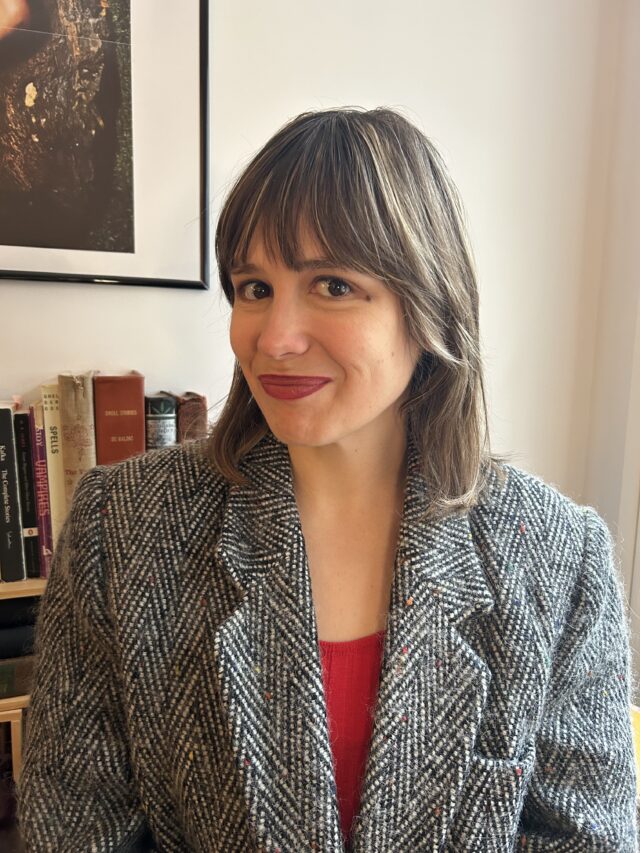 Amelia Christmas Gramling is a writer and teacher from southwestern Kentucky. She received her MFA in Nonfiction Writing from the University of Iowa where she was awarded the Provost Postgraduate Fellowship for her graduating thesis. She now lives in New York. Her work can be found at Bloodletter Magazine, Autostraddle, Bellevue Literary Review, and elsewhere. She’s drawn to stories that defy discreet eras of history: missing archives, found objects, and migratory ghosts.