
There is no honorable way to kill.
No gentle way to destroy.
There is nothing good in war except its ending.
“The Savage Curtain” – Star Trek: The Original Series
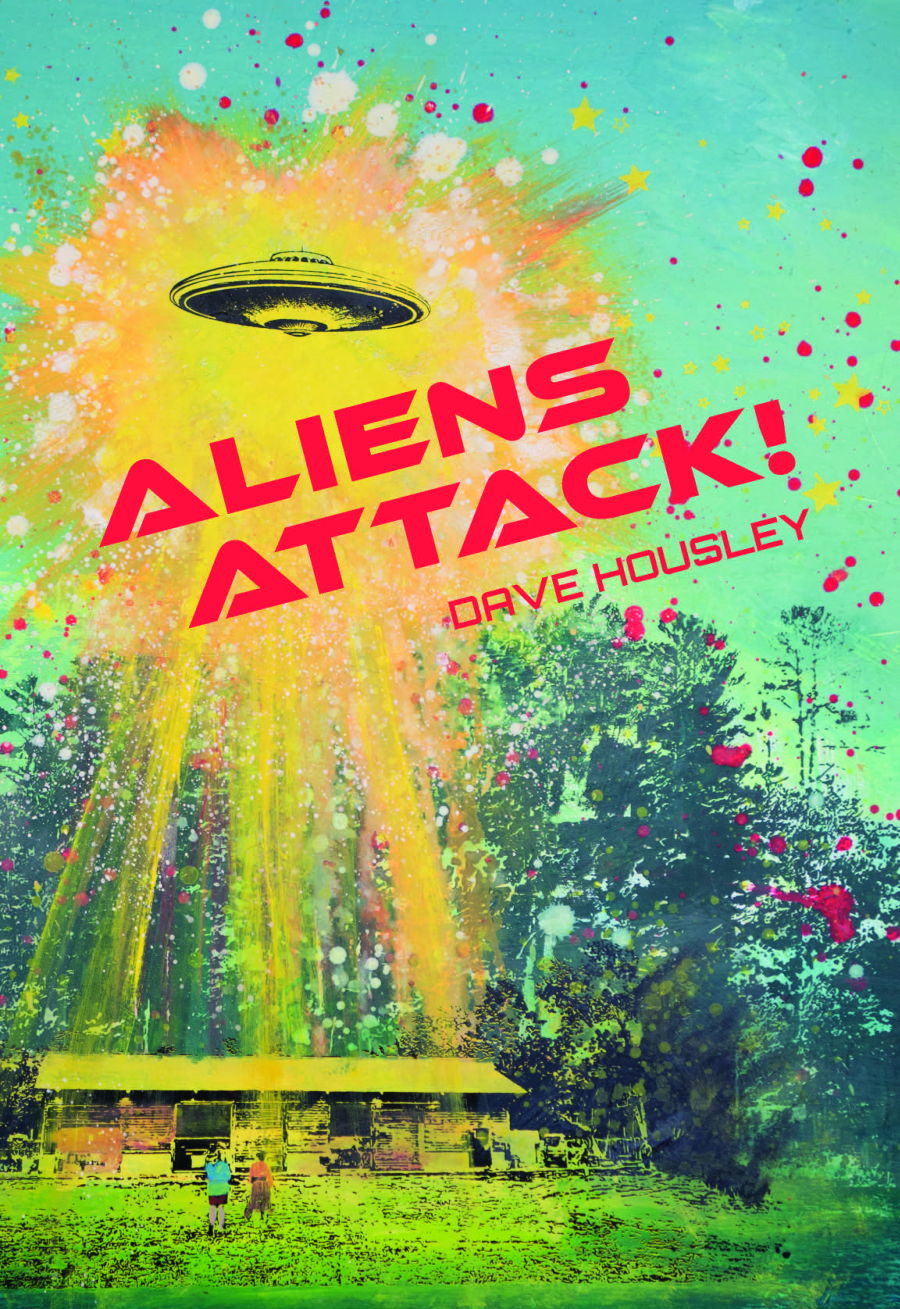
Dave Housley’s Aliens Attack! is a comic apocalypse that’s part novel, part short story collection. Housley signals this form clearly from the first chapter’s title: “What We Talk About When We Talk About Aliens,” is a Raymond Carver reference that’s about as subtle as the Death Star. This blend of long and short fiction allows Housley to worldbuild through the characters’ individual stories and compare two societies: a human one and that of their alien colonizers. Each chapter features a different protagonist—sometimes they’re human, sometimes alien, sometimes it’s a new character, sometimes a return to one we’ve already met.
The opening chapter’s portrait of humankind isn’t particularly noble. We follow Burns, whose plans to divorce his wife Sarah are interrupted by the aliens’ arrival. While escaping in their car, they see a gang of children attacking a young boy balled up on the sidewalk:
There is blood gathering in a puddle around the boy’s head and he is motionless. Burns wonders if he should get out and help the boy, but the older children are nearly as tall as Sarah and he is not sure if he would be able to defend himself.
This Lord of the Flies-like scene, which centers rabid children and passive adults, is an indictment on the human instincts for violence and individualistic self-preservation. All are poor indicators of our chances against alien invaders. How can we save each other from extraterrestrial warships if we can’t save our kids from each other?
Burns and Sarah are one of the many single-chapter characters whose stories are set on the day of the invasion. There are also chapters featuring a couple rehearsing for their wedding, middle-aged college friends at a reunion, opioid-dependent pastors, and others. Many of these chapters have been published in literary magazines and journals as stand-alone stories and so they work on their own. As part of the novel, they set the stage for the one human whose story we periodically return to: Clifford, father of two from Philipsburg.
In his opening scene, Clifford is driving his family away from Washington DC after the first attack. Trying to maintain a veneer of normality, he stops at a McDonald’s so his son can use the restroom. Approaching the building alone to make sure it’s safe, Clifford “feels like he is an extra in a movie about an alien invasion.” He isn’t an action hero and he knows it.
[He] will never be anything more than what he is right now, here, in this moment, a father walking into a McDonald’s, a man unqualified to be the leader of this small and imperfect family, a person who will almost certainly be vaporized by an unknown alien force in ships shaped like zeppelins.
Clifford is an everyman: small town, straight, and married with two kids. He can’t imagine being a hero or even a good leader of his family. In fact, while looking for danger ahead of him, Clifford missed the alien zeppelins coming up the road from behind. His story, a long walk home to Philipsburg where he hopes against impossible odds that he’ll reunite with his family, is tragic and comic. But he finds strength in his care for others and in his refusal to give up on humanity. His generosity of spirit even extends to the aliens. That could be seen as a sign of weakness, but none of the alpha male action heroes seem to have survived day one of the invasion, so who is left to judge?
Otho, an alien ship captain who loves the Supreme Commander’s daughter, also recurs in several chapters. Interestingly, Otho has the characteristics of a classic hero: the lovesick captain of an underdog ship with a scrappy crew. But he and his crew have been assigned to dock on an abandoned planet far from Earth. They learn about the invasion over their news screens.
By the time the news comes across the screen, Otho has already resigned himself to the situation. They have been duped, marooned on this in-between nothing of a planet. His father-in-law is a genius and a monster. Scratch that. His ex-father-in-law is a genius and a monster.
[…]
The words TREMENDOUS VICTORY scroll across the control room’s massive central screen. Then COMPLETE PLANETARY TAKEOVER.
Even though humans look just like them, not many aliens express remorse for wiping out the inhabitants of Earth. But those who recognize the cruelty of the Supreme Commander who ordered it are sent to a no man’s land. Empathy, which helps humans survive their decimated world, is a trait alien leaders stamp out or disregard in their people. The Supreme Commander wants the blue planet and the only deal he’ll make with humanity is down the barrel of a ray-gun.
There are also aliens who also feature in their own chapters as their military commits genocide and razes cities. Alien scientists, religious leaders, and political figures all have chapters showing how the different pillars of society find justifications for the annihilation of humankind. Their Supreme Commander uses a contestable study that humans have an extra chromosome, alongside the aliens’ religious fervor, as rationalization for killing Earth’s inhabitants and taking the land. This should sound familiar; the manipulation of science and religion to legitimize colonial violence is nothing new to humankind.
It’s hard to resist making comparisons between the Supreme Commander and the current US president. From the first “TREMENDOUS VICTORY” on the news screen, an image arises of tiny hands firing off another bombastic, self-congratulatory post from White House social media accounts. Science Fiction’s longtime use as a vehicle for political criticism primes us to instinctively look to it for analogies that confirm our opinions. So is the book’s big, evil villain Trump or not? With Housley’s sense of irony and humor running throughout the novel, he certainly plays with the comparison. Also, US readers are his target audience: How else to explain why almost all of the characters representing humanity are Americans? But then, the very fact that all Americans are being exterminated by the aliens complicates any direct analogy. Surely in a straightforward one they would wipe out half the country.
This makes all this analogy-searching feel more like a playful distraction for readers (and maybe the author) than a clarification of what the novel is showing us: the strength of compassion and empathy, and how these traits can not only give us a reason to survive, but also provide resilience in the face of violence and oppression. The book also suggests that ignoring or suppressing our instincts to empathize might equate to complicity in atrocities. And while our consciences’ suffering is nothing compared to that of the victims of those atrocities, the only true peace will go to those governed by compassion. Perhaps for kindhearted Americans who are despairing at the cruelty of the current, seemingly all-powerful government, Aliens Attack! is sending a message: We are not alone!
Publisher: Mason Jar Press
Publication Date: April 21, 2026
Reviewed by David Lewis
David Lewis’s reviews and fiction have appeared or are forthcoming in the Los Angeles Review of Books, Joyland, Barrelhouse, Strange Horizons, The Weird Fiction Review, Ancillary Review of Books, 21st Century Ghost Stories Volume II, The Fish Anthology, Willesden Herald: New Short Stories 9, The Fairlight Book of Short Stories, Paris Lit Up and others. Originally from Oklahoma, he now lives in France with his husband and dog.