
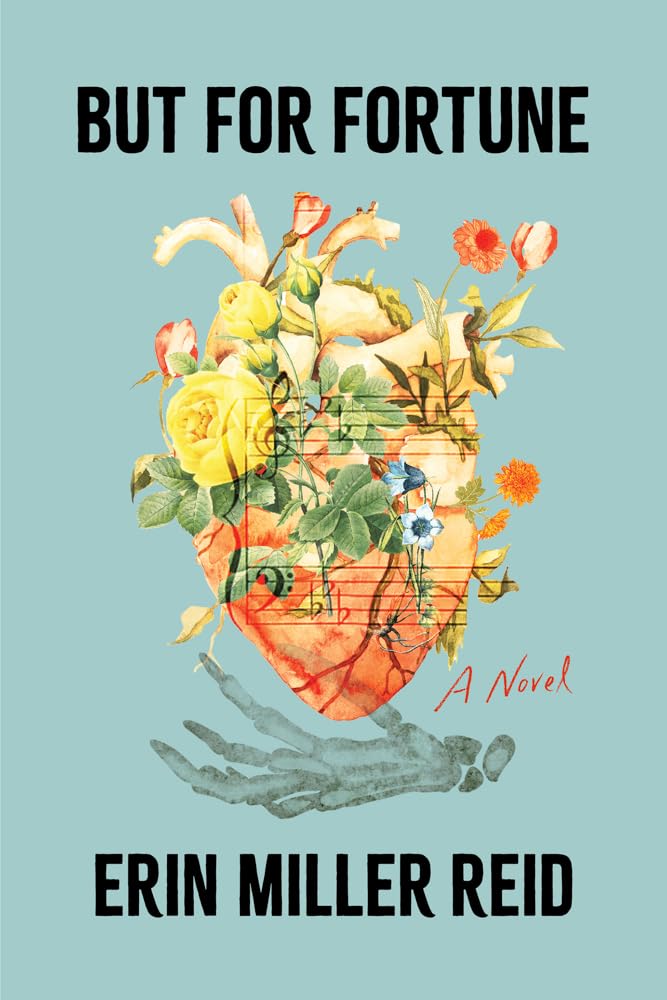
 But for Fortune is an ambitious debut novel from physician-turned-author Erin Miller Reid, who draws from her career in medicine and her Appalachian roots to craft a visceral work about inheritance, womanhood, and what it means to live with—and survive—mental illness. The novel unfolds through dual narratives. One, set in 2000, follows Corinth, a young medical student whose disciplinary case involving a patient’s medical chart threatens the career she has spent her life building. The other flashes back to the 1950s, in which Corinth’s grandmother, Mary Esther, survives an abusive marriage and repeated institutionalizations at a psychiatric hospital. Reid writes in the postscript that the novel grew from a question about how different her own life might have been had she been born in another era, a question reflected in the title and made more intimate by the book’s dedication to her grandmother.
There is much to admire in what Reid has accomplished, but the novel’s structure often undermines the narrative tension and character work it is meant to illuminate. Again and again, Corinth and Mary Esther are forced into symmetry when the more interesting questions arise from the ways their lives do not match.
Corinth learns that Mary Esther was institutionalized at the same hospital where she works during her suspension from medical school. She searches her grandmother’s history hoping to understand what happened to Mary Esther. But the novel’s mystery has been undermined by then because the reader has already spent dozens of pages watching Mary Esther become a wife and mother, suffer abuse, experience psychosis, and enter the psychiatric hospital. Corinth’s investigation asks the reader to wait for her to discover a woman we already know intimately through scene—much more so than a medical chart or family testimony will reveal. More importantly, Mary Esther’s life is so different from Corinth’s that the fear of a shared fate struggles to bear the narrative weight placed on it.
Mary Esther can be angry, reckless, frightened, cruel, and difficult. She threatens her abusive husband with a gun and later loses a stable job after hurling jars at him when he appears with another woman. Her chapters are where Reid’s novel is strongest. Mary Esther does not possess Corinth’s clinical vocabulary: She cannot neatly name depression, abuse, psychosis, or trauma; she must experience them. Trees speak to her. Her paranoia and hallucinations coexist with a gift for numbers, a love of music, desire, and an abiding attachment to her children. After ECT damages her memory, the woman who emerges is quieter and diminished, but never absent.
Corinth suffers profoundly, but Reid rarely allows her to be difficult or seriously wrong. In the medical crisis that leads to her suspension, her failure is mainly one of passivity, while a senior resident commits the clearer ethical transgression. She also neglects both her boyfriend, Adam, and closest friend, Cecily, but a later affair between the two makes Corinth the wronged party before she must fully confront what her withdrawal has cost either relationship. Arjun, the more compatible romantic possibility, then becomes available without Corinth having to make the painful decision to leave one person because she wants another. Perhaps this protection is itself Corinth’s “fortune.” That would be a painful enough truth, but the novel never quite commits to anything so bleak.
The novel repeatedly asks us to imagine that, but for fortune, Mary Esther might have been Corinth; it is less convincing that Corinth might have been Mary Esther. The difference between the women is not simply temporal, but which side of medicine they occupy. Mary Esther is a patient: observed, diagnosed, confined, medicated, and written about. Corinth is training to become a doctor: She observes, interprets, reads charts, and participates in treatment. Even while suffering from mental illness herself, Corinth retains the authority to understand and describe what is happening to her. That difference is related to opportunity, but it cannot be explained by era alone: There were doctors in Mary Esther’s time, just as there are psychiatric patients in Corinth’s.
The contemporary psychiatric ward therefore offers a more unsettling version of the question posed by the title than the one the novel ultimately explores. Mercy, one of Corinth’s patients, has far more in common with Mary Esther: Her illness, treatment, relationships, and freedom are still being negotiated by other people. The contrast becomes even sharper through Dr. Jacinda, Corinth’s attending at Maxwood. Jacinda and Mercy attended the same school, yet one became a physician while the other became a psychiatric patient. Women have not stopped living versions of Mary Esther’s story simply because medicine has changed; fortune still helps determine who gets to become the doctor and who becomes the patient. Yet despite having so much to say about medicine and its institutions, the novel pushes these questions to the background, even though Corinth’s medical identity is far more central to her character than being a granddaughter.
Corinth’s discovery of Mary Esther’s medical chart further exposes the divide. She criticizes the record for reducing her grandmother to diagnoses and treatments, but Mary Esther is still alive, and Corinth rarely treats her as a valid source of her own history. Her age, illness, and years of treatment have made communication difficult, but difficulty is not the same as absence. At one point, Corinth becomes so absorbed in the chart that she neglects the woman beside her long enough for Mary Esther to attempt to light a cigarette on the stove and singe off much of her hair. Corinth searches for the woman her grandmother once was while repeatedly overlooking the woman who is still there.
That distance does not entirely disappear in the novel’s final movement. Corinth returns to caring for Granny, but some of those scenes retain an odd coldness: Even as she dresses and tends to Mary Esther, she continues to understand her largely through what has been lost, describing a life “fractured beyond repair.” The language sits uneasily beside everything Mary Esther’s own chapters have shown us. She has been altered profoundly, but she has not disappeared.
But for Fortune is absolutely worth reading. Its central symmetry sometimes constrains the richer questions around it, but those possibilities exist because Reid has created a novel ambitious enough to raise them. Its strongest scenes are vivid, painful, and difficult to forget. Reid is an author worth watching.
Publisher: University of Kentucky Press
Publication Date: September 15, 2026
Reviewed by Karina Gonzalez-Espinoza
Karina Gonzalez-Espinoza is a Mexican-American reader and writer based in Tulare County, California. She studied at Harvard University and works in municipal government. Her free time is spent playing word games, collecting handbags, and spending time with her sisters.