In third place, “The Big Reboot” by Michael Hughes Wesner, which expertly employs its breezy comic voice to glide the reader past the transparent goofiness of its premise. Its main strength, though, is its narrator’s understated capacity to register—even as he refuses to confront—just how much pain and disconnect lies beneath his relationship to both his family and the world he’s so deftly satirizing, especially when it comes to his wife. I choose to read the ending as only an ersatz happiness—as his having decided to will himself into a state of acceptance that the reader cannot entirely celebrate. —Guest Judge Jim Shepard

The first thing I see through this new head of mine is Jenny’s smiling face, red-nosed and tear-crusted, gazing down at me in the hospital bed. As I blink away the loading screen and stare at her again for the first time, she screams and cries. Bright figures in the back of the room whoop and dance and high-five. My father abandons his cane to hug my little nephew. Nathan, my brother, shoots his fist and howls.
“Come on!” he shouts, careful not to curse in front of his son. “Let’s eff-word go!”
Jenny hugs me tight enough to pop my new head clean off. But somehow it stays taut atop my shoulders, steady enough to notice, from the corner of my eye, Nate Junior’s gawking. His wide-eyed terror tells me everything I need to know. Everything the hooting and hollering won’t reveal.
That’s my first concern in this new head: how shit I look. My second: who brings a twelve-year-old to something like this? Like, what if I hadn’t woken up? Wouldn’t that, say, traumatize Junior for the rest of existence? I make a mental note to ask Nathan about this once my jaw is freed from the gauze and tape.
Only after receiving hugs from Nate and Dad do I notice the cameras. The kid might not approach me, but the cameras will: lenses constricting and contracting under hospital fluorescents. When the doctor explains my situation, he postures toward them, not me, as though he’s being interviewed. Which, maybe he is.
“We successfully uploaded the patient’s consciousness to the cloud during surgery—no small accomplishment given the trauma sustained by the former cranium.”
They’re filming for posterity, Jenny explains, since my operation was first-of-its-kind. She signed off on my image rights for research purposes, in order to afford the surgery. Something about insurance, an issue with disputed fault after the accident.
“You’re a medical celebrity.” She winks.
Dad says: “More like medical anomaly!”
The cameras pan from Doc to me. And I don’t notice Nate Junior hovering until his father screams at him to remove his finger, poking into my freshly sewn neck, wriggling around like he’s mid-booger-check.
* * *
The first thing I can’t recall is also the most alarming. My own name.
“That’s a problem,” Doc says. “Unless, of course, you want to try something new on for size?”
Jenny says: “You always joked about liking the name Atticus. Remember, hon?”
But of course I don’t. It’s a miracle I remember her.
Nate asks: “How does that work, exactly?”
“There’s some ongoing legal debate over whether a new head defines new personhood,” Doc says. “Some think a prosthetic brain implies fresh identity. New driver’s license, new social. In which case, a new name is only fitting.”
“Well, I already named him once,” Dad says, “so I’ll sit this one out. Eh, Atticus?”
Jenny laughs and laughs. She squeezes my hand and loses herself in my fisheye lenses. In the end, they choose not to rename me, but they also don’t reveal my old one. Something about the cognition tests, Doc says. He can’t compromise the integrity of his studies. Not with the posterity recordings, his teleconferences, the world of medicine watching his every move.
“Our every move,” he’s quick to remind.
* * *
Other memories escape me too. Which is odd, since everyone seems to think this new-fangled mind of mine is infallible. But I can’t recall Jenny’s phone number. Or my SSN, for that matter. Or the ending of How I Met Your Mother, or the last World Series winner, or even the crash that brought me here.
“That last one is intentional,” Doc says. “Your wife opted for the trauma suppressant prototype. To make things easier.”
“And the rest?” she asks.
“Revealed with time.”
We use whiteboards to communicate while the gauze still mutes me. They ask questions and I scribble responses, most often three letters: IDK. Then they act all impressed, like I can’t see it in their eyes: the worry that I’ve woken empty-headed. Literally.
Even post-gauze, I’m not allowed to see myself. All phones are confiscated. The bathroom mirror, uninstalled. “We wouldn’t want you experiencing shock while your body’s still recovering,” Doc says. But as they unravel the bandages, Nate Junior’s glaring suggests I’m uglier than ever before. And a real looker, I was not.
“Well, honey…” Jenny smiles, like it’s the first time she’s seen me. Which, I suppose, it is. “How’re you feeling?”
“Fine.” The word slips out in a hoarse baritone, a new voice that startles me to tears. And then I’m wondering: how do I even produce tears? Does this head contain some tear duct repository? Will it require filling, like windshield wipers? And that sends me spiraling, until soon I’m kicking and punching, rolling in bed, screaming about how I miss my old self, how they should’ve just let me die, blah, blah, blah.
On the bright side, at least I’m starting to get this whole mirror confiscation thing now.
* * *
When I’m finally discharged, Nate and Jenny tour me around the house. It concerns me a little that I can’t even recall the layout of my own home. I can picture our marriage bed perfectly. I just don’t know how to get to it.
Nate bakes frozen pizzas, and it takes me three tries to find the pizza slicer. Every drawer I open is the wrong one. Wrong, wrong, wrong.
Home is mirror-proofed as well. Phones, still a no-go. But I accept this as is, because anything is better than the hospital. Those fluorescent lights. The cameras and stares from Nate Junior, like I’m some Twilight Zone freak. If there’s one thing I’m grateful for, it’s the fact that Junior’s with Nate’s ex-wife while Nate supports my reintegration, not over here sticking his thumb in my neck.
Then again, maybe Junior’s the only one being genuine. They can shield me all they want, but I know the vague silhouette of me. On my very first night home, I catch a glimpse of my reflection in the oven door and spot thick hair sprouting from my crown. My face feels sleeker, too. Heavier, with a sharper jawline. I can’t shake this alien feeling, as though I’m staying the night—every night—in a swanky hotel room, sleeping in a bed that’s not my own.
When I ask Jenny about it over pizza, the question shocks her. And not just because of the raspy, smoky voice that asks it.
It says, “You changed me, didn’t you?”
“Well…” Jenny blushes. “I was given some cosmetic options.”
“And thank goodness she did!” Nate punches my shoulder. “Otherwise she’d be stuck with your old ugly mug forever!”
He laughs into his pizza, averting my gaze. Jenny stares at him, like, Oh no, you didn’t. And I just stroke my newly chiseled chin—perfectly cropped stubble scraping my thumb.
“These are all things we talked about,” Jenny says. “Things you wanted over the years.”
Memories flicker like old films, clouding the dinner table. I recall glimpses of a bald spot. Flab rounding my cheeks and throat. Endless mornings, shaving before work, interrogating the mirror for creases or wrinkles.
The likeness fades and I’m back eating pizza. Shifting in my chair, I readjust my straining waistband and sit up straight. Even after the accident, I’ve still got my muffin top. My slouching shoulders, my desk hunch.
“Those weren’t your decisions to make.”
“Honey, you couldn’t exactly be consulted! You were dead, remember? Legally dead?”
As Jenny’s questions land, an uncanny image bubbles to my vision. Heavy snow on the interstate. Grim grays of a winter’s evening. And a semi-truck sliding forward.
I flinch. The dinner table reappears.
“Uh, hello?” Nate knocks on my temple. I can hardly feel him through the thick layers of silicone, or rubber, or whatever. “Anybody in there?”
Jenny hands me another slice, urging me to eat. But not once does she ask how things taste on this foreign tongue.
* * *
Jenny and I, to my recollection, have never been church people. But I guess I was out longer than I realized, getting my head screwed on, and now she’s doing good on some emergency room promises. So here I sit bracing pious stares while my wife’s grateful sobbing echoes through the pews, drowning out the sermon about life and second chances. You’d expect angelic choirs, heavenly light streaming down upon me. Instead, a strange ringing like microphone feedback paralyzes me—a side effect of my hyper-attuned ears in this somber chamber. I hardly catch a word of the priest’s lecture about God making us in his own image.
Caressing my stubble, I’m considering whose image I’m made in when Jenny squeezes my hand and points forward. The priest has called me to stand. When I rise, we lock eyes, and I get the impression that he’s dreading this as much as I am.
“And please give a warm welcome to our, uh, friend here, who, by God’s good grace—” he clears his throat “—has conquered an unconquerable fate.”
I rotate in my spot, offering little waves to the congregation. Paled faces stare back, unsmiling. Struggling to bear witness.
When I’m seated, I lean forward, head in hands, gripping the thick, brittle locks of mane that I’ve been blessed with. But this isn’t my real hair. It’s not even my real scalp. This is a hunk of plastic, stuffed to bursting with computer guts. Dentures and doll hair and marbly fisheyes. Ears that translate scripture and music and my wife’s soothing words into mosquito buzz.
What kind of a second chance is this?
“Wow.” The pastor chuckles. “What can’t our God do?”
* * *
Even after the mirrors return, it takes a while to recognize myself. I catch awkward glimpses where I least expect me. I’ll get lost and find the bathroom where I looked for the office, then jump at the shock of my reflection. Or I’ll go down to the foyer when I meant to go upstairs to bed, and I’ll catch my polymer perma-smile grinning from the mirror above the shoe rack. I can’t help thinking I’m a home intruder—some haunted mannequin risen from the Springfield Mall. After finding myself in the porch slider one evening, I threaten to call the cops. It takes Jenny lifting my chin and revealing my throat scar to convince myself: I’m me.
For the rest of the evening, I squat at her vanity, inspecting that little seam, behind which connects the flesh and bone of me to the plastic and circuitry. No wonder Nate Junior’s so fascinated. It runs zipper-like around the trunk of my neck—the long red ribbon of a gift I can’t return.
“Stop playing with that,” Jenny says from bed. “You could hurt yourself.”
I do as she asks, but my mind fixates on it, the border where real me meets fake me. As I climb in beside her, I ask if she’s noticed I can’t stop smiling.
She grins, like it’s our first time sharing a bed. “Neither can I.”
“No, I mean, literally—I can’t stop. Like, the muscles or motors or whatever won’t quit.”
Jenny pinches my cheeks with both hands, massaging the squishy synthetic meat of me until I fear it’ll peel off. When she’s done, I check the mirror, but there they remain: two perfectly rounded dimples.
“You’ve got a lot to smile about,” she says. “Try to enjoy it, would you?”
With that, I flip over, returning to this pillow sculpted by another head. After some time, my brain triggers the sleep program, and my vision is filled with animated sheep hopping animated fences, grinning their animated grins.
* * *
Jenny throws a family get-together in honor of my successful face reveal. She blows up blank balloons and serves cake to family and friends, who compliment me on how good I look now. In the living room, Nate hangs a banner that reads, It’s A Boy!, with the last word crossed out and replaced with: New Head! (Jenny doesn’t seem particularly pleased with this but helps him hang it all the same.)
Letters pour in from hospitals across the country—surgeons thanking me for my contributions to science. Jenny stands beneath the banner and reads them aloud, but I zone out after the first few. Staring blankly into space for long enough, I’ve learned, triggers the sleep program. I’m literally asleep with my eyes open when Nate shakes me awake.
“All good in there?”
“Sure,” I say, blinking away the sheep. “Yourself?”
“Better than you, I bet.” He pulls up a chair. “But things with Junior have been tough.”
“Divorce stuff?” He nods with proud surprise. I can’t recall my own name but somehow remember in perfect detail the nasty proceedings of his separation. Nate explains how Junior suffers from self-confidence issues. How he’s taken to wearing masks at school. Theater props, Halloween leftovers, anything that hides his face.
“I caught him packing a rubber George Bush into his backpack last week.”
Craning my neck—so far I fear detachment—I spot Junior playing Pin the Head on the Person. Sure enough, the kid’s wearing a Batman mask under the blindfold. He fidgets with it, picking at the fields of acne that litter his cheeks.
“Isn’t he a bit old for that?”
“The school shrink says it’s a phase. That age is tough to get through, huh?”
Light screaming, as Junior pins the Head on Dad’s back. I sort of imagined face reveal parties as low-key, wine-and-cheese affairs, rather than cake and games. Then again, we’re paving the road with new traditions.
“Anyway, it’s good to talk to you about this stuff. I wish we’d done it more before the, well—” Nate pauses, sips his beer. “Anyway, you get what I’m saying, right?”
Of course I don’t. Not at all. But what else is new? I just smile my great big constant smile, until Nate leaves to chastise Junior for picking at his face.
* * *
After some time, my PTO dries up, and I’m forced back to the office. And, with it, my old commute. The scene of the crime, as they say: I-95.
In the end, I keep my license, but provisionally, since my brain has technically never operated a motor vehicle. Nate chaperones me from the passenger seat. Even if it wasn’t a legal thing, I’d like to imagine he’d come along for moral support.
Brown, barren trees race past, and I think about all the other things my brain has never done. Be intimate with Jenny, certainly. Drink into blackout. Cry until my tear ducts run dry. What happens to my perma-smile then?
Nate’s question drags me out of my head.
“How’s Jenny taking things?”
“Good, I guess.” My hands operate the steering wheel like they’ve done it a thousand times, which, technically, they have. “Better than me, I think.”
This surprises him for some reason. Before I can ask why, a familiar sight shocks me out of my own thoughts. I recognize it: the scene of my own demise. Recollection hits with movie thickness, replacing my vision with images of windshield shards and engine smoke. I worry for a moment that I’ll crash again.
When it fades, I see a cross standing beside the crash site. There’s a photo, too, of some bald schmuck with pudgy cheeks and dark circles beneath the eyes. How sad to think: the many people who’ve shared my fate. Maybe I’m the lucky one, after all.
“Sorry about that,” Nate says. “It’s from before we knew everything would be okay.”
I find his comment strange until our drive home that evening, when I see the cross again. And I recognize the man in the photo is me. Even if the man in the rearview is not.
* * *
Work takes a while to acclimate. But it’s good, overall, to shut my brain off without the sheep. The menial tasks—data entry, spreadsheet formulating—come back without a hitch.
They’ve removed my nameplate, replacing my desktop profile with a generic John Doe display. Nobody refers to me by name, just awkward glances toward my desk. The whole office, complicit in Doc’s experiment. My password, randomized, is written on a Post-it for me to enter. I’m the ideal employee: silent, anonymous. My coworkers feign politeness, trying their darndest to contain the cross-cubicle stares. But I can tell.
It’s strange: reflected in the men’s room, my head actually looks appropriate for once, like it was tailor-made to strut atop this suit. (Even if the suit’s a size or two bigger than my perfect jaw might indicate.) “Ready for the runway?” one coworker asks. I look at her strangely, but she just smirks. Only after returning to my desk do I realize that I was grinning back. As always.
For once, I feel like Nate, who always, our whole lives, was confident in his appearance. Nate the Great, they called him. Nate of many prom dates—enough to spare—of wife and son, of settling down. Unlike me, who took years of trial and error to find Jenny. And, even then, never felt completely comfortable in his own skin.
“Look at you with the happy ending, while I just wound up divorced,” Nate recently said, scanning me up and down like an art exhibit he couldn’t comprehend. The same look he gives Junior now, with his masks galore.
Don’t I know what that feels like. If my old head could talk—the stories it would tell.
* * *
“He jumped from a tree at recess, head-first, wearing a rubber horse mask. We’re lucky he only broke his collarbone!”
Nate’s voice shakes over the phone. Faint hospital noises dizzy me with recollection: machines beeping, intercoms buzzing. The fluorescent orchestra I left behind.
“Can you believe that? My son tried to kill himself in a fucking horse head!”
“Nate,” Jenny says. “You don’t know that.”
“His mom thinks it was an accident, but that doesn’t add up. I mean, what if this shit’s genetic? What if everyone in this family wants to—”
Jenny quells the speakerphone, darting outside to finish the call. When she returns, moments later, she sits me down to explain some things. Things she doesn’t want me hearing through the rumor mill. Like, for example, that I wasn’t always the most enthusiastic about this whole “life thing.” Before the dashcam footage was recently recovered, they feared the worst.
“You thought I did this to myself?”
“You catch on quicker every day,” she says, though I fear that’s just an insult to the old me.
“What did the dashcam show?”
She opens her mouth, then second guesses. Instead, Jenny opens the footage straight from the email to the lawyers.
The incident occurs similar to how I see it in retrospect. My car drives southbound at an average speed, flowing with traffic. The top of the semi-truck—I clock it instantly—floats in the opposite direction. Everything looks normal until it doesn’t. Abruptly, my car slides between lanes, skating right, then left. It drifts out of control, rotates on a dime, pummeling with ease through the thin rubber dividers into the northbound lane.
And here comes the truck. And there goes the horn.
Honk, honk.
“Black ice,” Jenny says, and I notice she’s fighting tears. “No fault collision. They just ruled it.”
“Great!” I pat my knees. Nod my head.
“Is there anything you wanted to share?” she asks. “About the collision? Or anything?”
It crosses my mind whether she and the surgeons can watch my memories as I can, like rewound tapes. In which case, she’d know exactly what I’m thinking. That maybe the doctor screwed up his trauma suppressant? That I’m not fully certain whether I was at fault, or if I ever knew to begin with?
But I don’t share this with Jenny because—well.
My head, my business.
So, all I say is: “Nope. I’m good.”
And she says: “Good. That’s good.”
But just before leaving, she turns back and yanks my hands from the seam of my throat. Which I hadn’t even realized I was toying with, mindlessly, yet again. Under her breath, I hear her say, “I swear to God, you’re gonna kill yourself.” But I’m not sure how to take that.
* * *
It hits me after work one night, chopping vegetables while Jenny visits Junior at the hospital: I used to garden.
The knife clangs atop the countertop as I rush outside. Finding it takes a few tries—failing first in the backyard, then the front—but eventually I stumble upon the raised bed in the side yard, between our house and the woods. A familiar rushing sound permeates from the tree line, like blood surging through my head, and I wonder whether these supersonic ears can pick up the very white noise of the universe.
All my plants are dead—dried out and weed-choked—which makes sense, considering Jenny’s not exactly the greenest of thumbs. Yet it’s strange: standing here, when I close my eyes, I don’t see black. I see vivid images of how things used to be. Lush winter cabbage, thick leafy broccoli. An organized, weedless earth.
Before I know it, I’m on my phone, peeking at old photos for the first time since the accident, desperate for verification that yes, in fact, I was something of a plant whisperer. Opening my old gardening selfies, I discover something better than blooming produce. It’s that same uncanny face: that pock-marked, double-chinned head from the roadside memorial.
Tired, aging. Me.
I close my eyes, determined to live in that memory. Man and garden, thriving in this season of neglect. But just as I begin to feel relief, the image fades, replaced by the sheep—jumping, and jumping, and jumping—and that pesky sleep program abducts my mind again.
My phone falls to the hard soil as I stand, dreaming in the ruin of what was. And that’s how Jenny finds me, hours later. The upturned selfie, shining through the weeds. Countless sheep, dancing before my lenses.
“That’s it!” she cries. “We’re settling this once and for all.”
* * *
With Christmas approaching, the surgeons are all booked up. But even then, they’re kind enough to clear their schedules and make room for me: the celebrity-anomaly. With Jenny’s permission, they want to try something called The Big Reboot. Something they say will ease my negative feelings forever.
“How’s the head?” Doc threads wires around my seat, plugging them into the atlas of my spine, right where the bone ends and the fun begins. “Any complications?”
Jenny responds: “He still can’t remember his name.”
“A strange side effect but not altogether worrying. Could be something to do with the trauma suppression. A forced forgetting of the prior self.”
“But that’s the thing, he remembers the accident perfectly.”
Doc stops what he’s doing and stares at me. “Is this true?”
I see it again: the cars, the dividers, the truck flying toward me. With a jump and a shudder, the memory fades and the hospital reappears. Jenny whispers to Doc in the corner.
“And that’s another thing,” I hear her say, “he experiences these total blackouts, going unresponsive.”
“Another side effect, albeit an expected one. Your husband no longer experiences memory in the traditional sense. His memories were downloaded, like media files. He watches them in playback. Full-screen, so to speak.”
“He also has these daydreams, like he’s in another world, completely zonked, and—”
“I’m right here, y’know.”
The words arrive from my throat low and confident, startling us both. The whole room glares—Jenny, Doc, the nurses, several students scribbling notes—as though expecting some grand speech. But all I’ve got to say is this:
“Y’know, I’ve been here all along.”
Doc steps behind me and flips the switch. Everything goes dark, except that familiar loading screen. Then the sheep appear. And that’s how I know The Big Reboot has begun.
* * *
The grinning sheep jump and jump and won’t stop jumping and it’s while I count them one two three that I remember my name it’s Ian Ayling I’m thirty-one and I’m the lucky survivor of decapitation the world’s first recipient of a prosthetic head I work in money management in Philadelphia I live in Broomall in the suburbs in a big house between the state park and the golf course and when it’s quiet in the evening from our yard I hear the gentle sound of waterfalls at Ridley Creek near where I live with my wife Jennifer Eriksen-Ayling and I have one brother Nate Ayling and a nephew Junior who cannot seem to keep his hands to himself which is kinda funny because I so remember being the exact same way I remember the self-doubt and the self-consciousness and the curiosity and the exhaustion of not knowing not ever finding out the things that can’t be found out like did I really do this to myself and why did they bring me back like this and was I really worth it because if I was then maybe they’re right I was something worth loving after all and sometimes he feels so close to me the old me closer even than the sheep that jump one two three like I’m walking through the park and the water falling falls louder the rush of water rushing clearer and I can almost reach out and touch him if I can only hurry up and reach the sheep as they jump and jump and jump and jump and—
* * *
Jenny insists we go to church on Christmas Eve, although I’m pretty sure we’ve never done that before. Dad hitches a ride with us, as does Nate, and Junior, who’s with his dad for Christmas, mask-free but wearing a sling. So we all embark on yet another new tradition.
“I just want us to feel the warmth and appreciation,” Jenny says in the car. “There’s so much to appreciate this year.”
“Speaking of warmth,” Dad calls from the backseat, “I’d appreciate if you turned the heat up. I’m freezing my cajónes off!” And Junior laughs and laughs, his sling bouncing in-time.
The kid sits beside me in the pew. He can’t help his usual staring, and I can’t help but feel a warm sensation, like gratitude, or its awkward relative. My anger and annoyance are distant memories.
It’s kinda nice, being back here. Being alive again. In this crazy, silly head of mine.
“Wanna feel my neck seam?”
Junior lights up. But just as his fingers are floating toward me, his father smacks his hand away.
“Nuh uh.” Nate shakes his head at me. “Heck no.”
The pastor takes his spot up front and recites some boring God stuff. As the sermon drags on, I tune out the words and bring on the sheep. It’s easy to ignore the negatives now, like the stares from all around, or the gossip between pews. I could listen in if I wanted to—I’ve got the ears for it. These days, though, I’m choosing peace and quiet.
That strange mosquito buzz returns, though it’s gentler now. Calmer, like white noise. The few words I do catch from the pastor are about love and remembrance, and taking care to remember the ones we’ve lost. Jenny squeezes my hand. Nate wraps his arm around Junior, then pats my knee.
“By the grace of God,” the pastor says. “We live such varied lives.”
* * *
After services, we visit Ridley Creek Creamery. Jenny, Dad, and Nate complain that it’s too cold, but Junior and I outvote them. My vote counts twice, Junior says, because I’ve had two brains. (And the robot brain gets the tiebreaker, he’s quick to add.)
Junior and I get our cones first and opt to sit outside along the snowbanks, stargazing beneath the trees. I wonder whether the rushing sound I hear is water falling, deep within the woods, or if it’s just that same old buzzing. I’m about to ask Junior whether he hears it too, when some kids pass by, pointing and calling me names, like DollHead and FrankenFucker.
That’s just something I’ve gotten used to. And I’m something they’ll get used to, too.
Our ice creams stay stiffly frozen in the cool night air, and my breath is a warm cloud as I invite Junior to touch my neck seam again, now that his dad’s inside. Of course he accepts. It’s that childlike wonder that I hope to emulate during this: my second chance at second chances.
Junior’s fingers, still dripping with chocolate, run the width of my throat, following the ribbon of flesh and mingled plastic all the way to the hump where my spine ends. I ask him what it feels like.
“Like the sweater Grandpa got me last Christmas, after Mom sewed the neck I tore.”
“That’s basically what happened to me. Give or take a semi-truck.”
“Do you think I could get one, one day?”
“Another sweater? Well, it’s a bit late for Christmas, but I’m sure Grandpa would—”
“No, no, no! A new head, just like yours!”
The question stuns me for some reason. I wanna tell him that he doesn’t need a prosthetic head, that the one he’s got is perfect as is. But who am I to crush a child’s dream on Christmas?
“Hey, wanna see a trick?”
He nods yes, so I guide his hand back to my throat. Then I take a bite of mint chip, making sure I swallow hard enough for him to feel the icy chill slip down the plastic layer of my skin. When Junior screams, I rejoice in his reaction: the horror and excitement and delight all at once.
“Ewwww!” he squeals. Then, bouncing on the bench, he asks: “What’s it taste like, Uncle Ian?”
“Well, like mint chip, you goofball.” But what I mean, of course, is that things taste sweeter now—fresher, like they never used to. Then I grab him tight, squeezing him until both our heads might roll off, as though letting go would be to surrender him to some distant, faceless memory. And I won’t let that happen again.
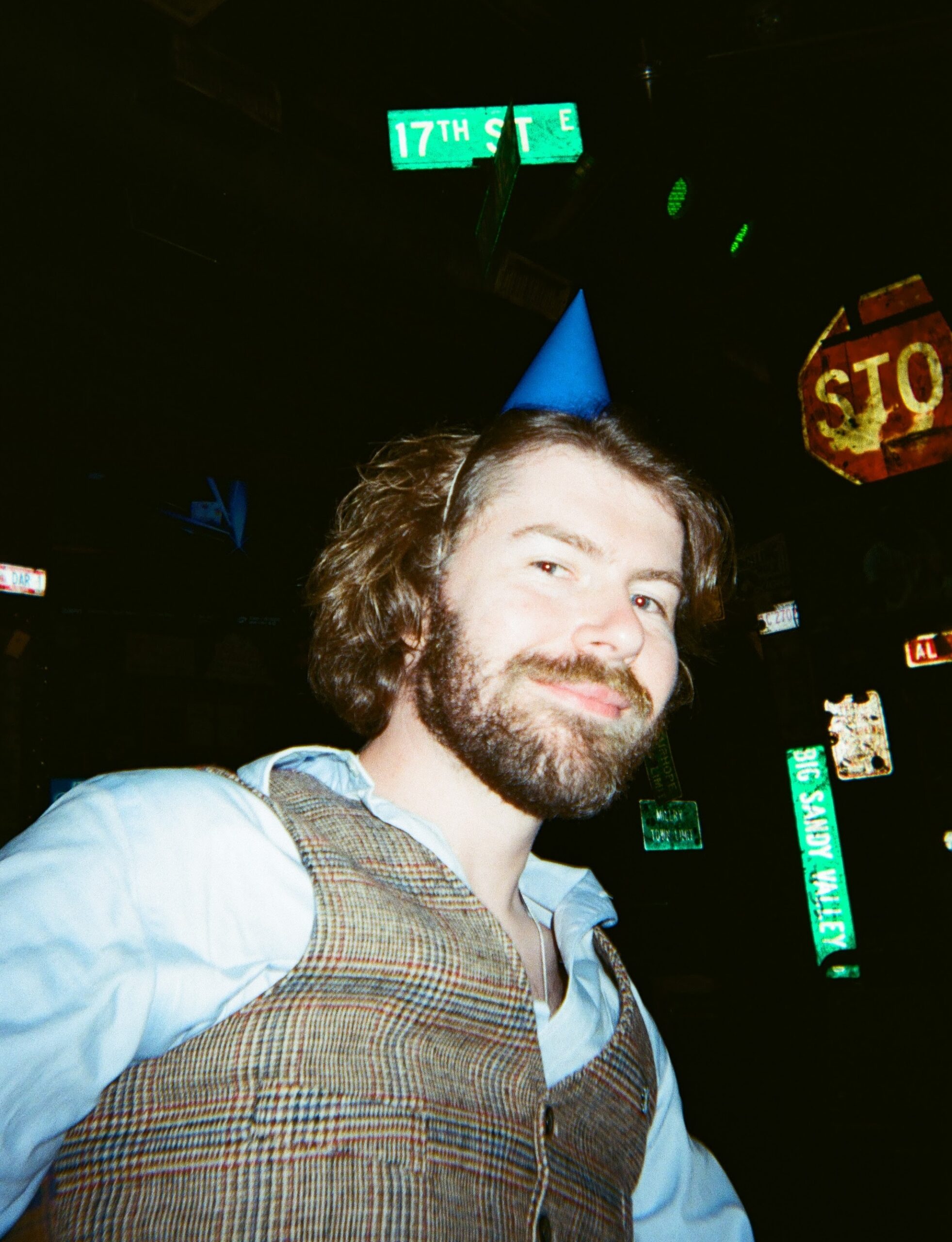 Michael Hughes Wesner is a writer from Philadelphia or thereabouts. His short fiction has been featured in The Good Life Review and The Bulb Region. An alumnus of the Kenyon Review Fiction Workshop, he is an MFA candidate at the University of Alabama and Fiction Editor of Black Warrior Review. Complaints may be directed via Instagram: @mhwesner.