
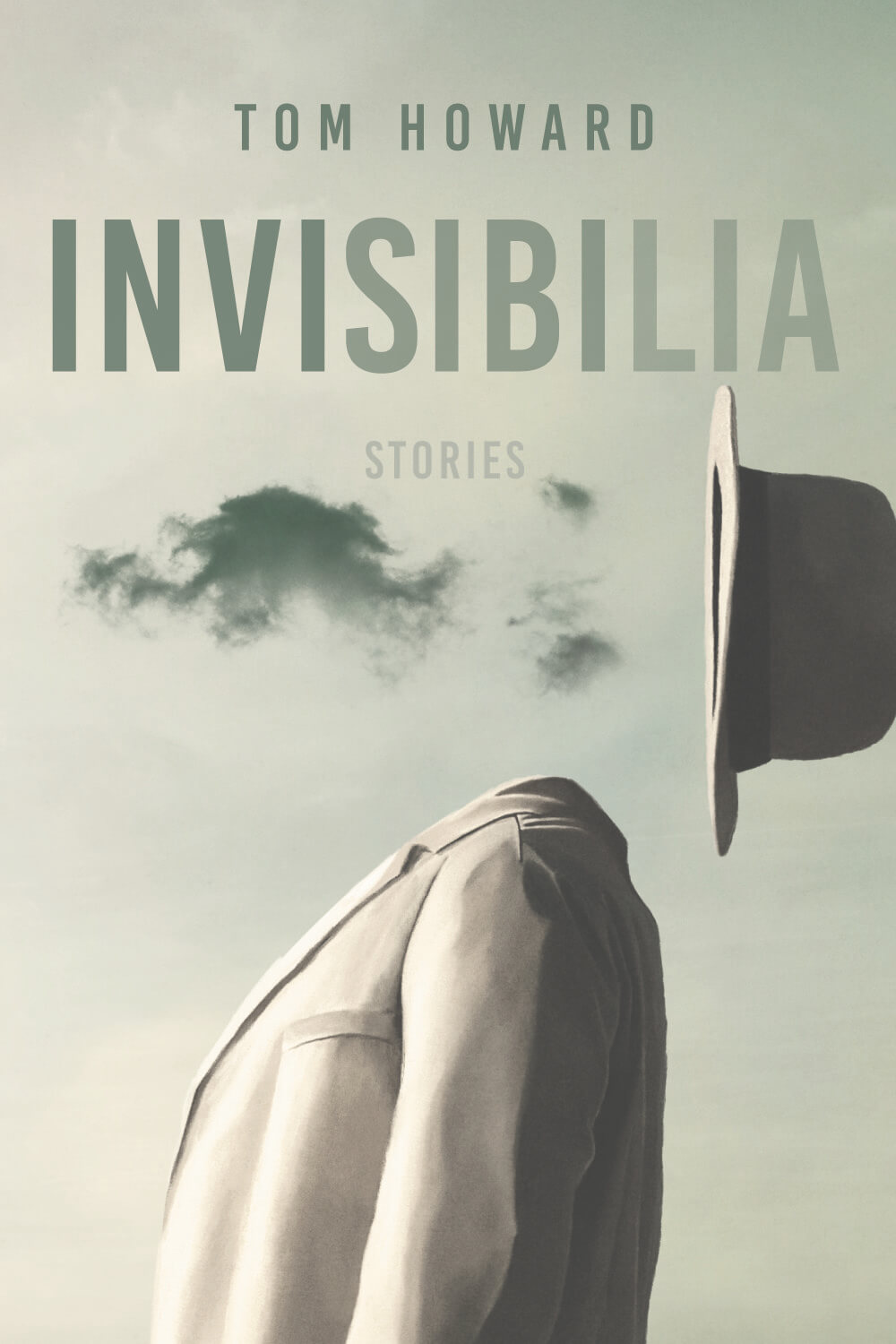
 Invisibilia, Latin for all invisible things, includes unseen forces such as thoughts, feelings, and beliefs. It is also the title of Tom Howard’s second book of short stories, the follow-up to his award-winning debut, Fierce Pretty Things. In each of the book’s eleven stories, Howard gives shape and voice to the ungraspable and unseen.
The opening story of the collection, “Heart of Gold,” revolves around two couples in a wealthy suburb, and is, other than their wealth, a study in contrasts. Kay (and her husband Mike) sees her new neighbors, Jasmine and Dave, as perfect. But a nesting doll of Kay’s own stories reveals Jasmine to be a vulnerable and stressed-out human just like the rest of us. Kay had a miscarriage that she cannot emotionally recover from, but later confesses that she was drinking heavily when she was pregnant and continues to drink to manage her guilt and sadness. Kay does not excel at homemaking but bakes brownies for the “perfect couple” to welcome them to the neighborhood. Per the recipe, “it’s critical to use room-temperature eggs, so I remove the egg carton from the fridge and leave it on the counter. This feels like progress, like I’m delegating work to the eggs.” The humor is in the power Kay relinquishes over something so insignificant. She and Jasmine find common ground in feeling powerless over the tide of emotions that swell every day. Eventually, Jasmine, exhausted by motherhood and in need of an afternoon nap, accepts Kay’s offer to babysit her young daughter, and Kay and the girl break into Kay’s old house. The story ends without revealing the consequences for Kay’s crime, but there is an undeniable sense that she wants to get caught.
In “Night Parade,” an executive order allows for ticketed revelers to unleash chaos in DC one night a year. In order to make up for his court-mandated anger-management therapy, Mitch makes a list of what to do with his son on the weekend of the Night Parade. Before indulging in the chaos of animal mask baseball-wielders, the list includes two hours of “Unwind and Casual Conversation” and “Dylan Memories Bingo,” none of which is of interest to Dylan. Mitch turns his embarrassment into pithy reply: “Well I mean the schedule’s flexible.”
Magic, sleight of hand and art that operates on unseen forces appear in several stories. In “Disappearing Act,” a man gets a call informing him that Bennie, whom he knew when they were children, has died. The funeral already took place, but the protagonist writes a eulogy anyway, perhaps taking it as an opportunity to confront his own mortality. Over the course of the story the man remembers more about Bennie’s interest in magic, in particular a game of chance that originated in Egypt. This game serves as his frame for reviewing the last forty years, mostly his recollection of ex-girlfriends, noticing the knots he tied himself into in relationships, especially by letting women make decisions for him. His sense of lostness is tempered when he surrenders to the fact that his memory is imperfect: “I couldn’t even remember all that I wanted to remember.” In a game with a moving target, it’s hard to keep your eye on the ball all the time.
In the book’s only flash fiction, “Jellyfish” a young boy glimpses his mother in the sea and compares her to magician’s card trick—a flash and then gone—as he and his brother round up dead jellyfish—another translucent thing—on the shore.
The collection’s most heartbreaking story, “Cary Grant at the Orpheum Theatre” takes place in a small town called Edgewood, which was founded on a false mythology about George Washington and an Art Deco movie theater. Will is thirteen and works at the Orpheum, which his father owns and his mother loves, not just the films, but the dark, fading glory of the theater, too. But Will only talks about his mother, never to her, and eventually the reader understands she is a ghost—either a true spectral figure or just a manifestation of his grief. She’d left when Will was eleven, saying she didn’t know how to be a mother, returned and left once again, and came back a final time before leaving for good. Will, inspired by the story of Cary Grant joining traveling stage acts to escape his grief, hopes to leave Edgewood when he graduates high school and have a chance at life that doesn’t revolve around the economic and social sadness of the town, as well as the memory of his mother.
With humor and deep empathy, Howard builds sandcastles and mandalas out of characters and time: here only for a short while as all things are and then they go. Where all things go and why is not for us to know and for Howard those aren’t the questions worth answering. Instead he finds the how and the what of story much more interesting and illuminating. Invisibilia is a collection that billows with voices that whisper and roar and yawn, and characters who are drunk or bereaved or left behind, but who stay long after closing the book.
Publisher: Slant Books
Publication Date: April 14, 2026
Reviewed by Jeannine Burgdorf
Jeannine Burgdorf is a writer and storyteller on stage in Chicago. Her fiction has appeared in The Signal House Edition, New Reader Magazine, Orange Quarterly, the anthology WriterShed Stories Volume 2, most recently in The Bridge Journal, and elsewhere. Her book reviews can be found in the Chicago Reader, the Chicago Review of Books, the Los Angeles Review of Books, The Masters Review, Necessary Fiction, The Coachella Review, and elsewhere. She is a member of the National Book Critics Circle.