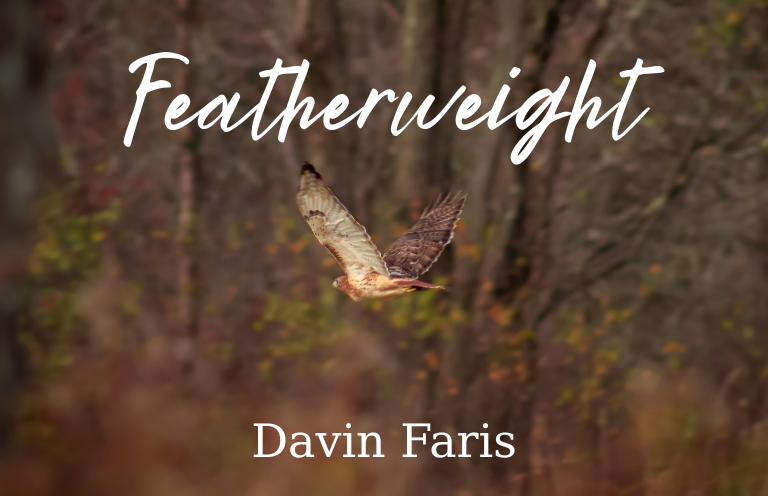
In “Featherweight,” Davin Faris beautifully renders the death of a red-tailed hawk. With prose that is at once poetic and scientific, he brings the reader into the moment so that we, too, feel the inevitable loss of this bird, but also the sense of connection to and resilience of the larger world.
A corpse is an intimate creature. How the body softens in abeyance, ligatures unstrung, flesh vacated in some abrupt and unspeakable way. Observation is violation. The silence is so pure it suffocates. You can feel the warmth fleeing into the damp morning air, subsumed by the clouded mirrors of magnolia leaves, swallowed up by your palms, your lungs. Tender lessons in entropy.
So we hold our impromptu funeral in the courtyard.
Only two mourners: me and Joshua. It is 7am on a Tuesday, the last week of August and the first week of the school year. You rarely expect to deal with death before breakfast. All around us, the college is still unconscious, slowly stirring from its summer hibernation. An hour earlier, Joshua and I claimed a table in a narrow glass-paneled room known as the Fishbowl for its voyeuristic ambience. In the habitual manner of sophomore philosophy students, our conversation concerns the metaphysical existence of knowledge. Our whispers echo through the empty room, resonant as the ghosts of ancients. Rorty and Popper, Plato and Heraclitus. The pragmatists, the idealists. We ask questions neither of us can possibly answer and rejoice in the asking. There’s a strange delight to the incomprehensible, isn’t there? The esoteric and obsessive? Maybe its incantation makes us realize how dazzlingly human we are.
Then—thwack.
One flank of the Fishbowl adjoins a white-tiled hallway; the opposing glass wall frames the courtyard. A slice of grass so green it burns, sagging benches, pink-yellow flowers, magnolia trees hunched and loitering on the periphery. Joshua says: Something hit the glass. I imagine a falling branch, a pigeon, or maybe a hefty beetle. We leave our discussion of knowledge spread on the table, like a face-down paperback splitting at the spine.
In the courtyard, we find her on her back at the base of the window. Eyes wide and dark, intelligent, contorted with panic. Later, my naturalist friend will identify her as a red-tailed hawk: Buteo jamaicensis. She’s stunned, at first. Her breaths come rapidly, fluttering the soft white feathers of her chest. Being this close beside something wild is illicit, almost criminal. Her world and ours should not overlap. Any moment, you expect her to vanish or lash out, to etch again the sacrosanct boundary between human and animal, feather and flesh.
But instead of flying away, she begins to writhe.
(When was the last time you watched something die? Not an insect or a neglected houseplant. I mean a creature large enough to stare back at you, to implicate you with its terror. What do you remember? What absolution did you cling to?)
The hawk thrashes against the bricks. Something is broken, maybe her neck. She must have glimpsed some phantom prey in the half-mirror of the glass. Red-tailed hawks can dive at more than one hundred miles per hour. I imagine a car crash, bodies hurtled through splintered panes. Chalk outlines, black plastic sarcophagi. Her talons—brilliant gold skin, onyx claws—seize at the air like she’s drowning. Her thrashing yields only a soft, papery sound. It has been a long time since I’ve felt this helpless, robbed of any recourse but witness. At least—I tell myself, without conviction—she doesn’t have to die alone.
When she stops moving, Joshua and I remain quiet for a while. In her stillness, you can see her more clearly. She’s a beautiful creature. Long burnished tail-feathers, pristine and ornate. A delicate symphony of a predator. A fallen angel, brutally stripped of her miracles.
In the aftermath, our first words are meaningless, little more than pale offerings to the ravenous air. The morning crackles around us like television static—a suitably dead metaphor. I say something like: We can’t leave her here. Joshua watches the body while I fetch a slurry of paper towels from the antiseptic bathroom around the corner. He’s Catholic, whereas I remain determinedly agnostic, yet I hope he says a prayer in my absence. She deserves a gesture toward holiness.
(Cut to an empty classroom, a hurricane of pages, bleeding ink—a textual interjection. In the Phaedo, shortly before his execution, Socrates insists that the project of the philosopher is to practice his own death, to prepare for its concluding embrace. I don’t think I’m ready for even its most glancing caresses.)
We wrap the hawk in her blank paper shroud and bear her across campus furtively, like a pair of inept murderers. A dense skirt of woods shadows the creek. We surrender her there, out of sight in a barrow of ivy and decomposing leaves. On the ground again, she looks smaller, as if her body is already beginning to dissolve. The emptiness of her hollow bones fills me with a strange and luminous grief.
It’s all over too soon. Journeying back across the buzz-cut lawn, the grass weeping dew at our feet, we debate what this means. People have always asked birds for answers. It’s their proximity to the gods, their intermediary dominion between heaven and earth. Messengers, arbiters. I spend the next week submersing myself in legend and artifact. A frieze in an ancient Etruscan tomb depicts two priests observing eagles in flight, seeking omens. Shale discs and carvings from sites across the United States show the sacred Thunderbird of the Algonquians and Iroquois. Trained parakeets tell fortunes with tarot in southern India. We are so fascinated with the impossibility of flight, the gleaming promise of prophecies. Another sort of philosophy, perhaps. Though to me, it remains as opaque and jarring as a snapped neck.
Still, I keep encountering birds. A heap of exposed bones and rusting feathers marks where a goldfinch lies by the sidewalk outside my dorm. A hummingbird trapped in a foyer hammers frantically against the glass like a buried pulse. Huge slate herons glide over the creek before dawn, their croaking cries mythic in the half-light. Another hawk skims over us, deft as a skipping stone, a ragged clump of fur clutched in its claws.
The temptation of significance pervades these moments. Don’t you ever feel as if the world is desperate to explain something in a language too immense for you to grasp? Like all the incoherent strands and tangles of your life might knit together? Sometimes, the sky herself lunges forward and dares you to flinch. Or maybe I’m thinking of death. (If I were a better philosopher, no doubt I would be prepared to tell the difference.)
My favorite tale of fatal flight: Aeschylus, the Ancient Greek playwright. According to the poet Sotades, Aeschylus was associated with raptors and bird divination, ornithomancy: in Greek, οἰωνίζεσθαι. The chorus in one of his most famous scripts, Agamemnon, describes two generals shouting
like birds of prey who, crazed
by grief for their children, wheel around
high above their eyries.[1]
According to legend, Aeschylus himself died when an eagle dropped a tortoise on him, after mistaking his bald head for a rock on which to smash the shell apart. Isn’t there a superb symmetry to that demise? The bird-whisperer, the augur-poet, struck down by his own lofty muses. It’s comic and tragic and so unbelievable that centuries of apocrypha have cemented it as plain truth.
So this is how life ends: a tortoise plummets from the sky like a doomed hawk—sudden, shattering, unaccountably lethal. A revelation without answer. Reason evaporates beneath the gloss of magnolias. A corpse cools in silence, dark eyes ever-watchful. Aeschylus knew something of augury, I’m sure. Maybe he could have made more of my fleeting omen than I have, just as he would doubtless have interpreted his own perfect death.
He might have commanded me: οἰωνίζου. You there—deliver this prophecy from the birds. Study their dispatches. Listen: Something is sacred here.
The weeks flicker by like restless pages, the first chapters of autumn, and at last I return alone to the clump of woods beside the creek where Joshua and I laid the hawk to rest. She’s gone, of course. Nothing lingers, not even unmaking. I can’t say whether I’m disappointed or relieved. Some questions, we never really answer. Some signs elude us endlessly. I can only stare up into the sky, through the black lace of branches, into searing cloud.
Somewhere, raptors carve their long ellipses, crying out for the dead. Red feathers slice the day apart, softly. Eyes radiant with hunger. Talons outstretched, razor interrogations, grasping at their own inscrutable significance.
[1] Aeschylus, Oresteia, 47. Trans. Alan H. Sommerstein.
 Davin Faris (he/him) is a writer, climate justice organizer, and student at St. John’s College in Annapolis, Maryland. His writing has appeared in the North American Review, CRAFT Literary, ONLY POEMS, and elsewhere. When he isn’t studying old books, he enjoys backpacking and dancing. He can be found on Instagram @davinmfaris.