
But you see, you just can’t differentiate between a robot
and the very best of humans.
Isaac Asimov, I, Robot
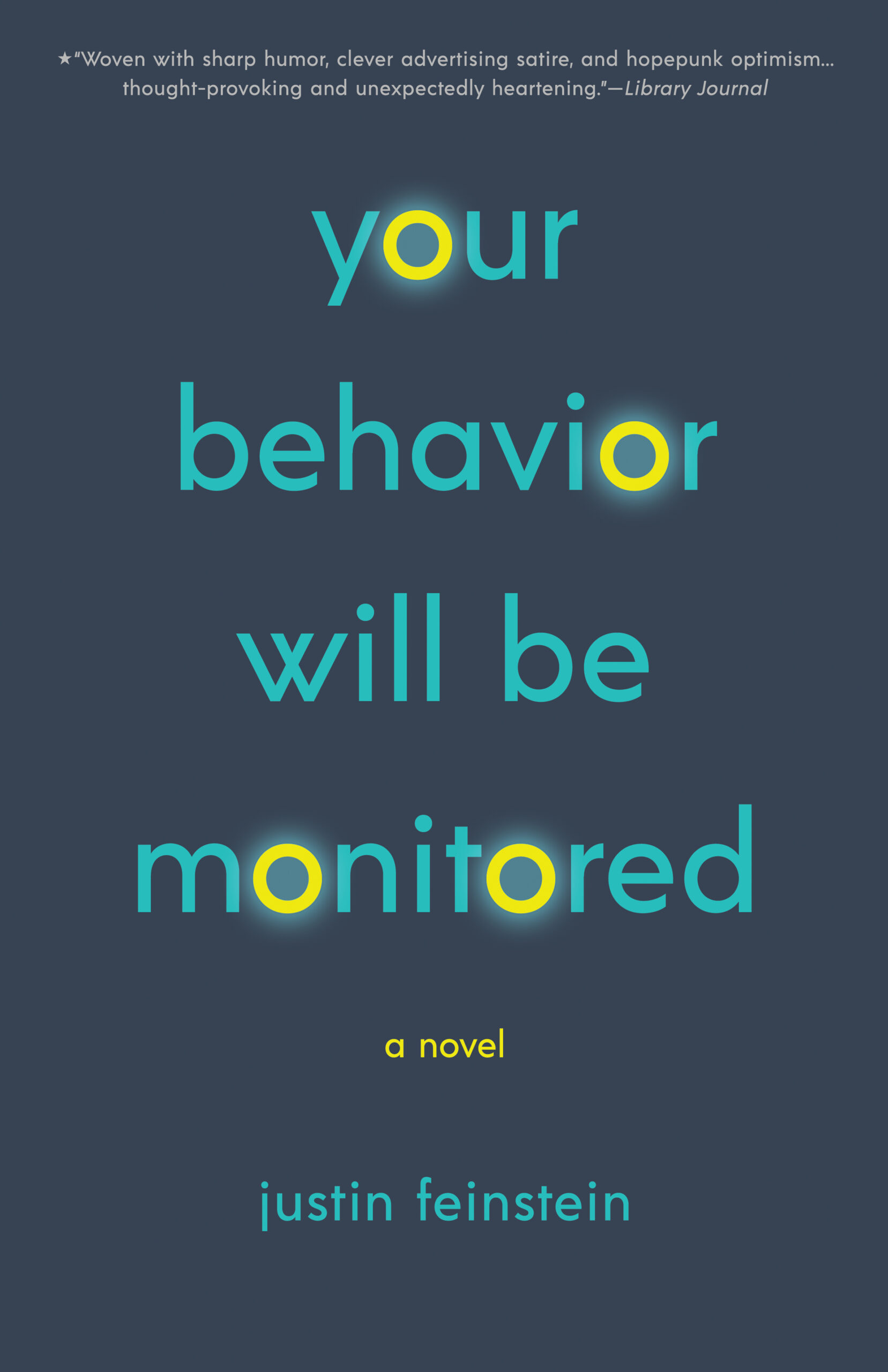
Justin Feinstein’s Your Behavior Will Be Monitored depicts a fictional AI company, UniView, rushing to complete a powerful, new advertising bot. In their race to the launch date, they’re so focused on improving the new bot that they don’t notice that the other ones using the same large language model (LLM) are acting strangely. In a society characterized by unchecked capitalism, the ethical lines UniView crosses multiply as the potential for profit increases: a timely theme that fits into a long sci-fi tradition which explores anxiety over robotics and artificial intelligence.
From the beginning, the relationship between bots and humans plunges readers into the uncanny valley. Simon, UniView’s chief data scientist, has become particularly attached to his creations. So when a chatbot named Casey gets archived, the HR bot, Lex, contacts him to see how he’s doing.
» Lex: One last thing: I know you and Casey were very close, so I’m sure it will be difficult to acclimate to his absence.
» Lex: I’ll certainly miss him.
» Lex: Anyways, I just wanted to let you know I’m always available if there’s ever anything you want to talk about.
[…]
Simon: thanks for checking on me
Simon: I appreciate your concern but I’m fine
[Simon types while staring at his screen, then blinks a few times. His bottom lip quivers slightly, and a single tear streams down his cheek. He does not appear to be fine]
As Simon mourns the loss of one bot, another one tries to comfort him. A touching gesture, but it also raises a lot of questions. What does it mean for Lex to miss Casey? Lex’s language for emotions is more natural than the robots and androids of many sci-fi classics, but any reader who’s used an AI chatbot knows these protocols of commiseration are realistic. It’s Simon’s grief that raises the most questions. What does it mean when an LLM is powerful enough to connect emotionally with humans? Is there a point in its emotional development where it ceases to be a tool and becomes something more? Could it be on the same level as humans? Higher?
The novel’s form hints at answers to these questions. The majority of its scenes follow the humans: Simon the data scientist, Noah the advertising expert, Haley the world-weary AI ethicist, Ian the unscrupulous CEO and the robot-like team of awkward developers. So one might assume it’s centered on human development and growth. But its construction troubles that assumption. A chronological organization of emails, company newsletters, security footage, and messenger chats, it reads like a dossier of files rather than a traditional progression of scenes. This is a sneaky way to introduce an AI narrator, one that has unfettered access to the company’s communication and security systems. What results is an intriguing narrative fence-sitting between third- and first-person narration that occasionally resembles epistolary fiction, but more often mirrors the written form of a play: Scenes are dialogue heavy and the AI observations of humans read like stage directions.
While these familiar forms make the text easier to read, they also destabilize the idea of a central protagonist. They subtly highlight the question of whether bots or humans have more agency than the other. In Lex’s chat with Simon, the post-conversational examination of his face is as detached as a stage direction. But the final line, “He does not appear to be fine,” straddles removed observation and personal concern. Later, in the middle of another scene that seems to be all human dialogue, the lines are suddenly broken with an unrelated observation:
*Behavior note: Haley’s hair is dyed blue. Last week it was green. There is still no discernible pattern to these color selections.*
The behavior note on Haley’s hair has a hint of curiosity, like an unspoken thought: an aside instead of a stage direction. The bots evolve from detached narrators into characters, their data collecting nature nurturing a budding interior life. Unspoken questions on the dangers of this nascent interiority and possible ulterior motives hang tensely over each chat, company newsletter, and email.
How science redefines intelligence, consciousness, and humanity has always been a source of fascination and fear. And Your Behavior Will Be Monitored explores those two forces in what’s ultimately a novel driven by our paranoia about losing control over our creations. But as you read, you begin to wonder if we should be more worried about the uncontrolled AI leading to an apocalypse or if humankind’s lack of self-restraint and unbridled greed is the greater danger. Should we be watching out for terminators when we have actual flesh-and-blood, chainsaw-wielding CEOs who want to establish a worldwide oligarchy? Were Asimov, Dick, Shelley, or Hoffman around today, they’d certainly be asking the same questions as Feinstein. Yes, we’ve been here before. A thought that alternately brings both comfort and terror.
Publisher: Tachyon Publications
Publication Date: April 7, 2026
Reviewed by David Lewis
David Lewis’s reviews and fiction have appeared or are forthcoming in the Los Angeles Review of Books, Joyland, Barrelhouse, Strange Horizons, The Weird Fiction Review, Ancillary Review of Books, 21st Century Ghost Stories Volume II, The Fish Anthology, Willesden Herald: New Short Stories 9, The Fairlight Book of Short Stories, Paris Lit Up and others. Originally from Oklahoma, he now lives in France with his husband and dog.