
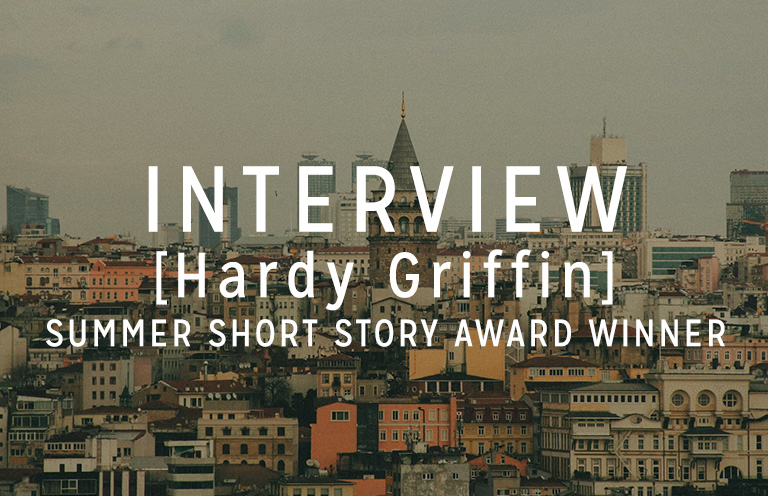
Hardy Griffin’s “Ahmet Usta” was selected by Jennine Capó Crucet as the first place winner in our Summer Short Story Award for New Writers. Read the winning story here and then check out this interview in which Griffin talks about what he learned about place from Jennine Capó Crucet’s work, how food is sometimes the way we express love, and how long it takes to get a draft right.
First, congratulations on winning the 2025 Summer Short Story Award for New Writers! You wrote in your cover letter how important Jennine Capó Crucet’s writing on place was for your story, and your writing in general. I just wanted to give you the space here to talk about what lessons you’ve learned from How to Leave Hialeah, and how you’ve incorporated those lessons into your depictions of Istanbul.
Thank you, it is an incredible honor to have won this award. I’m delighted every time Cole’s emails from The Masters Review hit my inbox, as his commentary and the featured work always inspires me. I am also immensely appreciative that this award opens a space for those who have not yet published a book, because there’s nothing more disheartening than entering a contest and then finding out the winner already has nine books on the shelves with a tenth currently in production.
In an irony that’s almost unbelievable, I went to Miami for the first time just recently, and that’s when I found out I had won this contest. And a few days earlier, I’d visited Hialeah, precisely because of Jennine Capó Crucet’s descriptions throughout How to Leave Hialeah as well as in Say Hello to My Little Friend and her other work. The area was alive with her characters—was I walking through the intersection where Julisa’s car had exploded?
To return to your question, take this description from the opening to the story, “Relapsing, Remitting” in How to Leave Hialeah:
“A bell clinked as Javier held open the bakery’s glass door. Two old men sat at the counter, sipping café out of tiny cups. Each of them wore wide-brimmed white hats, and the sun had baked their hands and faces the color of dried palm fronds. They turned on their stools to watch them enter, and each said, a second apart, Buenas.
…[Javier] sat down from Isabel a few minutes later, the foam cups of café con leche steaming in his hands, the baskets of toast perched on his arms. The little table rattled each time he put something down on it.”
When I read this, I was there in that bakery with these characters under the watchful eye of the two old men at the counter.
“Ahmet Usta” takes place almost entirely in an ocakbaşı, a type of restaurant that literally translates as before the hearth because you can sit on one side of a large charcoal grill and chat and drink with the usta (master) on the other side as they cook. I’d be absolutely delighted if someone read the story, went to an ocakbaşı, looked at the chef and wondered, “Could that be Ahmet?”
Food plays a huge role in this story—that’s tied back into the importance of place, of course, and of culture, but I feel that food can be difficult to utilize as effectively as you have here. How do you see food working in this story?
Ahmet’s job as a master chef is a catch-22 for him: As Bora says, Ahmet relives the horror of his wife and son’s fiery death every night that he lights the charcoal in the giant grill in the center of the restaurant. Yet his job—providing sustenance and comfort to people in the neighborhood—is also redemptive. My aim in showing the kitchen scenes was to present how he was born to do this work, how it is, truly, his entire life.
While I’m from the US, my wife is originally Turkish, and over the fifteen years we lived in Istanbul and even now when we meet her sisters in Canada, roughly half of our conversation is focused on food. This is one of my favorite facets of my wife’s family, that they take such care in the planning, preparation, and serving of our meals together. They would never put it this way, but it’s an expression of love, caring, and support on such a fundamental level.
For much of the story, Hardy is simply called “the foreigner.” It’s not until about halfway through that we learn his name. What was your rationale for withholding this from the reader, and from Ahmet as well?
This story is set in 2005, and at that time, this neighborhood (Cankurtaran) was in the early stages of gentrification as the number of tourists was just beginning to skyrocket. Just walking around that area, you could see tons of people working hard on turning every historic wood house into a touristic hotel or restaurant, just like Bora wants to do. In this context, I pushed Ahmet’s inner conflict and also brought out Bora’s treachery—what better way to do that than to have a foreigner come and study how to run an ocakbaşı? Ahmet doesn’t turn Hardy away, but he also makes Hardy earn recognition as a person and not just an embodiment of the gentrifying force pressing down on this sweet little neighborhood.
I’m constantly commenting on pace when I’m reviewing submissions. I would say that “Ahmet Usta” is a perfectly paced story. Jim Shepard’s rate of revelation comes to mind here. We are constantly learning new things in this piece—about the restaurant, Ahmet’s history with Bora, their shared tragedy, all building to this very dramatic conclusion. You’re demonstrating a real gift for storytelling here, so I have to ask: Did it all tumble out this way? How many drafts did you go through before you felt you had it right?
About a thousand drafts! No, maybe not quite that many, but I worked on it off and on for about seven years. I just kept going back and trying to squeeze it down so every word was intentional and pushing the pace forward.
The act of witnessing is crucial in “Ahmet Usta,” and that’s how I see Hardy in this story, as witness to Ahmet’s life, this conflict with Bora. He’s a little bit of Nick Carraway in a sense, except here Ahmet is still the narrator. Was Hardy always present in the story, or did he show up in a later draft?
Hardy was always present, although not with that name. He’s based on a real Japanese woman I met in Istanbul who worked at an ocakbaşı. She was apprenticing just like this character so she could open a similar restaurant in Tokyo. I just loved that idea—here was someone so dedicated to authenticity that they learned Turkish and lived in Istanbul for years to make sure they weren’t just ripping off the idea from the internet or something. But very early on, I felt I couldn’t do justice to everyone in the story if I had the apprentice usta be a Japanese woman, because I only met this woman a couple of times and had never been to Tokyo and couldn’t possibly do justice to a character who was Japanese. It was really hard to find just what witness would work. I went through a ton of possibilities before I found I landed on this version of myself. Certainly there is a lot packed in this choice and in the story around authenticity.
Who are your influences (besides Jennine Capó Crucet!)?
Last year I moved and I’m still taking my books out of boxes. They used to be arranged alphabetically, but I realized what I wanted to do was put them together loosely by theme, which is helping me more as a writer to see whole areas of influence.
For instance, I’ve noticed that recently a lot of great books are coming out that might be labeled Bildungsroman except they don’t focus on young people’s development so much as how people in their late teens/early twenties deal with the constant sense of impending doom in the world. Set in the mid-1990s at Harvard, Elif Batuman’s narrator in The Idiot feels so quintessentially Gen X and yet her voice is also a unique mix of melancholy and wry wit. The next book over is set a decade later: Joe Fassler’s The Sky Was Ours, which again has a college-aged woman narrating (Jane) but this time she basically has energy drink pumping through her veins as she tries to ace a computer programming course set in Ithaca, NY. Jane flips out and drives straight north almost to the Canadian border, where she runs into a man and his son living completely off the grid and there her addiction changes to literally flying. Next to this novel is Capó Crucet’s Say Hello to My Little Friend set in 2016. The main character, Izzy, channels Scarface because he’s a bit cracked, wildly creative, and as a kind of lashing out against the ever-present sense in Miami at the time (still true today) of impending doom from the rising ocean and extreme weather. Virginia Woolf’s first novel, The Voyage Out, has a narrator whose despair is surprisingly similar—she ends up dying of malaria after an ill-fated voyage to South America, but the description of her dream as she’s dying is of a woman walking into the waves, much as Woolf herself did many years later.
Another area is one where the fantastic becomes real—I turn to this not only to raise my spirits but also because I think we’re going to need some pretty fantastical approaches to reverse the current world geopolitical insanity. Here lies Eric Darton’s Free City, which I must have read a hundred times. Set at the beginning of the Enlightenment, it’s a novel about a love triangle between an inventor and a sorcerer who are both manipulated by (of course) money and political power. What’s striking about this book is how the writing shimmers with the writer’s delight in creating every sentence. Next to that is Kiran Desai’s epic, The Loneliness of Sonia and Sunny—also focused on romance, this one incorporates the fantastic in much smaller, although equally important, ways. Again, the writer’s delight is clear although this time also the struggle to create such a masterpiece—it was a pleasure for me to read but also a bit painful, because Desai’s writing is closest in style to my own and yet so mind-blowingly good.
What’s next for you? What are you working on now?
I’m revising a novel manuscript entitled Broken Kismet. The book opens as eighteen-year-old Eser, who has grown up in Istanbul, is about to go to university in New York where she was born but which she left as an infant. This young woman is precocious and intuitive, and she knows there’s more to the story than simply that she and her mother, Sara, moved to her father’s home country after he died to live with her grandmother. And yet, Eser is torn both about leaving Istanbul and about pressuring her mother to tell her more about her youth and falling in love—because Eser has been cradled since she was young in Istanbul’s komşuluk (roughly neighborliness), and at the same time because she even though Sara is happy to tell her about her college gang, it’s clear she’s holding something back.
It has been a humbling project (as all good ones probably are). I thought it was finished and was sending it out to agents, but while I got a lot of requests to review the full manuscript, it wasn’t landing. Thankfully, a new agent took the time to write that the device I was using—that Eser is a mad journaler who captures her and her mother’s entire conversation as it happens—not only made it hard to suspend disbelief (who writes that fast, and with full pages of dialogue?) but it also took away much of the drama. So I decided to rewrite the whole book with each chapter’s narration switching from one main character to another. As with “Ahmet Usta,” I’m finding that perseverance through focused, intense editing is uncovering the best possible work.
Interviewed by Cole Meyer