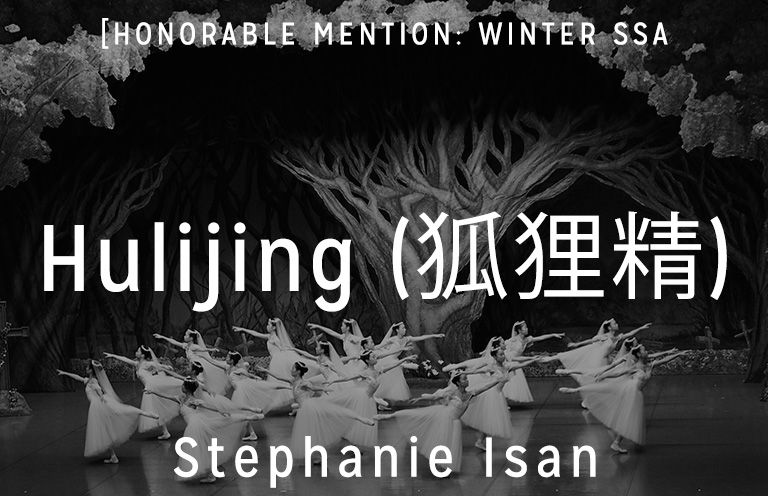
Jade’s mother, a renowned ballet teacher, has recently died. In an attempt to comfort and impress her, Jade’s boyfriend gifts her tickets to Giselle. Over the course of the ballet, with her boyfriend growing increasingly arduous, Jade reflects on the ways in which she has lost herself to her roles as accommodating girlfriend and submissive daughter. Can Jade break free from her mother’s damaging perfectionism or will she forever be trapped in the quest for the ideal? “Hulijing” by Stephanie Isan, our honorable mention for the 2025-2026 Winter Short Story Award for New Writers, is a story about expectations—the ones others burden us with and the ones with which we burden ourselves.
The nobleman Albrecht falls in love with beautiful, peasant girl Giselle and the two dancers flutter across the stage in a pas de deux. I taste bile at the back of my throat. Henry’s hand, heavy and slightly moist, rests against my knee. A discolored orange splotch mars the silk of my qipao. I resist the urge to rub at the fabric. He’s bored. It hasn’t been five minutes into the ballet and he’s been hungrily ogling at the peony print on my breasts.
Albrecht hides his fine clothes, his sword, his horn. He disguises himself as a fellow villager, Loys. With all his charm and charisma, he woos Giselle with a dazzling smile, flourishes of his arms. The village corps wiggle behind them in synchronous pirouettes and petit battement as they fall deeper and deeper in love.
“Is this actually good?” His whispers tickle the curls around my cheek and I nod, just barely. “That’s a relief,” he says, breath hot on my nape. “My prima donna, happy.”
The ballet was an early graduation surprise; this morning, he burst through my front door and smugly slapped down two VIP tickets on the counter. I screamed and jumped into his arms, tongue down his throat, a well-choreographed dance between the two of us as he untangled my bra and migrated us to the couch, pushing himself inside me as I clung onto his neck, not even bothering to shut the blinds. After he left for work, I ate a slice of the red velvet cake Henry brought back last night, moist and light with a dusting of cinnamon. I licked the plate. I had a second slice. It all feels so foreign now, a distant movie. An echo.
With some difficulty, Henry slips a hand through the slit of my skirt. Right before we sat down, he complained that I wasn’t wearing the dress he bought me, a black scallop-y number with a deep neckline, but he doesn’t seem too displeased right now. His forefinger rubs against my panties, searching for my clit. I worm back in my seat and abruptly vice my legs shut around his wrist. He grunts in pain and people around us shuffle at the interruption. His fingers retreat into his lap, his face hurt and confused as, on stage, Giselle glissades across the fields, clapping her legs, the chiffon of her skirt settling repeatedly around her like dust clouds.
* * *
A few months ago, I emptied part of my closet for Henry. I crammed my mother’s old practice tutus and qipaos in two Dollar Tree bins and shoved them in my furnace room. My landlord warned me about storing things there. Something about a fire hazard, the airflow, but everything is a risk when you have no space. All the buildings in the University District are frail and post-colonially tragic. Just the rumble of a nearby bus could crack the pipes and burst a leak full of asbestos.
“You sure about this?” He shrugged out of his sports jacket and hung it up on a hanger that once clipped onto my mother’s teal romantic tutu. “Didn’t you have, like, a million lace skirts and ancient Chinese dresses here?”
“They’ll live.” If it were at all possible, my mother would have risen from her grave like a Wilis and shat blood if she saw what I did to her clothes, more so than when she discovered my father’s whore.
I plucked off a piece of dog fur off Henry’s shirt, waving it in front of his nose, and he smiled apologetically, hands in the air.
“I tried to brush it all off before I came in, kitten. Honest.”
“Can’t you move out?” I pouted and pursed my lips. “I never get to visit you because of your roommate’s dog. And it’s not like you can’t afford it.”
He laughed and pecked my nose. “God, how can you be so adorable?”
“Henry,” I whined. “I’m serious.”
“I’ll keep a lint roller at work. Promise.”
Henry did something business-y for work, with involved conference calls and business trips. When he was gone, it was for days, sometimes weeks. But when he was here, he was a fixture, waiting for me every afternoon after class. Fresh cut flowers in the corner, gifts on my bar counter. Lilies and sunflowers, baby’s breath and roses, slinky Versace dresses, skinny patent Choo stilettos wrapped in tissue paper, diamond and sterling Cartier earrings, frosted cuts of red velvet cake slathered thick with cinnamon Chantilly cream, fruit tarts glazed shiny with syrup, pavlovas and Eton messes he’d eat off my stomach, my breasts, licking the meringue off my navel. I never asked why. He was a magician, pulling wonders from every pocket, coming and going in fistfuls of smoke. And I willed myself to believe, to clap for the spectacle: you never ask about the hand behind the illusion.
In the closet, Henry unbuttoned his shirt, exposing his collarbone, and I wanted to bite him. As if he could read my mind, he pushed me down to my knees. As I unzipped his pants, he whispered, his fist wrapped around my braid, “Be a good girl, won’t you?”
He came by every day that month—the longest stint he’d ever stayed—and each time he filled the closet, we fucked repeatedly on the floor over his fallen coats and my jeans. Soon, there were columns of black and blue ties in my drawer rolled equidistant from each other, spaced out like buns to be steamed. Monochrome dress shirts were ironed, pressed, and hung by color on the railing with velvet hangers. Engraved collar stays stood in a square tin, clip ties assembled, like minutemen, in a separate compartment. Blazers were linted free of his roommate’s dog’s fur, then kept spotless in nylon dry-cleaning wraps ready to be zipped open and presented like an art exhibition.
At night, when he wasn’t here, when I couldn’t sleep, I laid down in the closet, his clothes brushed above me like a midnight sky, his scent—musk, cologne, honey and sugar—twisted in my hair. I’d touch the silk of his ties, the cashmere and mohair of his blazers. I’d imagine him holding me, pinning me down, calling my name. And here, everywhere, was evidence that he was mine. He would come back. He would stay.
To want, then to have; to hunger, then to satiate. What a beautiful, perfect thing.
* * *
Giselle’s mother, Berthe, looks as if someone’s pissed in her shoes. She despises Loys, doesn’t trust him—she wants Giselle to be with Hilarion instead, the village gamekeeper and incel who pines for Giselle from dark and dusty corners. With a furious shake of her head, Berthe leads her daughter back into their cardboard cottage. Henry nudges my heel.
“Kitten, what’s wrong?”
“Nothing, nothing,” I murmur.
“Jade, you’re crying—” I’m not crying. But maybe he wants me to be, to have a tangible reason for my rejection. He strokes my hair and I stay imperceptibly still, like a wounded animal. It feels as if everyone around us is watching us and not the stage where Hilarion stalks about Loys’s house like a deranged hyena, hunting for evidence of his possible deception. “Did I do something? Kitten, please, just talk to me.”
“Henry, I want to watch this.” My mother would have called all these ballerinas fat. Wrinkly, even, if they were older than twenty-two. On weekends, we used to sit in the nosebleeds, sometimes with the whole row to ourselves, and she’d tell me which dancers were puking out their meals and which ones wouldn’t make it.
“Wait, wait,” I had said, once. My mother and I were watching Swan Lake, one of her favorite ballets. On stage was the famous pas de quatre, where the four cygnets skipped in linked harmony. “The middle one—”
“Middle left.”
“The one that looks like a Pillsbury dough girl? You think she pukes?”
She nodded, gloating.
“The last one you said was a puker looked anorexic.” Sitting in the back, with enough distance, the ballerinas didn’t even seem real, but Barbie dolls come alive. I loved watching their pancake tutus flounce.
“I told you, it’s not about their size. It’s, you know, their pallor. Their teeth.”
I squinted. “How can you even see that far?”
“If you did more than even a few years of ballet, you’d know too.” My mother, Li-Li, was almost considered for soloist at the company we were watching, the Pacific Northwest Ballet Company. The first Asian American soloist. She was born for the role: hyperextended legs, perfect Svetlana arches, a penchant for the dramatic. But she quit after the divorce, when I was seven. Until her death, she taught at a private studio in Capitol Hill, a cramped office space sandwiched between a pretzel shop and a Famous Footwear.
My mother had been known for results. Her protégés, the ones that continued, went on to companies, conservatories, even a few off-Broadway productions. But she wasn’t loved. None of her past students visited or even wrote when she died. If she was remembered in their lives, I knew it would be for her relentless screaming. There was always a reason—foot sickling during relevés, back leg heaviness in saut de chats, excessive traveling while fouetting— though the most devastating insults she reserved for the dancers that gained weight. She’d point at them and oink. Or quietly, matter-of-factly, almost gently, tell them she could see their lunch. After class, she’d remind them of the chocolate laxatives in her office, the ones she displayed proudly in a metal salad bowl by her office window. No one ever took them. They remained there, stale and gummy and expired, until I cleaned out her office last year.
When the four cygnets in Swan Lake pranced off into their respective corners, my mother hung her head. “Fucking fuck motherfucker.” She spat at the hem of her favorite blue qipao. I peered down at her feet, mottled and bruised, tucked in a pair of gel-padded Clarks. At night, she soaked her legs in Epson salt baths, rubbed Bengay on her joints and, right before bed, popped prescription strength Ibuprofen like Skittles. “Fucking fuck fuck. If that stupid fucking fuck cunt of a hulijing didn’t steal your father away, I might have even made principal.”
This was my mother’s constant refrain. I heard it after every show, every class she taught. Years after they separated, my mother cursed the “hulijing bitch/whore/fucker” that seduced my father. I hardly remember my father, the man who visited once every blue moon to bring me a stuffie of a giraffe, an elephant, a bear. They used to sleep with me until we incinerated everything of his in the backyard.
That night he left, everything we had of his rose up in stacks of smoke: photo albums, the earrings and necklaces he bought her, old wedding tapes of them dancing together at the Fairmont as my mother beamed, as she tilted her head and laughed, coiffed hair tumbling down the back of a crimson red, bone-tight qipao. In stark contrast, that night, my mother had laid in front of the fire, screaming curses at the hulijing, her arms pounding the dirt senseless as our neighbors’ dogs howled with her. I tossed my toys into the fiery trash can in camaraderie, the flames licking up the polyester and beady, plastic eyes. A week after my parents’ separation, my father and the hulijing had eloped. She’s pretty. She friended me on Facebook a few years ago. I have two half-siblings and they have her wavy brown hair, his green eyes. She doesn’t look much older than me. Her lips are a bloody red in all her photos, juicy and lined plump. She must fuck nice. Well. She must fuck nicer than my mother.
* * *
Henry smooths out my cheeks, but they’re dry. I know when intermission comes, he’ll want to talk. The harvest festivities begin on stage as Hilarion beats the drum and the village corps slice their legs into the air once more. My mother should have played Giselle; it should have been her that I’m watching. After some time, soloists get considered, they get promoted, then years later, they become principal. Or maybe she was too old. Too pregnant. Too fat. Too wrinkly. Maybe I could have been on the stage, as one of the villagers in the corps de ballet.
“Kitten, was this too soon?” Henry looks more tearful than I do. “Do you want me to take you home? I thought bringing you here would make you feel better tonight.” He’s hurting because he thinks I’m hurting for my mother. I know this. And so, strangely, I feel like the monster when it should be the other way around.
Giselle is crowned the harvest queen. She performs an unreasonable and dizzying number of pique turns on the stage, spinning like a rapidly blooming flower. It stings to look at even the fringes of her skirt, the way it billows like a ripple under ice. A few days after my mother’s wake, I stayed overnight in her studio office. Dark, dusty, alone, in the glowing light of a grainy CRT, I rewound one of her old practice tapes. It’s the early nineties, sometime in July. My mother is fifteen, a twiggy, bright-eyed, clear-skinned marvel. She looks like a young Maggie Cheung, her jet-black hair pinned in a Dutch braided bun as she stands to prim attention in a dim and empty auditorium. Light on a foggy day filters through the ceiling cracks. Someone shouts for her to hurry the fuck up already and my mother springs up. Thirty-two fouetté spins and I couldn’t help but gasp, be in awe, starstruck. An enchanting, effortless smile. Her outstretched leg bobbing and weaving, bobbing and weaving, as if she’s whipping cream. If only I could bottle her spins and wear it as perfume, but what do I know? Off-screen, the same person screams at her in Mandarin. A wrinkled, liver-spotted palm emerges to slap her across the cheek. The sound echoes, explodes. My mother spins, 360, before collapsing onto the floor. Unintelligible screeching, then something about her wobbling arms, traveling near the end turns. The beratement turns to insults and provocations. “You fuck up. Is this it? Is this all you can do? How do you think you’re going to make ABT? Lincoln Center? The Bolshoi? Not even fit to lick Gillem’s pointe shoes—” And my mother’s eyes blacken. She shoves aside the hand and performs the fouettés again and again and again. And again. Until the vamp of her one pointe shoes begins to spot with blood and her camisole is drenched in sweat. And in the Capitol Hill studio office, where my adult mother once sat nightly, wearing the faux leather seat of her chair thin, watching this same clip of herself as a teenager being screamed at by her own mother, I also rewound the tape again. And again and again and again.
* * *
My mother had enrolled me in an international ballet academy when I was four. I wasn’t a prodigy, but I wasn’t untalented either. The teachers—all Russian or German with long canes, beaded glasses, and floral jazz pants—tutted at my flat feet and natural inflexibility, but noted I could still develop good lines. Possess a stable carriage. Tone up my calves. But my mother was never pleased by my progress. She wasn’t allowed in the studio with me, but after class, when I showed her my drills on the barre, flinching with every rise of her voice, she’d weep. “Why are you out of breath, Jade? Why? If you want to do this as a career, you should make it look easy.”
It didn’t matter, anyway. At nine, just as I was about to start en pointe, I fractured my ankle riding my bike. It healed after a few weeks, but my mother withdrew me from classes while I was still in crutches. Temporarily, I thought, but she never brought up my ballet classes again. She still taught ballet, talked to me about ballet, still bought us tickets for every tour at McCaw Hall. But I was never asked to lose weight or dance again.
* * *
Just a few hours ago, before the play and after Henry left for work, I took a shower and stalked around, naked except for a pair of Louboutin’s, admiring my reflection before shimmying into the scalloped Prada dress he bought me. I sneaked another bite of the red velvet cake, crumbs dotting the corners of my lips. I hummed, curled my hair. Put on green contacts. Spent hours on my makeup, getting the wings just right. Then I looked for the blazer he wanted to switch into for the show tonight.
I unzipped the plastic. There was a crinkle in one of the pockets, a dry cleaner’s receipt from last week. It’s in Belltown, where Henry lives. I was about to toss it when I noticed, in loopy purple handwriting, a note on the back:
Henry,
Picked this up at the dry cleaner’s next door before you could forget again (for the umpteenth time, you ninny). Have fun at work, but don’t have too much fun without me. Miss you already.
XOXO
Kitty (and Bear)
I smoothed it out several times. My thumb lingered over the love, the name, the kisses. The handwriting was a calligraphic cursive you might see annotated in a book of poetry—long romantic slants with fat, loopy ascenders and descenders. I searched the pocket again and my fingers emerged with a ball of tweed fuzz, a few strands of his roommate’s dog fur. I rolled the strands in my fingers. They were dark brown, slightly curly, just like always.
I knew I should have felt angry or sad—primitive, simple, reasonable emotions. But all I could think of was Henry the night before at our favorite ramen spot, passing me a small pot of shichimi pepper flakes before I even asked. He ordered me extra soup because I never had enough for leftovers. He picked out the wood ear mushrooms in my bowl and gave me his soft-boiled egg, the yolk a gooey amber, my favorite. He’s terrible with chopsticks. When his noodles kept slipping back into his bowl, splashing us both sticky with broth, I slapped down a plastic fork from my purse. He laughed. God, the timbre of it. The cadence. My heart swelled. My cheeks simmered, brimmed, overflowed. And I still remember everything. The dim bar table. The blue of his eyes. The wood chip in the table, the warmth of his fingers around my waist, our knees bumping, and I imagined telling our children about this moment, the moment where I knew I’d marry him, and it all feels so silly to think about, so silly, because how? How could I, of all people, not have seen this coming?
* * *
A little after I found the receipt, I drove into the city proper in my mother’s Camry and parked a block away from the laundromat on the receipt. Drizzle tickled down the windows. At home, I had scanned the area on my phone, wandering aimlessly on Google Street View.
I headed towards the laundromat, receipt clenched between my fingers. Next to it was a decorative cake bakery, one with 4.8 stars and a few hundred reviews, the very same I saw virtually. The windowpane of the bakery glowed with bright white wedding cakes stacked tall and proud, evenly tiered like neat white packages. Fat fondant bows. Edible white chocolate rhinestones. Sugar birds and flowers split down layers in a toppling waterfall. Ballerina cake toppers in a rotating carousel by the door. I headed in, the bells loud and abrasive, and my hands closed in on one of the ballerinas, the tutu coarse and fibrous in my palms.
“Hello!” I turned. An older, pudgy blonde woman emerged from a set of swinging doors, her hair wrapped in a bandana. Freckles and lines tracked across her cheeks. “Can I help you?”
I opened my mouth, but nothing came out. After a few moments of awkward silence, she cocked her head. “We have a few samples, if you’d like to try.”
I drifted towards the front, as if crested by a wave. My heels clicked against the linoleum. Every echo was a gunshot in my head. She nodded, encouraging and beckoning me as if I were a puppy that she had just begun training, and handed me a slice of sheet cake barely thicker than a sheet of cardstock.
It was delicious. Of course it was. Just like I’d expected. Sweet and moist red velvet, the buttercream whipped and airy with a touch of cinnamon, just like the one Henry had brought this morning. No one else made cake like this. I asked him where he bought his desserts and he said, “Somewhere near home,” almost dismissively, as he kissed my ear.
When I glanced up, the woman smiled. A floppy golden tag dangled off her apron. Absentmindedly, she righted it. KITTY. Kitty, for Kittery Bakery.
And so, all of a sudden, I sniffled, which I tried to stop by covering my mouth, but the stopping turned everything into tears, then sobs, then full on wailing as I squatted on the floor, head between my knees. At some point, I might have howled. Kitty was alarmed. She asked me if I was all right, if I was in pain. She darted around the bar and waved a paper towel in front of my face, but I didn’t take it, couldn’t take it, because I still had the receipt, the note, clenched in my fist and so the towel fell to the floor as she stroked my back, gripped my shaking hands. Her fingers were calloused, plump, and warm. So warm. She was the kind of woman my mother would make fun of. A fatty. A woman who had let herself go. In my other hand, I clutched at the fabric of my skirt, bunching up the black silk. We stayed like this a while, seconds, minutes, hours, me unraveling in her place of business like a twisted skein of yarn and she sat by me, not even attempting to quell my tears anymore. She just let me finish.
In a brief break between my guttural cries, she said, “Sweetheart, are you all right? Do you need me to call someone?”
I looked up. Her face was round and soft and dented in all the wrong spots. Sunlight beamed across her hair, lighting the strands into gold flax. My mother would have told Kitty, to her face, that her skin was too dry. She would have said she needed moisturizer and sunscreen. She would have recommended her brands. Japanese ones, probably, because of the advanced UV filters. Then, she would have said to me, later, “Your father’s hulijing doesn’t wear SPF. That’s why she cakes on that disgusting laowai makeup.” And I would have laughed.
“No,” I said. “I just…” The receipt had grown rippled and wilted and petal soft between my fingers. Henry came inside of me this morning without a condom. I let him, because I didn’t care, and I loved that I didn’t care. The pit of my belly twinged. I could hand the receipt to her and leave. I could hand it to her and never see her again. But then I remembered my mother screaming in front of the fire pit, my stuffed animals and father’s photos disintegrating into ash, her weeping silently, endlessly, as she flipped through albums of her old performances, watched her child-self twirl like a top on screen. I balled the receipt, stuffed it in my mouth, chewed, then swallowed. Then I stood up. Brushed the dust off my skit. And ran outside, back into the rain.
The doorbells jingled. In my periphery, I saw Kitty’s mouth open, soundless. I jaywalked across the street, then beelined for the Camry. I pressed myself at the driver’s side door, heaving as my palms pressed up and squeaked against the slippery metal. I stared at my reflection. Bushy black curls down my back. Sickly cream smothered on my cheeks. Strappy stilettos with the thin, silver buckles and a bloody bottom. The tight black slip Henry bought me, just two months ago. My contoured cheekbones. My sharp collarbones. My cleavage. The green contacts in my eyes. He loved running his hands up and down my ribcage, feeling the protrusions of my hips. My sharp, crimson nails. He said he loved me. He said that I was beautiful.
“Hulijing,” I whispered. I kneeled and shoved two fingers down my throat, extending my knuckles deep past the ridges I remembered so well as a child. My mother taught me how to throw up when I was nine. It was something all great dancers did and she wanted to instruct me on the proper, safe way to do it. After I finished—my evening meal of salad and grilled chicken in a masticated puddle swimming in the toilet bowl’s surface—I wiped my lips, coughing. “Did I do this right?”
Vomit streamed down the hem of my black slip and calves. The stink of bile wafted away with the rain and I swam my dirtied hands through the gutter water. Pieces of the receipt floated, then sunk towards the grates. Cake crumbs, dark red and congealed, half-decomposed and softened, hung, with my saliva, like puppet strings down my fingers. After my mother had flushed, wiped my swollen cheeks, she cradled me in her arms. When I looked up at her, her own face was wet with tears. “Oh, Jadie,” she said. “What have I done to you?”
* * *
With a brandishing of Loys’s sword, Hilarion reveals that Loys is, in truth, the nobleman, Albrecht, engaged to Bathilde. Giselle is horrified. She twirls and descends into madness, a la Red Shoes style, until she reaches for Loys’ sword and guts herself. Berthe holds Giselle in her arms and weeps.
The curtains close and the bright lights flutter on, signaling intermission. Henry stretches his arms.
“Can you get me a drink?” I speak without looking at him.
“I thought we could talk.”
“A gin and tonic. Please.”
“Kitten…”
“Please.”
He touches my shoulder, gently. “All right, I’ll be back.” Before he leaves, his eyes linger on my body. “Have I mentioned how sexy and beautiful you look in that Chinese dress?”
I shake my head. In spite of myself, part of me wants to relent. He crouches in front of me, cups my face in his hands.
“I thought bringing you here would make you happy, cheer you up.”
“It did.”
“Kitten, do you know I love you? Do you?” Part of me still hungers for his touch. If only I could let myself lean in, cling on, never let go. I start to cry. “Jade, won’t you tell me what’s wrong?”
“A drink, first. We have thirty minutes until curtains.”
“I’ll be back.” He drapes his blazer around my shoulders and pecks my forehead. It smells like him—musky, inviting, cinnamon sweet. I watch him leave as I press the fabric into my nose. I let the scent linger and, for a moment, it’s the only thing I have, the only thing I am.
I put Henry’s coat down by my feet. I step on the lapel with my Louboutin’s, then head out towards the drizzle, into an Uber home.
* * *
Back home from the ballet, I change out of my qipao. This was the only dress I had managed to save from the leaky pipe in the closet. When I opened the cracked bins earlier in the evening, everything—my mother’s tutus, the pointe shoes she saved from every big performance, her qipaos and dresses—had been choking themselves in scum and sewage water for months.
The vivacious colors, the delicate silk, the lace, the pomp, the romance, the glitter, the embroidered chrysanthemums and orchids and camellias and azaleas—everything had bloated, everything had shrunken, everything frayed, disintegrated into white and grease and grey as I swam my shaking palms into the boxes. Each dress emerged from the mildewed bog like wet corpses, each one more irreparable and unrecognizable than the last, each one a deeper, more twisted wrench in my gut. I smoothed my fingers over what was my mother’s wedding qipao, the one from her videos, and the once-red-now-orange-grey silk tore apart, like fresh bread, into crumbs between my fingers.
Before I left for the show, I soaked the salvageable pairs of pointe shoes in a bucket. I grab and rinse off a pair labeled ‘The Nutcracker’. When I was a child, I didn’t ask for bedtime stories, but performances. In her Juicy sweats and a ratty Doraemon T-shirt, my mother attempted the Dance of the Sugar Plum Fairy for me, my nightlight her only limelight as she effortlessly soared and leapt on the crescendos and decrescendos, twirling on one leg as sweat spilled down her temples. She always treated every dance, whether for a crowd of thousands or for her only daughter, like her one and only lifeline.
I try on the pointe shoes. They’re soaking wet, but I slip my feet in anyway; the cardboard bends and the material squishes. She’s a size smaller than me, but I scrunch my toes, bones and all. In my underwear, I lace up the shoes like I remember and attempt en pointe. At first, I marvel at how I look in the mirror, how my calves look like hers, so long and so lean, but after a few seconds, it hurts. It hurts. It hurts my toes, my ankles, even my knees, and the pain radiates until I can’t take it anymore. I peel them off and slap them in the sink bowl, my mother’s Sharpie label of ‘Sleeping Beauty’ illegible against the velvet.
Henry calls again. And again and again and again.
I couldn’t keep much when I packed up my mother’s apartment, not that she had much to begin with. She kept to a spartan-like minimalism and practicality. There were only two photos in her house and they were both taped to the fridge: a selfie of us at my high school graduation and a photo of herself at sixteen, dancing as Rosaline in Romeo and Juliet. I kept both photos, then boxed and donated what I could—furniture, dishware and cutlery, her sewing machine—and I struggled with tossing what I knew no one could want and I couldn’t keep—her old tax forms and receipts, used makeup, the birthday and Mother’s Day cards I sent her over the years. One evening, shortly after the Salvation Army took away her bed and armoire, I cried over a box of her toe spacers, the silicone nubs wriggling in a shoebox like little, rolling caterpillars.
I gather a handful of the irreparable tutus and the qipaos and chuck them in the tub. I run hot water until it overflows, until it’s a sea of washed-out color, grease and sewage coating me like darkened puddles. I have made a shitty dress soup. Henry calls again. A text flashes across the screen:
I’m coming over.
I sink in the bathtub, naked. The tutus and qipaos float around me like deadened, oily jellyfish. One of Henry’s jackets is wrapped around me, the shoulder pads drenched from my wet curls. Mold and sweat and sugar linger in the air. A blond strand of hair drags to the surface between my red nails, catches light. I press it to my breasts, set it free.
 Stephanie Isan (she/they) is the pen name of a queer Taiwanese American writer, poet, and software engineer. Their work has been generously supported by Kundiman, the Tin House Workshop, the Juniper Institute Fellowship, and the Kenyon Review Writers Workshop. Her writing is published and/or forthcoming in AGNI, Joyland Mag, Split Lip, Five Points, The Bellevue Literary Review, Epiphany, and others. You can find out more about them at stephanieisan.com.