
Writers pour so much energy into their craft that sometimes we forget that creative pursuits other than writing can fill us up in other important ways. Here, we’ll look at what writers do when they aren’t writing, and how those pursuits affect the return to the page. This month, we hear from two writers—Chelsea Utecht and Kathy Shiels Tully—one who digs for artifacts and the other who taps into her crafty side.
What fills you up creatively when you’re not writing? If you’d like to contribute to the Writers on Not Writing series, email jen@mastersreview.com. We can’t wait to hear from you!
The air is cooler two and a half meters underground. There’s enough shade so that, except for the very height of the sun, I don’t need the umbrella precariously balanced above me, its pole weighted down by rocks that are part of a collapsed Iron Age wall, a staircase, or just some rocks. This is the best, and hardest, part of archeological excavation—the not knowing, the guessing, even the being wrong.
When I was young, I wanted to be an archeologist. Okay, I wanted to be Lara Croft, but that’s pretty close. The desire was supposed to go away, but never did. A few years ago, I was given the advice, “Go on one excavation. That’ll get it out of your system real quick.” In 2020 the country of Georgia was closed off to keep COVID at bay (spoilers: it was unsuccessful); this measure also kept out the archeology students who were supposed to volunteer at the excavation (this was much more successful). The university was desperate. They were willing to take the utterly clueless, for which I was qualified.
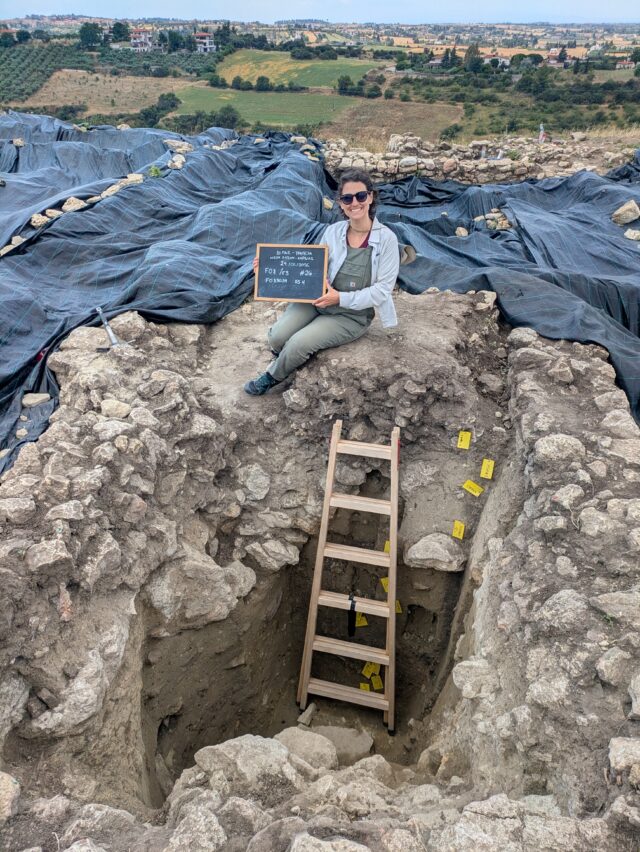 Far from “getting it out of my system,” I fell in love. The slow, meditative removal of the dirt to reveal something long buried is such a far cry from the rush of the everyday. There is a camaraderie among the archeologists, hopes for what might be ten more centimeters below the surface, inside jokes that are too specific and, frankly, too unfunny to land anywhere else (“basic” became Doric, “iconic” took the short step to Ionic, and “doing too much” became Corinthian). All these years later, and most of a masters degree, I can’t help but return to the trenches.
The writing is never really gone, though. In the paperwork (of which there is a staggering amount for a hilltop with no Wi-Fi) we can only describe what we see, but the writer part of my brain never turns off all the way. As I hold a piece of 2,600-year-old pottery in my hand and wonder at the incision made with a fingernail, I run my own fingernail along the ridge and wonder at the person who put it there.
Now, excavation season over, I return to writing once more, refreshed and with a new mindset. I’m not bogged down by the pressure to outline, draft cleanly, or hit all the story beats. I don’t even feel pressure for my writing to necessarily yield anything. Instead, I see writing not as a recipe to be followed, but an excavation. This has rekindled my excitement of discover. I write with a plan, or at least with a hope, but not with the answers. I write even though I’m not sure what’s there just beneath the surface—or even two and a half meters beneath the surface. I remind myself that there’s no way of knowing if what I’m writing is worth anything, and I won’t know until I’ve gotten my hands good and dirty and dug in.
Chelsea Utecht
One day, I spotted a notice posted at my local library advertising a free class on decoupaging shells.
I groaned, rolled my eyes.
Then I signed up.
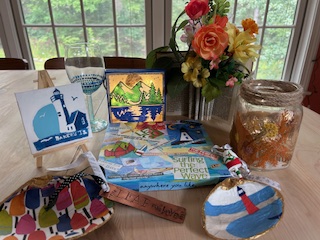 On the day of the class, there, in the library’s community room, tables were set up with white paper towel placemats, two paint brushes, a cup of pre-poured Mod Podge, and one large, precleaned clam shell, which had already been painted white inside and out. One table was covered with piles of prettily pattered napkins, an assortment of colorful paint bottles, and more paintbrushes. Twenty women, mostly older, with all levels of artistic abilities, attended.
That day, my life—including my writing life—changed.
During the class, we weren’t treated like children, but allowed to be like children, curious and eager to learn, creating, even mistaking. It was all good.
Within one hour, I saw the result of my efforts. There was no waiting. No rejection. We ooh’d and ahh’d each other’s creations.
Instead of feeling it was work, which my freelance writing dream had become, creating was child’s play. I felt joy. Sure, it wouldn’t earn me a living—or a byline, but who cared?
I left eager for the next month’s playdate.
Over the past year, I’ve made dot-painted wine glasses, a copper bookmark hammered with words and images, a flower-and-twine wrapped candleholder for an empty glass jar, and a 6” x 6” collage from images cut from magazines. I’ve painted a miniature wooden buoy that might become a keychain or a Christmas ornament, a 4” x 4” canvas, and a nightlight. My dry-flower vase fashioned from a discarded library book sits proudly on a shelf at an Irish pub in town.
Through these crafts, I’ve rediscovered the joie de vivre. Instead of writing alone, I’ve enjoyed the company of strangers while I craft. I’m re-experiencing the youthful exuberance that comes from learning something new, even though I’m “old.”
Hilary Mantel, a double Booker Prize winner who passed in 2022, gave this advice to writers: “If you get stuck, get away from your desk. Take a walk, take a bath, go to sleep, make a pie, draw, listen to music, meditate, exercise; whatever you do, don’t just stick there scowling at the problem.”
To which I would add: Buy some Mod Podge, paintbrushes, and paint.
When I realized my lifelong dream of becoming a writer, writing became work. Like my corporate job. Over time, I lost my excitement, my sense of play. I became blocked. Crafting helped.
Now, I sometimes create with words and sometimes with Mod Podge. I collect and create art with beach shells and clear glass jars just as I collect stories from ideas or strings of overheard conversation.
Next time you’re stuck, try crafting.
It might help you break out of your shell.
Kathy Shiels Tully
Chelsea Utecht is a speculative fiction writer. Her work has appeared in Bluestem Magazine, Shooter Literary Magazine, The Gravity of the Thing, Thirteen Bridges Review, and more. She lives in Sarajevo, Bosnia with her husband, two sons, and former street dog/current princess. More about her writing can be found at chelseautecht.com.
Kathy Shiels Tully is a writer in the Boston area. A longtime Boston Globe correspondent, her stories have also appeared in The Boston Globe Magazine, Christian Science Monitor, FamilyFun, The New York Times (Tiny Love Story), The Writer, schoolfamily.com, and various New England magazines. Her essay won the 2020 Erma Bombeck Writing Competition (Global Human Interest). Besides crafting, Kathy does stand-up storytelling at The Moth where she placed second at a recent Boston StorySlam. She lives with her family north of Boston. www.kathyshielstully.com.